


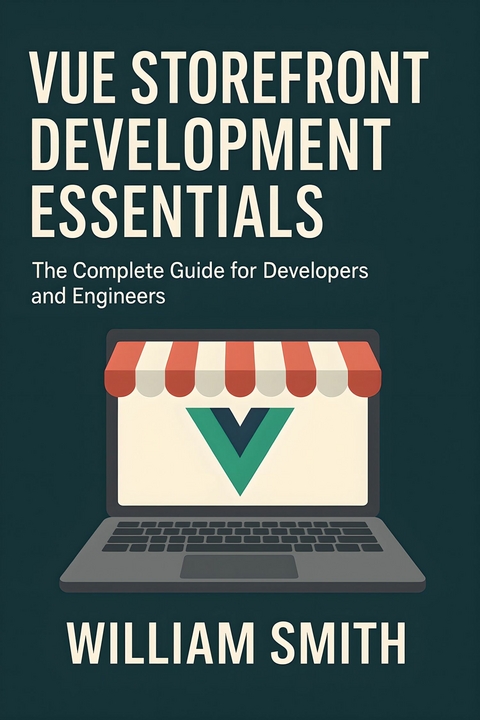
Vue Storefront Development Essentials (eBook)
250 Seiten
HiTeX Press (Verlag)
978-0-00-102980-4 (ISBN)
'Vue Storefront Development Essentials'
'Vue Storefront Development Essentials' is the definitive guide for architects and developers seeking to master the design, customization, and deployment of modern, high-performance eCommerce storefronts. The book opens with a thorough exploration of the headless and composable commerce revolution, positioning Vue Storefront as a leading solution in the API-first ecosystem and delving into its architectural underpinnings, modular philosophy, and scalability for enterprise applications. Readers gain an in-depth understanding of contemporary architectural models-such as SSR, SSG, and JAMstack-coupled with best practices in security and core design principles.
The book systematically covers every layer of Vue Storefront development, from project bootstrapping and environment management to advanced UI implementation, sophisticated API connectivity, and backend integration strategies. Through detailed chapters on component architecture, state management, plugin extensibility, and custom integrations-including headless CMSs and real-time personalization-the guide empowers teams to build adaptable, robust, and brand-consistent customer experiences. Emphasis is placed on internationalization, accessibility, dynamic routing, and performance engineering, ensuring that any storefront can thrive on a global and multi-device scale.
Beyond technical fundamentals, 'Vue Storefront Development Essentials' addresses the pivotal roles of quality assurance, observability, DevOps automation, and secure operations for enterprise deployments. The closing chapters look to the future, examining trends such as PWA excellence, AI-powered personalization, GraphQL federation, and advanced localization to future-proof your commerce platforms. Complete with practical guidance for migration, open-source collaboration, and continuous innovation, this book is an indispensable resource for any organization looking to accelerate digital commerce with Vue Storefront.
Chapter 2
Project Foundations and Advanced Configuration
Launching a storefront that’s ready for real-world scale is as much about thoughtful foundations as it is about advanced technical nuance. This chapter unpacks the lifecycle of initializing-and then meticulously tuning-a Vue Storefront project for enterprise readiness, multi-localization, security, performance, and seamless integration. Discover the underpinnings that distinguish professional deployments from proof-of-concept builds.
2.1 Bootstrapping an Enterprise-Ready Storefront
Initializing a Vue Storefront project within an enterprise context necessitates a disciplined approach that prioritizes reproducibility, scalability, and maintainability. The inherent complexity of commercial environments, combined with evolving business demands, requires an architecture and codebase structure that facilitate long-term expansion and seamless integration.
The foundational step is establishing a modular and well-organized codebase structure. Enterprise projects benefit from a domain-driven design where the code is segmented based on business capabilities rather than purely technical concerns. For Vue Storefront, this implies organizing the frontend into discrete modules such as catalog management, cart processing, user authentication, and payment workflows. Each module should contain its own components, composables, store (Vuex or Pinia), and service layers. This encapsulation reinforces separation of concerns and allows teams to develop, test, and deploy features independently. A recommended directory layout might resemble:
├─ modules/
│ ├─ catalog/
│ │ ├─ components/
│ │ ├─ composables/
│ │ ├─ store/
│ │ └─ services/
│ ├─ cart/
│ ├─ auth/
│ └─ payment/
├─ components/
├─ composables/
├─ store/
├─ plugins/
├─ layouts/
├─ pages/
└─ assets/
This modular approach integrates closely with configuration management best practices. Environment-specific variables such as API endpoints, feature toggles, and third-party integrations should be externalized and managed through a robust configuration system. Leveraging .env files with hierarchical overrides (e.g., .env, .env.staging, .env.production) allows deterministic environment instantiation. For enterprise-grade reproducibility, configuration values should be sourced from centralized management tools or secret vaults to maintain consistency across development, staging, and production pipelines.
Early inclusion of automated linting, type checking (e.g., TypeScript integration), and testing frameworks serves as a scaffold for maintainability. Defining Prettier and ESLint configurations aligned with team conventions ensures uniform code style, alleviating merge conflicts and cognitive overhead. Unit tests for composables and store modules, combined with end-to-end tests leveraging Cypress or Playwright, enable confident refactoring and regression prevention.
The initial project scaffolding can be accelerated through Vue Storefront’s official CLI, but customizing the generator templates to conform to enterprise standards is critical. Incorporating CI/CD pipelines with reproducible build artifacts and containerized deployments (e.g., Docker) then completes the automated delivery chain. A sample pipeline stage might include:
| Enterprise CI/CD Pipeline Outline |
| 1. Checkout source code from main repository |
| 2. Load environment variables from secure storage |
| 3. Run static analysis and type checks |
| 4. Execute unit and end-to-end tests |
| 5. If tests succeed: |
| a. Build production artifact |
| b. Package artifact into container image |
| c. Push image to private registry |
| d. Deploy to staging environment |
Crucial to alignment of business requirements with technical architecture is the continuous collaboration between product managers, architects, and developers from project inception. Documenting domain models, user journeys, and non-functional requirements guides the selection of Vue Storefront modules and integrations. For example, if the business requires omnichannel synchronization and headless commerce flexibility, interfaces for middleware layers and API gateways must be considered during bootstrapping rather than imposed retroactively.
Furthermore, introducing feature flags at the outset supports iterative delivery and risk mitigation. ...
| Erscheint lt. Verlag | 19.8.2025 |
|---|---|
| Sprache | englisch |
| Themenwelt | Mathematik / Informatik ► Informatik ► Programmiersprachen / -werkzeuge |
| ISBN-10 | 0-00-102980-0 / 0001029800 |
| ISBN-13 | 978-0-00-102980-4 / 9780001029804 |
| Informationen gemäß Produktsicherheitsverordnung (GPSR) | |
| Haben Sie eine Frage zum Produkt? |
 EPUB (Adobe DRM)
Größe: 679 KB
Kopierschutz: Adobe-DRM
Adobe-DRM ist ein Kopierschutz, der das eBook vor Mißbrauch schützen soll. Dabei wird das eBook bereits beim Download auf Ihre persönliche Adobe-ID autorisiert. Lesen können Sie das eBook dann nur auf den Geräten, welche ebenfalls auf Ihre Adobe-ID registriert sind.
Details zum Adobe-DRM
Dateiformat: EPUB (Electronic Publication)
EPUB ist ein offener Standard für eBooks und eignet sich besonders zur Darstellung von Belletristik und Sachbüchern. Der Fließtext wird dynamisch an die Display- und Schriftgröße angepasst. Auch für mobile Lesegeräte ist EPUB daher gut geeignet.
Systemvoraussetzungen:
PC/Mac: Mit einem PC oder Mac können Sie dieses eBook lesen. Sie benötigen eine
eReader: Dieses eBook kann mit (fast) allen eBook-Readern gelesen werden. Mit dem amazon-Kindle ist es aber nicht kompatibel.
Smartphone/Tablet: Egal ob Apple oder Android, dieses eBook können Sie lesen. Sie benötigen eine
Geräteliste und zusätzliche Hinweise
Buying eBooks from abroad
For tax law reasons we can sell eBooks just within Germany and Switzerland. Regrettably we cannot fulfill eBook-orders from other countries.
aus dem Bereich


