


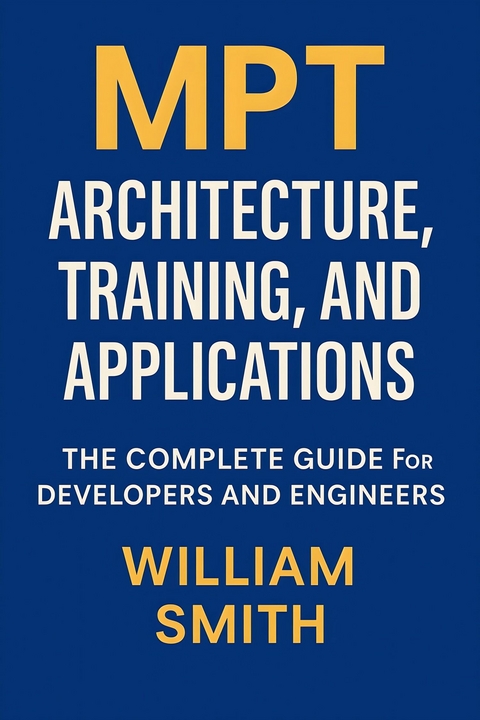
MPT: Architecture, Training, and Applications (eBook)
250 Seiten
HiTeX Press (Verlag)
978-0-00-102979-8 (ISBN)
'MPT: Architecture, Training, and Applications'
'MPT: Architecture, Training, and Applications' offers a comprehensive and authoritative reference on the next generation of transformer models-multi-modal and multi-parameter transformers (MPTs). Written for AI researchers, engineers, and advanced practitioners, this book unveils the conceptual foundations and mathematical principles underpinning MPT design, chronicling their evolution from early transformer systems to today's most sophisticated, multi-faceted architectures. Readers are meticulously guided through the taxonomy, motivation, and distinguishing traits of MPT, with careful attention paid to architectural caveats, key terminologies, and the wide array of practical and theoretical use cases these models now empower.
Delving into the technical heart of MPTs, the book presents a rigorous exploration of architectural design, parameterization strategies, and advanced training methodologies necessary for scaling these models to real-world complexity. Chapters offer in-depth coverage of data curation, progressive training regimes, robust optimization, and distributed infrastructures, while also detailing critical processes for model evaluation, benchmarking, and interpretability. Attention is given to efficient inference, hardware-aware deployments, and memory optimization-ensuring the text remains essential for practitioners addressing production-scale challenges and demanding performance constraints.
Beyond the core mechanisms, 'MPT: Architecture, Training, and Applications' thoroughly addresses applied domains, customization strategies, and the responsible use of MPTs. Its coverage of industrial and research applications showcases the versatility of MPTs across language, vision, science, interactive systems, and creative AI. The book engages with ethical, societal, and regulatory concerns, providing actionable guidance for responsible innovation, transparency, and sustainable deployment. In its concluding chapters, it charts promising future directions in scalable training, lifelong learning, unified reasoning, and cross-disciplinary collaboration-cementing its status as a foundational guide for those shaping the future of multi-modal AI.
Chapter 2
Deep Dive: Architectural Design of MPT
Go beyond surface-level architectures with an uncompromising examination of the internal workings and blueprints of Multi-Modal and Multi-Parameter Transformers. This chapter exposes the intricate engineering decisions, layer compositions, and design innovations that enable MPTs to seamlessly merge diverse data streams and scale across demanding applications, equipping advanced readers with actionable, research-driven knowledge for both analysis and custom model construction.
2.1 Multi-Parameterization Approaches
Multi-parameterization frameworks extend the representational capacity of multi-parameter tuning (MPT) models by explicitly accounting for diverse input characteristics and modular architectural components. These methods enhance the model’s flexibility and adaptability, enabling finer-grained control over internal dynamics and input-dependent behaviors. The following discussion delves into three principal dimensions of multi-parameterization: learnable token-type parameters, input-specific embedding strategies, and architecturally flexible parameter spaces. Each contributes distinctively to balancing expressivity and generalization in complex model systems.
Learnable Token-Type Parameters
A foundational step towards capturing input-level heterogeneity involves associating each token or token group with distinct learnable parameters, commonly termed token-type parameters. Unlike fixed embeddings or static positional encodings, learnable token-type parameters enable the model to adaptively shape representations based on token categories, facilitating improved discrimination across heterogeneous input distributions.
Mathematically, let the input vocabulary be partitioned into K token types, with each type k assigned a dedicated embedding parameter matrix Ek ∈ ℝd×|V k|, where d denotes embedding dimension and |V k| the subset vocabulary size. A token wi belonging to token-type k is embedded as
where one_hot(⋅) denotes the one-hot vector for token wi. These embeddings are simultaneously optimized with the model parameters during training, allowing type-specific representational nuance that can significantly improve performance in multilingual, multi-domain, or code-mixed text scenarios.
Moreover, token-type parameters can be extended beyond initial embeddings to any layer’s intermediate features, instituting a hierarchical parameterization where each layer contains a set of learnable tokens or scaling factors specific to input segments. This hierarchical approach amplifies the model’s expressive power, permitting selective modulation of the forward pass conditioned on token categories.
Input-Specific Embedding Strategies
Beyond static token-type parameterization, input-specific embedding strategies provide dynamic adaptability by contextualizing embeddings according to input characteristics or external metadata. Such strategies fall into several classes:
-
Conditional Embeddings: Embeddings conditioned on latent variables derived from input properties or side information. Formally, given input features z, the conditional embedding matrix E(z) is a function, often parameterized by a neural network, producing context-tailored embeddings as
This approach allows continuous interpolation between embedding spaces, enhancing the model’s adaptability to varying contexts.
-
Mixture-of-Experts (MoE) Embeddings: Embeddings formed by weighted combinations of multiple expert embeddings. For M experts, the embedding for token wi is
with gating weights αm(z) learned to reflect input-specific relevance. This modularity enables sparse and efficient representation allocation based on input complexity.
- Adaptive Input Embeddings: Embeddings modified dynamically through fine-grained transformations such as element-wise scaling or additive bias conditioned on the input or intermediate layer activations. Such adaptive embeddings allow the model to shift or rescale semantic representations responsively, improving its robustness to domain shifts.
These input-specific embedding methods enhance representational diversity without linearly increasing parameter counts, delegating precision to parameter-sharing and context-aware modulation.
Flexible Architectural Adjustments for Dynamic Parameter Spaces
Moving beyond input-side parameterization, multi-parameterization also leverages architectural flexibility to dynamically adjust the model parameter space during training or inference. This paradigm emphasizes modularity and conditional computation, reshaping internal architectures to balance model complexity and computational efficiency.
Typical mechanisms include:
- Dynamic Layer Width and Depth: Meta-parameters controlling the width (number of hidden units) or depth (number of layers) of the model can be conditioned on inputs or task identity. Formally, given an input descriptor z, the architecture adjusts parameters {hℓ(z)}ℓ=1L, where hℓ denotes the hidden size of layer ℓ, allowing adaptive scaling of representational capacity.
-
Conditional Parameter Generation: Parameters of certain layers are generated on-the-fly by hypernetworks-a secondary network producing primary network weights conditioned on the input. For a layer with weights W, one can write
where
| Erscheint lt. Verlag | 19.8.2025 |
|---|---|
| Sprache | englisch |
| Themenwelt | Mathematik / Informatik ► Informatik ► Programmiersprachen / -werkzeuge |
| ISBN-10 | 0-00-102979-7 / 0001029797 |
| ISBN-13 | 978-0-00-102979-8 / 9780001029798 |
| Informationen gemäß Produktsicherheitsverordnung (GPSR) | |
| Haben Sie eine Frage zum Produkt? |
 EPUB (Adobe DRM)
Größe: 1,1 MB
Kopierschutz: Adobe-DRM
Adobe-DRM ist ein Kopierschutz, der das eBook vor Mißbrauch schützen soll. Dabei wird das eBook bereits beim Download auf Ihre persönliche Adobe-ID autorisiert. Lesen können Sie das eBook dann nur auf den Geräten, welche ebenfalls auf Ihre Adobe-ID registriert sind.
Details zum Adobe-DRM
Dateiformat: EPUB (Electronic Publication)
EPUB ist ein offener Standard für eBooks und eignet sich besonders zur Darstellung von Belletristik und Sachbüchern. Der Fließtext wird dynamisch an die Display- und Schriftgröße angepasst. Auch für mobile Lesegeräte ist EPUB daher gut geeignet.
Systemvoraussetzungen:
PC/Mac: Mit einem PC oder Mac können Sie dieses eBook lesen. Sie benötigen eine
eReader: Dieses eBook kann mit (fast) allen eBook-Readern gelesen werden. Mit dem amazon-Kindle ist es aber nicht kompatibel.
Smartphone/Tablet: Egal ob Apple oder Android, dieses eBook können Sie lesen. Sie benötigen eine
Geräteliste und zusätzliche Hinweise
Buying eBooks from abroad
For tax law reasons we can sell eBooks just within Germany and Switzerland. Regrettably we cannot fulfill eBook-orders from other countries.
aus dem Bereich


