


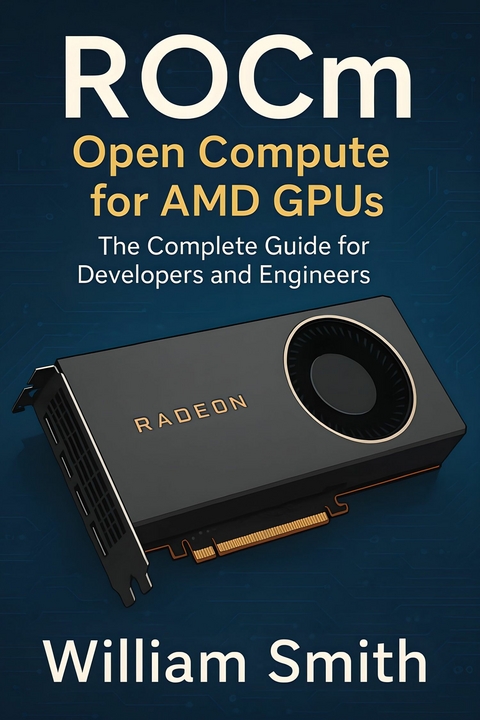
ROCm: Open Compute for AMD GPUs (eBook)
250 Seiten
HiTeX Press (Verlag)
978-0-00-102973-6 (ISBN)
'ROCm: Open Compute for AMD GPUs'
'ROCm: Open Compute for AMD GPUs' is an authoritative guide to the rapidly evolving world of open, high-performance GPU computing on AMD hardware. This book provides a thorough exploration of the ROCm platform, beginning with its motivations and architectural foundations, and contrasting its open, vendor-neutral approach against proprietary solutions. Readers are guided through the nuanced landscape of accelerator programming-from the underlying hardware architecture and software stack to in-depth discussions of usability, interoperability with existing frameworks, and deployment across a range of hardware and cluster environments.
Delving deeply into the HIP programming model, the text offers detailed explanations of core language constructs, optimizations for AMD GPUs, and strategies for porting and developing robust, high-performance applications. The book further illuminates ROCm's powerful ecosystem of libraries-such as rocBLAS, MIOpen, and rocFFT-demonstrating their application in AI, machine learning, scientific computing, and specialized analytic workloads. Practical sections on system installation, containerized deployment, and Kubernetes orchestration equip engineers and researchers with the skills needed to build, scale, and maintain ROCm-driven compute clusters in production and research settings.
Crucially, the book also addresses advanced topics such as performance engineering, security, reliability, and compliance, ensuring that readers can deliver efficient, secure GPU solutions. Real-world case studies and profiling guidance empower practitioners to diagnose bottlenecks, enhance energy efficiency, and guarantee system integrity. The concluding chapters foster active engagement with the ROCm open-source community, outlining pathways for contribution, extension, and future research directions in open GPU compute. This text is an essential resource for developers, engineers, and decision-makers dedicated to pushing the boundaries of accelerated computing with AMD technologies.
Chapter 1
Introduction to ROCm and Advanced GPU Computing
Discover how ROCm is reshaping the landscape of GPU computing by championing open, vendor-neutral innovation. This chapter zooms out to reveal the ideals, architectures, and disruptive impact of the ROCm ecosystem-exploring not just AMD GPUs, but the broader cultural and technological momentum toward high performance, accessible, and scalable accelerator computation.
1.1 Motivation for Open GPU Compute Ecosystems
The accelerating complexity of computational workloads across scientific research, machine learning, and high-performance computing has underscored the necessity for robust and versatile GPU compute platforms. Traditionally, industry adoption and research implementation of GPU acceleration have been dominated by proprietary ecosystems. While engineered for optimized performance on specific hardware, these closed platforms inherently impose limitations that hamper broader innovation, extensibility, and cross-vendor interoperability.
A principal limitation of proprietary GPU compute systems is vendor lock-in. Such ecosystems tightly couple the software stack to specific hardware architectures and drivers, creating a dependency that severely restricts choice. This fundamentally impedes the ability of organizations and researchers to tailor or extend hardware capabilities to emerging application demands without significant reengineering costs. Vendor lock-in creates strategic and economic risks, as migrating workloads or adapting new optimizations across different hardware architectures becomes prohibitively complex and resource-intensive.
Beyond lock-in, proprietary platforms exhibit limited extensibility. The development and integration of novel features or optimization techniques typically require privileged access or cooperation from the hardware vendor. This closed collaboration model restricts community-driven innovation and inhibits the rapid evolution of GPU compute capabilities that are essential in domains with continuously evolving algorithms and data models. The absence of open, modular interfaces obstructs the possibility of co-designing hardware and software components harmoniously, ultimately slowing down the pace of technological advancement.
Innovation itself is constrained under proprietary paradigms. Open collaboration catalyzes cross-disciplinary insights spanning hardware design, compiler construction, runtime systems, and application frameworks. Proprietary restrictions fragment development efforts and forestall cumulative progress. The natural scientific process of iterative hypothesis and experimentation becomes challenging when both the hardware capabilities and low-level software toolchains remain opaque. Consequently, the progress trajectory becomes fixed by the vendor’s internal roadmap rather than the broader computing community’s collective intelligence.
The evolving computational landscape necessitates a shift toward open and interoperable GPU compute ecosystems, wherein hardware and software co-design takes place transparently and inclusively. Such platforms enable direct hardware access via standardized and extensible programming models, fostering innovation in both system design and application development. Open ecosystems encourage modularity, allowing novel architectural features to be explored and integrated more fluidly. Additionally, this openness facilitates cross-vendor compatibility that mitigates lock-in and empowers users to optimize performance-tailored deployments and experiment across different hardware backends.
Research and industry alike benefit from the agility afforded by open ecosystems. Researchers can implement and evaluate custom extensions or novel algorithms natively on diverse hardware targets without constraint. Industry gains strategic flexibility, cost-efficiency, and risk mitigation by adopting interoperable software stacks that remain compatible across heterogeneous platforms. Moreover, an open approach creates a platform for broad community engagement-including academia, independent developers, and multiple hardware vendors-thus accelerating collective improvement and adoption.
The ROCm (Radeon Open Compute) platform embodies these considerations as its foundational philosophy. It aims to dismantle traditional barriers imposed by proprietary GPU frameworks by providing an open-source, modular stack that supports heterogeneous and scalable compute environments. ROCm emphasizes hardware-software co-design by offering extensible low-level runtime components, compiler infrastructure, and performance analysis tools that are accessible for modification and optimization by the broader community. This approach promotes transparency, extensibility, and interoperability, enabling the ecosystem to evolve rapidly in response to emerging computational demands.
Fundamentally, ROCm’s open GPU compute ecosystem strives to create a vibrant, collaborative environment where stakeholders collectively influence future GPU architectures and computing paradigms. By moving beyond vendor silos toward an open infrastructure, ROCm facilitates a more dynamic interplay between hardware capabilities and software innovations. This synergy is crucial for addressing the increasingly heterogeneous and data-intensive workloads pervasive in today’s scientific and industrial computing agendas.
In summary, the motivation for open GPU compute ecosystems stems from the necessity to overcome the entrenched challenges of proprietary systems-vendor lock-in, restricted extensibility, and inhibited innovation-while leveraging the transformative potential of openness to accelerate hardware-software co-design. This paradigm shift not only empowers researchers and engineers with unprecedented flexibility and control over computational resources but also lays the groundwork for sustainable, scalable, and collaborative growth in GPU computing technologies.
1.2 Overview of ROCm Architecture
The ROCm (Radeon Open Compute) platform presents a comprehensive and modular software stack designed to facilitate heterogeneous computing on AMD GPUs, providing a foundation for both high-performance computing (HPC) and machine learning workloads. Its architecture follows a layered approach that enables extensibility, interoperability, and robust performance optimization across a variety of hardware configurations.
At the lowest layer, the ROCm software stack interfaces directly with kernel-level components, primarily embodied by the amdkfd (AMD Kernel Fusion Driver) and kgd (Kernel Graphics Driver) modules within the Linux kernel. These kernel drivers are responsible for managing GPU resources, enforcing process isolation, and facilitating memory management tailored for GPU workloads. The amdkfd driver implements the Heterogeneous System Architecture (HSA) interface, enabling efficient sharing of compute resources between the CPU and GPU, with fine-grained synchronization and coherent memory access. This design supports unified virtual addressing and page fault handling, crucial for dynamic memory management in large-scale compute contexts.
Building atop the kernel layer is the ROCm Runtime, a critical component providing a hardware abstraction interface that exposes GPU computation capabilities while insulating user applications from low-level hardware details. The ROCm Runtime offers APIs compliant with HSAIL (Heterogeneous System Architecture Intermediate Language) and HIP (Heterogeneous-compute Interface for Portability), facilitating both portability and performance portability across AMD and compatible platforms. Central to this runtime is the concept of queues that schedule asynchronous command execution on the GPU, maximizing hardware utilization and enabling overlap of computation with data transfer.
ROCm’s execution model leverages a multi-tiered compilation strategy where either precompiled kernels or just-in-time (JIT) compiled intermediate representations are dispatched to the GPU. The architecture supports LLVM-based compilers that translate high-level programming languages (e.g., HIP, OpenMP, OpenCL) into device-specific code. This modular compiler framework not only enhances optimization opportunities by applying target-specific passes but also fosters innovation through third-party compiler integrations.
The subsequent layer consists of user-space libraries and frameworks, which encapsulate common computational patterns and facilitate developer productivity. Key libraries include rocBLAS for dense linear algebra operations, rocFFT for fast Fourier transforms, rocRAND for random number generation, and MIOpen for deep neural network primitives. These libraries comply with open industry standards and are engineered to exploit GPU features such as wavefront-level parallelism, private and shared memory hierarchies, and asynchronous execution. Each library adheres to well-defined Application Programming Interfaces (APIs), allowing them to serve as drop-in replacements or accelerators within larger software ecosystems.
One of ROCm’s defining architectural principles is modularity, enabling components to be independently developed, updated, and replaced without disrupting the overall stack. By decoupling the runtime, compilation...
| Erscheint lt. Verlag | 19.8.2025 |
|---|---|
| Sprache | englisch |
| Themenwelt | Mathematik / Informatik ► Informatik ► Programmiersprachen / -werkzeuge |
| ISBN-10 | 0-00-102973-8 / 0001029738 |
| ISBN-13 | 978-0-00-102973-6 / 9780001029736 |
| Informationen gemäß Produktsicherheitsverordnung (GPSR) | |
| Haben Sie eine Frage zum Produkt? |
 EPUB (Adobe DRM)
Größe: 695 KB
Kopierschutz: Adobe-DRM
Adobe-DRM ist ein Kopierschutz, der das eBook vor Mißbrauch schützen soll. Dabei wird das eBook bereits beim Download auf Ihre persönliche Adobe-ID autorisiert. Lesen können Sie das eBook dann nur auf den Geräten, welche ebenfalls auf Ihre Adobe-ID registriert sind.
Details zum Adobe-DRM
Dateiformat: EPUB (Electronic Publication)
EPUB ist ein offener Standard für eBooks und eignet sich besonders zur Darstellung von Belletristik und Sachbüchern. Der Fließtext wird dynamisch an die Display- und Schriftgröße angepasst. Auch für mobile Lesegeräte ist EPUB daher gut geeignet.
Systemvoraussetzungen:
PC/Mac: Mit einem PC oder Mac können Sie dieses eBook lesen. Sie benötigen eine
eReader: Dieses eBook kann mit (fast) allen eBook-Readern gelesen werden. Mit dem amazon-Kindle ist es aber nicht kompatibel.
Smartphone/Tablet: Egal ob Apple oder Android, dieses eBook können Sie lesen. Sie benötigen eine
Geräteliste und zusätzliche Hinweise
Buying eBooks from abroad
For tax law reasons we can sell eBooks just within Germany and Switzerland. Regrettably we cannot fulfill eBook-orders from other countries.
aus dem Bereich


