


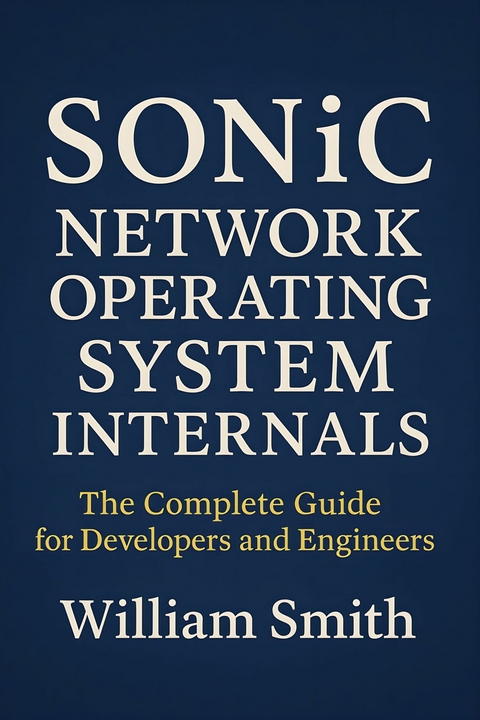
SONiC Network Operating System Internals (eBook)
250 Seiten
HiTeX Press (Verlag)
978-0-00-102971-2 (ISBN)
'SONiC Network Operating System Internals'
'SONiC Network Operating System Internals' offers a comprehensive, in-depth exploration of the design and architecture underlying SONiC, the open-source network operating system powering some of the world's largest data centers and cloud-scale deployments. Beginning with SONiC's evolution, community-driven development, and modular microservices architecture, the book guides readers through its foundational components, including the Switch Abstraction Interface (SAI) and robust hardware platform support. The narrative demystifies the separation of dataplane and control plane functions, SONiC's flexible build system, and its strategy for reliable multi-platform deployments.
Delving into the core system services, the book lays out how SONiC leverages advanced database architectures-such as its multi-Redis model-for high-throughput state management and system orchestration. Readers are introduced to orchestration agents, state consistency models, and essential protocols for Layer 2 and Layer 3 networking, all tightly integrated for scalable, mission-critical operation. Chapters on switching ASICs detail programmable data planes, hardware offloads, packet processing, as well as mechanisms for quality of service, multicast, and robust traffic management.
Beyond technical architecture, the book provides guidance for deploying, observing, and securing SONiC in real-world production environments. It illuminates advanced topics like container lifecycle management, automated testing, continuous integration, and industry-leading security and telemetry practices. With practical insights on deployment topologies, zero-touch provisioning, and lessons from hyperscale adopters, this book is an indispensable reference for network engineers, system architects, and anyone seeking to master the inner workings of SONiC and its transformative role in modern network infrastructure.
Chapter 2
Core System Services and Databases
Beneath SONiC’s user-facing network features lies a robust fabric of system services and specialized databases-the silent engines that drive orchestration, persistence, and real-time state transitions at terabit speeds. This chapter exposes the architectural choices, performance trade-offs, and internal data flows that power SONiC’s dynamic, distributed service ecosystem. Prepare to examine the inner lifelines that ensure reliability, consistency, and high-throughput operation across every subsystem.
2.1 Redis Database Architecture
SONiC (Software for Open Networking in the Cloud) employs a Redis-based multi-database architecture that is central to its design as a modular, extensible network operating system. Redis acts as the primary communication bus among microservices, facilitating seamless interaction, state synchronization, and event notification in a highly optimized manner. This architecture is explicitly engineered to satisfy stringent requirements for low latency and high throughput, which are critical in network environments.
At its core, Redis is used within SONiC not simply as a key-value store but as a layered set of logical databases, each serving distinct functional domains. These logical databases are deployed within a single Redis instance and are isolated through logical partitioning, enabling multiple services to maintain discrete data contexts without mutual interference. The logical separation reduces the complexity associated with multi-tenant data management, while still leveraging the native performance characteristics of Redis.
The Redis architecture in SONiC can be broadly categorized into the following logical databases:
- Config DB: Stores the configuration data applied by network administrators. It serves as the authoritative source for the desired network state and supports atomic transactions for consistent updates.
- App DB: Holds the operational state communicated between different application modules. It acts as a transient layer where microservices publish or subscribe to changes effectively, enabling an event-driven paradigm.
- State DB: Contains the current state information reported by hardware components or lower-level software subsystems. Its data is typically more volatile and reflects the live network condition.
- Counters DB and Intf Counters DB: Specialize in storing performance and error metrics, facilitating real-time monitoring and diagnostics.
The partitioning into multiple logical databases within Redis is critical for optimizing both scalability and isolation. It allows SONiC to allocate resources proportional to workload demands on each functional domain while minimizing cross-database contention. This organization also simplifies keyspace management by reducing namespace collisions and enabling role-based access control mechanisms grounded in database selection.
SONiC’s deployment pattern for Redis emphasizes high availability and performance tuning tailored to networking workloads. Due to the necessity for rapid data access and minimal response times, Redis instances are configured with memory-centric optimizations, including aggressive use of in-memory data structures and minimal serialization overhead. Persistent storage is typically de-emphasized in favor of runtime performance, with snapshotting and AOF (Append-Only File) features either disabled or carefully tuned to avoid impacting processing latency.
Inter-service communication leverages Redis’ native PUB/SUB (publish/subscribe) mechanisms and keyspace notifications. These mechanisms underpin SONiC’s event-driven model, enabling instantaneous updates and asynchronous notifications without polling overhead. This design facilitates reactive service behavior where microservices subscribe to specific event channels or keyspace changes, thereby decoupling service interactions and improving scalability.
The configuration of Redis within SONiC is also customized to handle high concurrency models ubiquitous in data-plane and control-plane operations. Connection pooling, optimized thread scheduling, and fine-tuned eviction policies ensure that Redis can sustain the intense bursts of read/write operations typically observed in network switch management. Additionally, non-blocking command execution patterns and pipelining are frequently leveraged to maximize throughput without sacrificing latency.
State management within SONiC relies heavily on efficient Redis commands for atomic operations. Transactions and Lua scripting extend Redis capabilities by allowing multi-key atomicity and complex update logic to be encapsulated server-side. These capabilities are essential for maintaining coherent network states amid concurrent modifications by multiple microservices.
From a DevOps perspective, monitoring and fault diagnostics integrate tightly with Redis metrics, providing visibility into command latencies, memory usage, and connection health. Such telemetry enables proactive tuning and rapid troubleshooting, critical for high-reliability network deployment.
SONiC’s Redis database architecture is a carefully engineered multi-database deployment that transforms the open-source key-value store into a sophisticated communication bus tailored for dynamic, distributed network environments. Its design harnesses Redis’ efficient in-memory capabilities, logical partitioning for service isolation, and event-driven communication primitives to deliver a scalable, high-performance platform for modern cloud-scale networking.
2.2 Key SONiC Databases: ConfigDB, AppDB, StateDB
SONiC’s architecture employs a triad of primary databases—ConfigDB, AppDB, and StateDB—each serving distinct, yet interrelated functions that collectively enable robust, scalable network operating system behavior. These databases are implemented atop Redis, leveraging its in-memory data structures and pub/sub capabilities, but are semantically distinct. Understanding their individual purposes, data schemas, and the mechanisms that ensure consistency across concurrent processes is essential for grasping SONiC’s runtime design.
ConfigDB: Persistent Network Configuration
The ConfigDB holds the canonical source of persistent configuration data. It primarily stores the desired system configuration as committed by operators or orchestration systems. The schema of ConfigDB is organized as a collection of tables, where each table represents a major configuration domain—such as INTERFACE, VLAN, BGP_NEIGHBOR, or LOOPBACK_INTERFACE. Each key within a table is unique and maps to a field-value dictionary, representing configuration attributes. For example, an INTERFACE table entry may map the interface name Ethernet0 to fields like "mtu":"9100" and "admin_status":"up".
Transactions in ConfigDB are crucial, as configuration changes must be atomic and consistent. Typical operations to ConfigDB are performed via Redis transactions or Lua scripting, ensuring that partial updates do not leak into the system. Written configurations persist across reboots, stored on disk as JSON-formatted files that bootstrap ConfigDB on startup. The database itself does not communicate directly with hardware; instead, it acts as a source of truth from which other components synchronize.
AppDB: Operational Intent and Synchronization Layer
AppDB functions as the bridge between high-level configuration and hardware programming. It stores operational intents submitted by various SONiC applications—such as routing daemons, QoS managers, and ACL controllers—that interpret ConfigDB and perform business logic. The schema mirrors that of ConfigDB in its table/key/field structure but holds transient, mutable state data expressing runtime intentions rather than persisted configuration.
Updates to AppDB must guarantee consistency under concurrent operations by multiple asynchronous applications. SONiC employs Redis’s transactional pipelines and optimistic concurrency mechanisms to isolate conflicting updates. Notably, AppDB is the source database for hardware synchronization processes—such as syncd—which consume these operational intents and translate them into low-level ASIC commands via the Switch Abstraction Interface (SAI).
Tables in AppDB are carefully designed to prevent race conditions by isolating application domains and leveraging Redis pub/sub to notify hardware synchronization daemons of changes. For example, routing updates placed in the ROUTE table trigger immediate reprogramming of ASIC forwarding tables, ensuring minimal configuration-to-hardware latency.
StateDB: Real-Time Device State Reflection
The StateDB serves as a central repository for real-time status monitoring and feedback from physical devices, software agents, and...
| Erscheint lt. Verlag | 19.8.2025 |
|---|---|
| Sprache | englisch |
| Themenwelt | Mathematik / Informatik ► Informatik ► Programmiersprachen / -werkzeuge |
| ISBN-10 | 0-00-102971-1 / 0001029711 |
| ISBN-13 | 978-0-00-102971-2 / 9780001029712 |
| Informationen gemäß Produktsicherheitsverordnung (GPSR) | |
| Haben Sie eine Frage zum Produkt? |
 EPUB (Adobe DRM)
Größe: 860 KB
Kopierschutz: Adobe-DRM
Adobe-DRM ist ein Kopierschutz, der das eBook vor Mißbrauch schützen soll. Dabei wird das eBook bereits beim Download auf Ihre persönliche Adobe-ID autorisiert. Lesen können Sie das eBook dann nur auf den Geräten, welche ebenfalls auf Ihre Adobe-ID registriert sind.
Details zum Adobe-DRM
Dateiformat: EPUB (Electronic Publication)
EPUB ist ein offener Standard für eBooks und eignet sich besonders zur Darstellung von Belletristik und Sachbüchern. Der Fließtext wird dynamisch an die Display- und Schriftgröße angepasst. Auch für mobile Lesegeräte ist EPUB daher gut geeignet.
Systemvoraussetzungen:
PC/Mac: Mit einem PC oder Mac können Sie dieses eBook lesen. Sie benötigen eine
eReader: Dieses eBook kann mit (fast) allen eBook-Readern gelesen werden. Mit dem amazon-Kindle ist es aber nicht kompatibel.
Smartphone/Tablet: Egal ob Apple oder Android, dieses eBook können Sie lesen. Sie benötigen eine
Geräteliste und zusätzliche Hinweise
Buying eBooks from abroad
For tax law reasons we can sell eBooks just within Germany and Switzerland. Regrettably we cannot fulfill eBook-orders from other countries.
aus dem Bereich


