


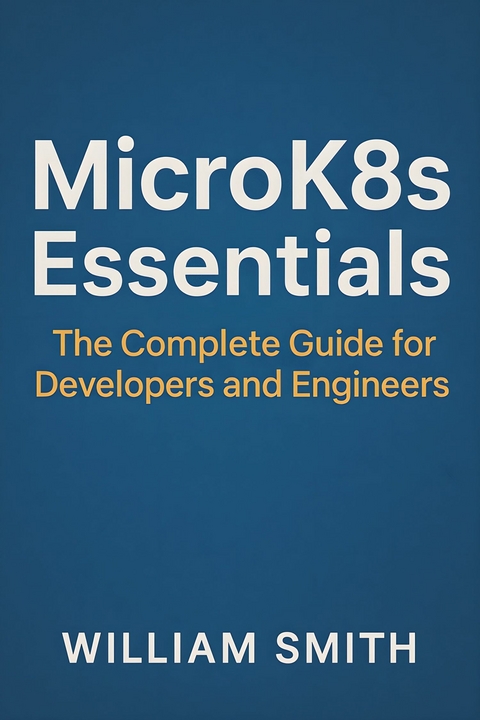
MicroK8s Essentials (eBook)
250 Seiten
HiTeX Press (Verlag)
978-0-00-102968-2 (ISBN)
'MicroK8s Essentials'
'MicroK8s Essentials' is a comprehensive guide designed to demystify and enable mastery of MicroK8s-a lightweight, yet fully featured Kubernetes distribution trusted for edge, cloud, and development environments. The book begins by exploring the architectural foundations and design trade-offs of MicroK8s, unraveling its internal mechanics, modular addon architecture, distributed state management using Dqlite and etcd, and robust security fundamentals. Readers receive a clear perspective on how MicroK8s maintains Kubernetes conformance while offering specialized optimizations for resource efficiency and deployment flexibility.
Building on this foundation, the book delivers practical, in-depth coverage of installation, initialization, and diverse deployment models across Linux, Windows, macOS, hypervisors, and bare metal. Readers learn to confidently manage cluster lifecycle operations, from seamless scaling and high availability provisioning to zero-downtime upgrades, backup, and disaster recovery. Extensive chapters are devoted to networking intricacies-including CNI plugins, service discovery, ingress architectures, and multi-cluster connectivity-as well as stateful storage management, persistent data strategies, CSI integrations, and best practices for high availability.
Bridging theory and hands-on expertise, 'MicroK8s Essentials' equips practitioners with the skills to deploy, manage, and secure modern containerized workloads. It addresses every tier of security and compliance-from advanced RBAC, image provenance, and TLS management to policy enforcement in regulated environments-while also charting a path through monitoring, observability, CI/CD pipeline integration, operator frameworks, and custom addon development. Complete with troubleshooting methodologies and future-focused insights into ecosystem integration and open source community collaboration, this book is an indispensable resource for engineers, DevOps teams, and technology leaders adopting or operating MicroK8s at any scale.
Chapter 1
MicroK8s Architecture and Core Design Principles
Dive beneath the surface of MicroK8s to discover its finely balanced architecture-where power meets minimalism, and fundamental design principles shape a Kubernetes distribution ready for edge, cloud, and beyond. This chapter unveils the engineering choices that empower MicroK8s to thrive in diverse, demanding environments while upholding Kubernetes fidelity and offering a frictionless, modular experience. Explore the intricate gears and principles that drive one of the most versatile Kubernetes platforms today.
1.1 MicroK8s System Architecture
MicroK8s embodies a minimalistic yet robust Kubernetes deployment designed for lightweight and efficient operation on edge devices, developer workstations, and resource-constrained environments. Its internal microarchitecture leverages a streamlined composition of Kubernetes components that are tightly integrated to optimize resource utilization without sacrificing functional completeness. The system architecture can be understood through the critical system components, their roles, and their interactions, particularly emphasizing the separation and orchestration of control plane and data plane services.
At the heart of MicroK8s lies the API Server, which serves as the gateway and unified interface for all interactions with the cluster state. Functioning as a RESTful front end to the cluster’s shared state stored in etcd, the API server authenticates, validates, and processes incoming requests from users, controllers, and nodes. Unlike full-scale Kubernetes deployments, MicroK8s typically runs a single-instance API server, reducing complexity and resource overhead. This single API endpoint consolidates all cluster communications, ensuring a coherent and consistent view of desired and observed cluster states.
The Scheduler in MicroK8s is responsible for assigning newly created pods to appropriate nodes based on scheduling policies, resource availability, and affinity rules. Operating as a centralized process, it watches for unscheduled pods through the API server and makes binding decisions that optimize load balancing within the cluster constraints. Despite its minimal footprint, the scheduler retains all standard pluggable extension points, allowing customization of scheduling logic. The tight integration of the scheduler with the API server minimizes latencies in pod placement decisions, facilitating swift workload deployments.
Equally pivotal is the Controller Manager, which runs multiple controllers to manage various aspects of cluster state, including node lifecycle, replication, and endpoint updates. Controllers constantly monitor desired state definitions from the API server and work to reconcile them with the actual state by creating, updating, or removing Kubernetes objects. In MicroK8s, the controller manager is consolidated into a single binary to reduce overhead, but it retains full functionality for key controllers such as the deployment, replica set, and namespace controllers. This consolidation is critical to the small footprint objective while maintaining reliable cluster health monitoring.
The Kubelet operates on each node, managing pod lifecycle and ensuring containers are running as expected. It periodically communicates with the API server to receive pod specifications and reports node status and pod health back to the control plane. Embedded within MicroK8s, the kubelet is streamlined for lightweight operation and configured to communicate exclusively with the embedded MicroK8s API server endpoint, enforcing strict boundaries between control plane and data plane interactions. The kubelet’s local management of pods includes initiating container runtimes and monitoring container status, providing rapid local response to changes without excessive network communication.
Integral to the kubelet’s operation is the Container Runtime Interface (CRI) runtime, which abstracts container lifecycle management beneath the Kubernetes layer. MicroK8s employs containerd as its default CRI runtime, selected for its efficiency, simplicity, and native Kubernetes compatibility. Containerd handles image lifecycle management, container execution, and resource isolation with minimal overhead. The container runtime interfaces with kubelet through the CRI, enabling modularity and allowing MicroK8s to switch runtimes if needed without disrupting upper-layer orchestration processes. This separation ensures that workload execution is decoupled from the complexity of the Kubernetes control logic.
The interplay between these components facilitates a clear separation of concerns between the control plane and data plane. The control plane, comprising the API server, scheduler, and controller manager, orchestrates cluster state and overall system behavior. These components manage declarative state, react to changes, and enforce policies. The data plane, consisting primarily of kubelets and their CRI runtimes on each node, executes workloads, manages containers, and reports status. This separation enhances scalability and fault isolation: control plane failures do not imply immediate workload disruption, and data plane abnormalities are reported back for rectification.
MicroK8s’ internal service orchestration is designed for low-latency and low-footprint operation. Rather than spreading control processes across multiple distributed nodes, MicroK8s collates core control plane components into a single-node deployment architecture, minimizing network chatter and synchronization overhead. Moreover, the underlying processes leverage snap confinement and systemd integration on Linux systems, enabling efficient startup, resource cgroup isolation, and automatic recovery. The core components run as services managed via systemd, orchestrated by snap hooks, ensuring that dependencies such as containerd and networking are available when components start.
Networking within MicroK8s is enabled via a simplified but extensible CNI (Container Network Interface) plugin system, which is tightly coupled with the kubelet and CRI runtime to provide efficient pod-to-pod communication. Although minimal by default, it supports deployment of standard plugins such as Flannel or Calico on demand, demonstrating the microarchitecture’s adaptability without sacrificing its lean baseline.
In sum, MicroK8s synthesizes a set of full-featured Kubernetes components into a unified, minimal, and yet flexible system. The internal microarchitecture achieves compactness by consolidating control processes, utilizing lightweight container runtimes, and enforcing strong component cohesion and separation. This design enables MicroK8s to deliver Kubernetes-compatible orchestration with low resource consumption, rapid responsiveness, and enhanced suitability for edge and development environments.
1.2 Kubernetes Conformance and MicroK8s Specialization
MicroK8s is designed to provide a lightweight yet fully conformant Kubernetes environment, enabling users to deploy and manage containerized applications with the assurance of upstream compatibility. Achieving strict conformance with the Kubernetes API and behavior is fundamental to MicroK8s, ensuring that applications verified against standard Kubernetes distributions function identically, thus preserving portability and predictability. This fidelity is accomplished while simultaneously introducing selective extensions and performance optimizations tailored for edge, IoT, and developer workflows.
The foundational approach to conformance in MicroK8s involves utilizing the unmodified Kubernetes upstream codebase. MicroK8s packages and runs the vanilla Kubernetes components—kube-apiserver, kube-controller-manager, kube-scheduler, kubelet, and kube-proxy—thereby inheriting their API semantics and stable behavioral characteristics. The Kubernetes conformance tests, administered by the Cloud Native Computing Foundation (CNCF), constitute the primary validation suite to certify MicroK8s as compliant. Continuous integration pipelines execute conformance test suites regularly, mitigating regressions in API behavior or stability. This testing regimen attests that all standard resource definitions, controllers, admission webhooks, and lifecycle events behave as expected, including critical edge cases and failover scenarios.
Furthermore, MicroK8s incorporates strategies for compatibility testing that emphasize version synchronization and deterministic environment reproduction. The embedding of Kubernetes upstream binaries is precisely version-locked, often aligned with official Kubernetes releases or supported Long-Term Support (LTS) versions. Automated verification cycles cross-validate MicroK8s clusters with reference distributions using conformance tooling such as Sonobuoy. By leveraging these tools, any divergence in resource handling, scheduling decisions, or API response schemas is detected early, allowing remediation before user impact.
Despite its strict adherence to upstream compatibility, MicroK8s introduces intentional deviations and additions to optimize usability and performance, particularly for constrained or specialized environments. These extensions are architected to operate orthogonally...
| Erscheint lt. Verlag | 19.8.2025 |
|---|---|
| Sprache | englisch |
| Themenwelt | Mathematik / Informatik ► Informatik ► Programmiersprachen / -werkzeuge |
| ISBN-10 | 0-00-102968-1 / 0001029681 |
| ISBN-13 | 978-0-00-102968-2 / 9780001029682 |
| Informationen gemäß Produktsicherheitsverordnung (GPSR) | |
| Haben Sie eine Frage zum Produkt? |
 EPUB (Adobe DRM)
Größe: 754 KB
Kopierschutz: Adobe-DRM
Adobe-DRM ist ein Kopierschutz, der das eBook vor Mißbrauch schützen soll. Dabei wird das eBook bereits beim Download auf Ihre persönliche Adobe-ID autorisiert. Lesen können Sie das eBook dann nur auf den Geräten, welche ebenfalls auf Ihre Adobe-ID registriert sind.
Details zum Adobe-DRM
Dateiformat: EPUB (Electronic Publication)
EPUB ist ein offener Standard für eBooks und eignet sich besonders zur Darstellung von Belletristik und Sachbüchern. Der Fließtext wird dynamisch an die Display- und Schriftgröße angepasst. Auch für mobile Lesegeräte ist EPUB daher gut geeignet.
Systemvoraussetzungen:
PC/Mac: Mit einem PC oder Mac können Sie dieses eBook lesen. Sie benötigen eine
eReader: Dieses eBook kann mit (fast) allen eBook-Readern gelesen werden. Mit dem amazon-Kindle ist es aber nicht kompatibel.
Smartphone/Tablet: Egal ob Apple oder Android, dieses eBook können Sie lesen. Sie benötigen eine
Geräteliste und zusätzliche Hinweise
Buying eBooks from abroad
For tax law reasons we can sell eBooks just within Germany and Switzerland. Regrettably we cannot fulfill eBook-orders from other countries.
aus dem Bereich


