


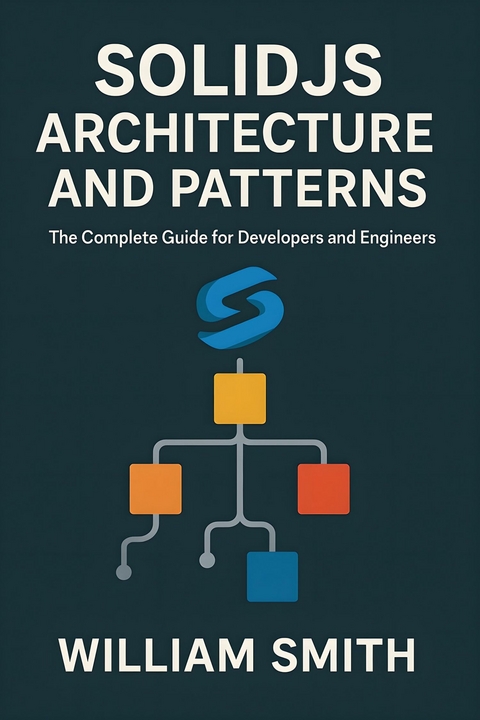
SolidJS Architecture and Patterns (eBook)
250 Seiten
HiTeX Press (Verlag)
978-0-00-102965-1 (ISBN)
'SolidJS Architecture and Patterns'
'SolidJS Architecture and Patterns' is a definitive guide to building robust, scalable, and high-performance user interfaces using SolidJS. The book begins with a deep dive into SolidJS's reactivity model, exploring signals, memoization, and fine-grained update mechanisms as core primitives that set SolidJS apart from virtual DOM-based frameworks. Readers will gain a comprehensive understanding of Solid's lifecycle, JSX compilation pipeline, and the architectural implications of granular reactivity, laying a strong foundation for advanced SolidJS development.
Through detailed chapters on component composition, state management, and application architecture, the book uncovers modern patterns that enable maintainable and flexible design. Practical guidance ranges from container/presentational decomposition, compound components, and dynamic runtime patterns to best practices for coordinating local and global state. Special attention is given to advanced topics such as history management, resource synchronization, real-time integrations, and enterprise-level structuring with micro-frontends, plugins, and dependency injection.
Performance engineering, integration strategies, and quality assurance are thoroughly addressed, equipping architects and teams to deliver optimized and dependable SolidJS apps. Coverage includes in-depth profiling, lazy loading, memory management, and robust testing methodologies, while deployment, operations, and security practices ensure readiness for production. Concluding with a look toward the evolving SolidJS ecosystem-covering streaming SSR, edge computing, AI augmentation, and forward-looking standards-the book is an indispensable resource for modern frontend engineers seeking to master SolidJS architecture and patterns.
Chapter 2
Advanced Component Patterns
Beyond the basics lies a world of compositional ingenuity-where SolidJS’s fine-grained reactivity enables advanced architectures, high cohesion, and maximal code reuse. This chapter invites readers to master sophisticated component design patterns that unlock scalable, expressive UIs. Traverse the landscape of context, advanced composition, local-global coordination, and dynamic runtime structures, all tailored for high-performance, maintainable applications.
2.1 Container and Presentational Components
The architectural paradigm of dividing user interface components into container and presentational forms remains a fundamental design approach for managing complexity in modern frontend applications. In the context of SolidJS, this separation takes on nuanced characteristics due to the library’s unique reactive system centered on fine-grained reactivity, signals, and stores. Understanding how to effectively isolate business logic from view definitions using these primitives is key to achieving modularity and maintainability in large-scale SolidJS applications.
Container components serve as the stateful drivers of the application’s logic and data flow. They typically perform asynchronous data fetching, manage state transitions, and orchestrate user interactions. In SolidJS, containers leverage signals or stores to encapsulate stateful information. Signals, created via the createSignal API, provide a reactive getter/setter pair that emits updates when the contained value changes. Stores, introduced through createStore, offer a more complex state structure capable of representing nested objects with structural sharing and recursive reactivity. Emphasizing the use of signals or stores at the container level facilitates separation from presentation concerns, as these components act as the primary data sources.
Presentational components, by contrast, are predominantly stateless and devoted to rendering the user interface based on props. They do not fetch data or modify application state directly but instead receive data and event handlers from their container counterparts. In SolidJS, presentational components can be implemented as simple functions that destructure props or as small compositions of JSX, relying on the reactivity system to automatically update the DOM when data passed from container components changes. This statelessness dramatically simplifies testing and reuse, as presentational components have no external dependencies or side effects.
Isolating business logic within container components, while confining view and markup definitions to presentational components, yields several notable benefits. First, by localizing data fetching and state mutations in containers, side effects are minimized in the view layer, reducing unpredictable behavior and rendering complexity. Second, it allows business logic to be refactored, optimized, or replaced without impacting presentation code, enhancing the adaptability of the UI. Third, controlled reactivity through signals and stores enables granular updates, limiting rerendering and improving performance.
To illustrate effective stratification, consider a container component responsible for fetching a list of items from an external API and managing selection state:
function ItemsContainer() {
const [items, setItems] = createSignal([]);
const [selectedId, setSelectedId] = createSignal(null);
createEffect(() => {
fetch(’/api/items’)
.then(r => r.json())
.then(data => setItems(data));
});
const selectItem = id => setSelectedId(id);
return <ItemsList items={items()} selectedId={selectedId()} onSelect={selectItem} />;
}
Here, ItemsContainer abstracts away all asynchronous data fetching and state management. It exposes a clean API to ItemsList, the presentational component, passing reactive values and callbacks. ItemsList can be a simple stateless renderer:
...
| Erscheint lt. Verlag | 19.8.2025 |
|---|---|
| Sprache | englisch |
| Themenwelt | Mathematik / Informatik ► Informatik ► Programmiersprachen / -werkzeuge |
| ISBN-10 | 0-00-102965-7 / 0001029657 |
| ISBN-13 | 978-0-00-102965-1 / 9780001029651 |
| Informationen gemäß Produktsicherheitsverordnung (GPSR) | |
| Haben Sie eine Frage zum Produkt? |
 EPUB (Adobe DRM)
Größe: 696 KB
Kopierschutz: Adobe-DRM
Adobe-DRM ist ein Kopierschutz, der das eBook vor Mißbrauch schützen soll. Dabei wird das eBook bereits beim Download auf Ihre persönliche Adobe-ID autorisiert. Lesen können Sie das eBook dann nur auf den Geräten, welche ebenfalls auf Ihre Adobe-ID registriert sind.
Details zum Adobe-DRM
Dateiformat: EPUB (Electronic Publication)
EPUB ist ein offener Standard für eBooks und eignet sich besonders zur Darstellung von Belletristik und Sachbüchern. Der Fließtext wird dynamisch an die Display- und Schriftgröße angepasst. Auch für mobile Lesegeräte ist EPUB daher gut geeignet.
Systemvoraussetzungen:
PC/Mac: Mit einem PC oder Mac können Sie dieses eBook lesen. Sie benötigen eine
eReader: Dieses eBook kann mit (fast) allen eBook-Readern gelesen werden. Mit dem amazon-Kindle ist es aber nicht kompatibel.
Smartphone/Tablet: Egal ob Apple oder Android, dieses eBook können Sie lesen. Sie benötigen eine
Geräteliste und zusätzliche Hinweise
Buying eBooks from abroad
For tax law reasons we can sell eBooks just within Germany and Switzerland. Regrettably we cannot fulfill eBook-orders from other countries.
aus dem Bereich


