


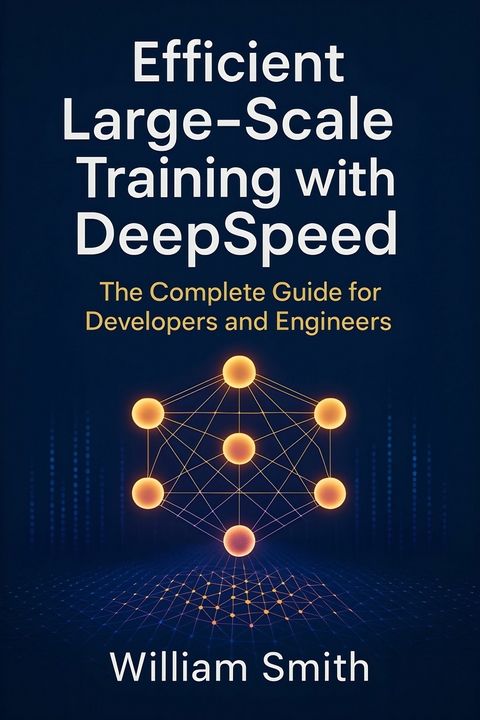
Efficient Large-Scale Training with DeepSpeed (eBook)
250 Seiten
HiTeX Press (Verlag)
978-0-00-102957-6 (ISBN)
'Efficient Large-Scale Training with DeepSpeed'
'Efficient Large-Scale Training with DeepSpeed' is an authoritative guide for machine learning practitioners and researchers looking to master the cutting edge of distributed deep learning. This comprehensive volume delves into the motivations and challenges of scaling deep learning to unprecedented heights, from the basic design principles behind DeepSpeed to its advanced optimizations. Readers gain a nuanced understanding of parallel training paradigms, with in-depth comparisons to other popular frameworks, real-world success stories, and clear explanations of DeepSpeed's unique architectural philosophy.
The book offers meticulous, hands-on insights into DeepSpeed's modular components, with chapters exploring the Zero Redundancy Optimizer (ZeRO) and its evolutionary impact on memory efficiency and scalability. Detailed discussions cover progressive memory partitioning, optimizer state and gradient offloading, mixed-precision execution, and the hybrid parallel strategies that underpin the training of massive models. Complemented by case studies and empirical analyses, the text demystifies the design and implementation of complex memory and performance engineering techniques, including profiling, throughput tuning, and large-scale hyperparameter optimization.
Beyond the technical architecture, this work explores the broader operational, ethical, and research landscape of large-scale AI. Readers are guided through the intricacies of cluster orchestration, cloud integration, security, telemetry, and cost optimization. The book concludes with forward-looking perspectives on responsible AI, hardware innovation, federated learning, and emerging trends poised to shape exascale model training. With best practices for both extending DeepSpeed and contributing to its open-source ecosystem, this book equips readers to drive the next generation of highly efficient, scalable, and responsible AI systems.
Chapter 1
Introduction to Large-Scale Deep Learning
As deep learning systems advance toward ever-larger scales, the unique opportunities and demands of distributed model training are reshaping the field. This chapter reveals the strategic motivations driving the pursuit of massive models, explores the formidable technical hurdles involved, and introduces the key frameworks and paradigms that underpin modern large-scale learning. By the end of this chapter, readers will appreciate not just the ’how,’ but the crucial ’why’ behind scaling efforts, setting a foundation for the deep dives that follow.
1.1 Motivation for Large-Scale Deep Learning
The pursuit of large-scale deep learning arises fundamentally from the aspiration to enhance model performance beyond the capabilities of traditional architectures and training regimes. As deep learning models have evolved from modest-sized neural networks to architectures comprising billions of parameters, empirical evidence has demonstrated a consistent correlation between increased model scale and improvements in accuracy, generalization, and the breadth of representational capacity. This correlation is succinctly captured by scale laws, which reveal predictable performance gains as a function of parameters, dataset size, and computational resources.
One pivotal driver for scaling up is the ambition to achieve state-of-the-art results on complex tasks across diverse domains such as natural language processing (NLP), computer vision (CV), and multi-modal learning. In NLP, the advent of architectures like transformer-based models has propelled language understanding and generation capabilities to unprecedented levels. Models trained at large scale have exhibited emergent abilities, such as few-shot learning, zero-shot generalization, and nuanced conversational skills, which smaller counterparts fail to replicate. These emergent properties underscore nonlinear gains in performance by increasing model size and training data, reflecting that scaling not only refines existing capabilities but also unlocks qualitatively new functionalities.
Computer vision has similarly benefited from scale, with convolutional and vision transformer models reaching higher accuracy on benchmarks through larger parameter counts and extended datasets. The migration toward multi-modal systems-models that integrate inputs across text, images, audio, and other sensory modalities-illustrates the expansive potential afforded by large-scale architectures. Multi-modal models facilitate complex reasoning that bridges modalities, enabling tasks such as image captioning, video understanding, and cross-modal retrieval, which are instrumental for applications in robotics, medical diagnostics, and autonomous systems. The capacity to learn richer, joint representations from heterogeneous data sources is inherently dependent on sufficient model expressivity and training at scale.
The empirical laws governing scale effects have been explored in foundational research, elucidating the relationships among model size (N parameters), dataset size (D tokens or images), and achievable loss or error. These relationships can be approximated by power laws of the form
where L denotes loss, C and C′ are constant coefficients, α and β reflect the sensitivity of performance to scaling parameters, and L∞ signifies irreducible error. Such scaling laws enable principled forecasting of performance improvements and inform resource allocation for training. Importantly, these laws confirm that increasing compute and data in tandem yields more substantial gains than scaling one alone, which has motivated an integrated approach to large-scale deep learning efforts.
Emergence phenomena observed in large models challenge linear extrapolations. Novel behaviors, such as arithmetic reasoning, language translation without explicit supervision, or code generation, manifest only once a particular threshold in parameter count or training volume is surpassed. These capabilities often arise suddenly and unpredictably, suggesting phase transitions in model ability that traditional theories do not fully capture. Understanding and anticipating emergent capabilities is crucial for both leveraging the benefits of large models and addressing associated risks.
Transfer learning constitutes another strong motivation for scaling deep learning. Large pretrained models serve as foundational assets that can be adapted for downstream tasks with limited labeled data. As models grow, their internal representations become more general and robust, permitting efficient fine-tuning or prompt-based adaptation in diverse domains. This capability reduces the dependence on extensive task-specific data collection and accelerates deployment cycles. Moreover, the rising prominence of self-supervised learning paradigms, which exploit vast quantities of unlabeled data, is intertwined with model scale-larger models capitalize more effectively on such data, enhancing pretraining quality and subsequent transfer performance.
Beyond engineering and performance considerations, large-scale deep learning models have profoundly impacted scientific discovery. In fields such as genomics, drug design, and climate modeling, scaling neural networks enables the modeling of complex, high-dimensional systems with improved predictive precision. Such models facilitate hypothesis generation, accelerate simulation workflows, and enable the interpretation of intricate patterns in data that were previously intractable. These advances exemplify a broader shift in scientific methodology toward data-driven, model-guided inquiry, powered by computational scale.
The motivations for scaling deep learning encompass a multifaceted array of empirical, theoretical, and practical factors. The scale-induced improvements in accuracy and generalization, emergence of novel capabilities, facilitation of transfer learning, and enablement of sophisticated multi-modal and scientific applications together form a compelling impetus. As hardware and algorithmic advances continue to reduce barriers to scale, understanding these motivations guides strategic investments and innovation trajectories in the expansive field of deep learning.
1.2 Challenges in Scaling Deep Learning
Scaling deep learning models to handle increasingly large datasets and more complex architectures faces significant technical impediments stemming from intertwined hardware, software, and algorithmic limitations. These challenges manifest primarily as memory bottlenecks, compute throughput constraints, distributed data handling complexities, and communication overhead. Understanding each of these issues provides insight into the practical and theoretical hurdles that must be overcome to achieve efficient training at extreme scales.
Memory bottlenecks arise because modern deep neural networks involve billions of parameters and require vast amounts of intermediate data storage during both forward and backward passes. The memory required for storing activations, weights, gradients, and optimizer states grows proportionally with model size and batch size. This often exceeds the capacity of available GPU or accelerator device memory, necessitating intricate memory management strategies. Techniques such as gradient checkpointing, activation recomputation, and mixed-precision training partially mitigate memory demands by trading off computational overhead and numerical precision against memory savings. However, these strategies introduce further algorithmic complexity and may impact convergence behavior. The limited bandwidth between host memory and device memory also exacerbates the problem, as frequent data transfers stall execution and degrade effective memory utilization.
Compute throughput constraints are tightly coupled with memory usage but extend beyond raw floating-point operations per second (FLOPS) to include the efficiency of hardware utilization. Achieving peak computational throughput requires carefully balancing parallelism across multiple levels: vectorization within accelerator cores, parallel threads on single devices, and coordination across multiple devices or nodes. Inefficient kernels, underutilized hardware pipelines, or synchronization stalls can prevent effective scaling of compute resources. Moreover, the growing divergence between increasing model sizes and the fixed hardware capabilities of accelerators mandates algorithmic innovations such as model parallelism, pipeline parallelism, and sparse training methods. These approaches attempt to partition models or data more effectively but complicate scheduling, load balancing, and introduce additional synchronization points that impact throughput.
Distributed data handling presents unique challenges as datasets grow beyond the capacity of local storage or the memory of individual compute nodes. Data must be partitioned, shard-distributed, and dynamically loaded for efficient access during training, all while ensuring randomness and representativeness to avoid training biases. Additionally, data preprocessing steps, such as augmentation and normalization, must be parallelized without introducing significant overhead or data bottlenecks. Distributed file...
| Erscheint lt. Verlag | 19.8.2025 |
|---|---|
| Sprache | englisch |
| Themenwelt | Mathematik / Informatik ► Informatik ► Programmiersprachen / -werkzeuge |
| ISBN-10 | 0-00-102957-6 / 0001029576 |
| ISBN-13 | 978-0-00-102957-6 / 9780001029576 |
| Informationen gemäß Produktsicherheitsverordnung (GPSR) | |
| Haben Sie eine Frage zum Produkt? |
 EPUB (Adobe DRM)
Größe: 786 KB
Kopierschutz: Adobe-DRM
Adobe-DRM ist ein Kopierschutz, der das eBook vor Mißbrauch schützen soll. Dabei wird das eBook bereits beim Download auf Ihre persönliche Adobe-ID autorisiert. Lesen können Sie das eBook dann nur auf den Geräten, welche ebenfalls auf Ihre Adobe-ID registriert sind.
Details zum Adobe-DRM
Dateiformat: EPUB (Electronic Publication)
EPUB ist ein offener Standard für eBooks und eignet sich besonders zur Darstellung von Belletristik und Sachbüchern. Der Fließtext wird dynamisch an die Display- und Schriftgröße angepasst. Auch für mobile Lesegeräte ist EPUB daher gut geeignet.
Systemvoraussetzungen:
PC/Mac: Mit einem PC oder Mac können Sie dieses eBook lesen. Sie benötigen eine
eReader: Dieses eBook kann mit (fast) allen eBook-Readern gelesen werden. Mit dem amazon-Kindle ist es aber nicht kompatibel.
Smartphone/Tablet: Egal ob Apple oder Android, dieses eBook können Sie lesen. Sie benötigen eine
Geräteliste und zusätzliche Hinweise
Buying eBooks from abroad
For tax law reasons we can sell eBooks just within Germany and Switzerland. Regrettably we cannot fulfill eBook-orders from other countries.
aus dem Bereich


