


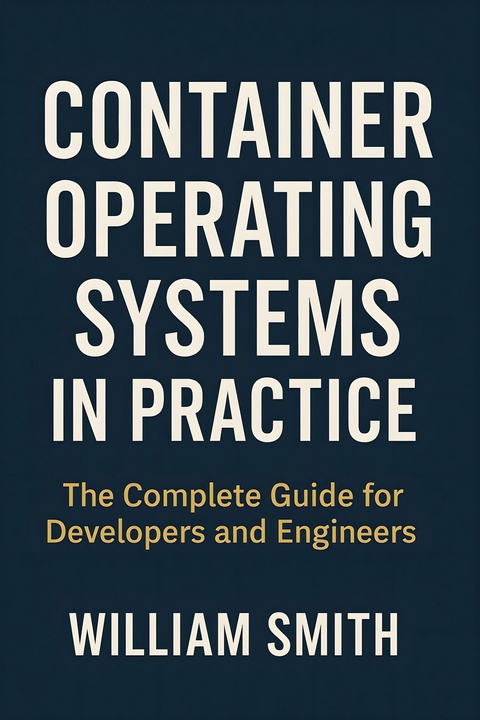
Container Operating Systems in Practice (eBook)
250 Seiten
HiTeX Press (Verlag)
978-0-00-102953-8 (ISBN)
'Container Operating Systems in Practice'
'Container Operating Systems in Practice' offers a comprehensive and in-depth exploration of the rapidly evolving landscape of container-optimized operating systems. Tracing their origins from classical general-purpose operating systems and virtualization technologies, the book provides historical context for the rise of containers, highlighting key distinctions, cloud-native influences, and pivotal innovations that have shaped modern infrastructure. Readers will discover how principles such as immutability, minimalism, and security-by-design underpin the architecture of today's container OSs, empowering organizations to efficiently support microservices, orchestrators, and cloud deployments at scale.
With a methodical approach, the book delves into the technical foundations that set container operating systems apart, including kernel tailoring, userland reduction, advanced filesystem layering, and automated update mechanisms. System architects, DevOps engineers, and security professionals will gain practical insights into attack surface minimization, secure networking, storage management, and compliance enforcement within immutable, ephemeral environments. Detailed discussions on orchestration integration, observability, lifecycle management, and debugging equip practitioners with best practices for reliable production operations, ensuring optimal performance across diverse deployment scenarios.
Featuring real-world case studies from industry leaders such as Google, AWS, Red Hat, and VMware, as well as explorations into innovative projects and emerging trends, 'Container Operating Systems in Practice' offers both strategic vision and actionable guidance. The book concludes with forward-looking perspectives on microVMs, unikernels, confidential computing, and the future challenges of edge and distributed deployments. This essential resource will elevate the expertise of anyone engaged in modern infrastructure, helping harness the full potential of container-native operating systems.
Chapter 1
The Evolution of Container Operating Systems
Beneath the efficiency of cloud-native applications lies a remarkable evolution in the underlying operating systems that enable lightweight, isolated, and secure deployments. This chapter embarks on an in-depth exploration of how container operating systems emerged from classical computing paradigms, spotlighting the innovations and shifts that have led to today’s highly specialized infrastructures. By tracing pivotal milestones-technological, architectural, and philosophical-we reveal how container OSs have become indispensable to modern distributed computing.
1.1 Historical Context and Predecessors
The emergence of container operating systems represents a culmination of decades of evolution in system isolation and resource management technologies. To fully appreciate their significance, it is essential to analyze the lineage that begins with traditional monolithic and UNIX-like operating systems and advances through the epochs of virtualization and early application isolation mechanisms.
Monolithic UNIX-like operating systems, such as System V and BSD variants, were foundational in providing multi-user capabilities, process isolation, and hierarchical file systems. Their architecture centralized the kernel as a monolithic entity responsible for process scheduling, memory management, device control, and inter-process communication. While robust for general-purpose computing, these systems lacked native features for fine-grained application isolation beyond user and group privileges. Consequently, processes running on the same host shared global namespaces and system resources extensively, making true separation of applications challenging.
The concept of application isolation in UNIX was initially addressed through the chroot system call, introduced in the late 1970s. chroot allowed a process to change its root directory, effectively restricting its view of the file system to a subtree. Despite its utility, chroot jails presented glaring limitations: they offered only superficial isolation confined to the filesystem namespace, did not isolate process IDs, network sockets, or other kernel resources, and were susceptible to escape through privileged operations or misconfiguration.
Advancements in hardware virtualization during the late 1990s and early 2000s introduced hypervisors such as VMware ESX and Xen, which enabled multiple isolated operating system instances to coexist on a single physical machine. These virtual machines (VMs) achieved strong isolation by virtualizing hardware resources, ensuring that each guest OS operated independently. However, this isolation came at substantial overhead in terms of resource consumption, boot time, and management complexity, making VMs unsuitable for highly dynamic or resource-constrained environments.
Parallel to virtualization, research and development in the UNIX family led to more granular isolation mechanisms. Two notable innovations were FreeBSD Jails and Solaris Zones, both exemplifying OS-level virtualization with resource and namespace isolation.
FreeBSD Jails, introduced in 2000, extended the idea of chroot by creating a secure partition within the FreeBSD kernel. Each jail provided an isolated environment with separate namespaces for process IDs, users, file systems, and networking. Jails allowed running multiple virtual instances while sharing the same FreeBSD kernel, which minimized overhead compared to full VMs. However, jails retained the limitation that all jailed applications shared the kernel, making kernel-level exploits potentially system-wide threats. Moreover, FreeBSD’s smaller market penetration limited the widespread adoption of jails.
Solaris Zones, debuting around the same period, presented a similar approach on the Solaris OS. Zones partitioned a single Solaris instance into multiple isolated environments, each with its own filesystem namespace, process space, and network stack. They supported the concepts of “sparse” and “whole-root” zones, offering flexibility in resource sharing and isolation. While more feature-rich than jails, Zones inherited Solaris’s complexity and licensing constraints, limiting their penetration outside specific enterprise environments.
The technological and cultural shortcomings of these earlier paradigms significantly influenced the design of container operating systems. From a technological standpoint, the absence of robust kernel support for lightweight resource control, dynamic namespace management, and broad hardware compatibility restricted the scalability and security of jails and zones. Additionally, the tight coupling of applications with specific OS versions impeded portability and reproducibility.
Culturally, the prevailing emphasis on heavyweight virtualization in enterprise IT shaped expectations around isolation, security, and manageability. Containers’ emergence challenged this orthodoxy by offering a model that traded some isolation strength for agility, efficiency, and density. This paradigm shift was propelled by the evolution of Linux kernel features such as control groups (cgroups) and namespaces, which provided the essential primitives to implement fine-grained resource allocation and environmental partitioning without full hardware virtualization.
Hyperscale applications-characterized by extensive horizontal scaling, rapid deployment cycles, and microservices architectures-exposed the deficiencies of traditional VMs and OS-level partitions. Their operational demands necessitated fast startup times, minimal resource overhead, and consistent runtime environments across heterogeneous infrastructures. Containers addressed these needs effectively by packaging applications with their dependencies in isolated user-space instances, enabling reproducible builds and simplified portability.
Lessons from jails and zones informed container technology in several respects:
- The importance of comprehensive namespace isolation.
- The need for secure and minimal kernels.
- The centrality of orchestration in managing many lightweight instances.
Furthermore, the community-driven Linux ecosystem leveraged open-source innovations to accelerate the maturation and adoption of container operating systems.
In essence, the lineage from monolithic UNIX systems through chroot jails, FreeBSD Jails, Solaris Zones, and virtualization represents an iterative refinement of isolation techniques. The convergence of these historical efforts, combined with modern kernel advancements, laid the foundation upon which container operating systems were constructed-providing scalable, efficient, and secure solutions to contemporary distributed computing challenges.
1.2 Key Distinctions: Container OS Versus General-Purpose OS
Container-optimized operating systems and general-purpose server operating systems are both foundational to modern computing environments, yet they diverge significantly in architectural design and operational philosophy. This divergence originates from their distinct target use cases which impose unique requirements on system components, service models, and security postures. Understanding these differences is crucial for architects and operators when selecting and managing infrastructure that balances agility, performance, and security.
At the kernel level, container OSs maintain a minimal footprint by including only the core components and kernel modules necessary to support container runtimes and orchestration. Unlike general-purpose OSs, which are designed to support a wide variety of workloads and hardware configurations, container OS kernels often forego extensive device driver support, legacy compatibility layers, and modular kernel features not directly relevant to container execution. The reduction in kernel footprint decreases the overall attack surface and reduces maintenance overhead, but it can limit hardware compatibility and the flexibility to run diverse, non-containerized workloads. For example, a container OS may exclude support for certain filesystem types or advanced networking features if these are not required for container orchestration.
The userland environment in container OSs is intentionally streamlined to enable fast boot times, rapid scaling, and simplified update mechanisms. These environments typically dispense with traditional package management systems and instead rely on immutable, atomic updates or transactional images that replace the entire userland in one operation. This contrasts with general-purpose OSs, which provide extensive package repositories, dynamic dependency resolution, and configuration management capabilities designed for diverse application requirements. The trade-off involves sacrificing granular control over installed software and runtime environments in favor of consistency, predictability, and ease of automated deployment. For practitioners, this means adopting a workflow centered on rebuilding and redeploying container OS images rather than patching or customizing live systems.
Security postures also exhibit fundamental differences. Container OSs adopt a zero-trust and minimalism mindset by default. The restricted kernel surface, accompanied by a minimal...
| Erscheint lt. Verlag | 19.8.2025 |
|---|---|
| Sprache | englisch |
| Themenwelt | Mathematik / Informatik ► Informatik ► Programmiersprachen / -werkzeuge |
| ISBN-10 | 0-00-102953-3 / 0001029533 |
| ISBN-13 | 978-0-00-102953-8 / 9780001029538 |
| Informationen gemäß Produktsicherheitsverordnung (GPSR) | |
| Haben Sie eine Frage zum Produkt? |
 EPUB (Adobe DRM)
Größe: 740 KB
Kopierschutz: Adobe-DRM
Adobe-DRM ist ein Kopierschutz, der das eBook vor Mißbrauch schützen soll. Dabei wird das eBook bereits beim Download auf Ihre persönliche Adobe-ID autorisiert. Lesen können Sie das eBook dann nur auf den Geräten, welche ebenfalls auf Ihre Adobe-ID registriert sind.
Details zum Adobe-DRM
Dateiformat: EPUB (Electronic Publication)
EPUB ist ein offener Standard für eBooks und eignet sich besonders zur Darstellung von Belletristik und Sachbüchern. Der Fließtext wird dynamisch an die Display- und Schriftgröße angepasst. Auch für mobile Lesegeräte ist EPUB daher gut geeignet.
Systemvoraussetzungen:
PC/Mac: Mit einem PC oder Mac können Sie dieses eBook lesen. Sie benötigen eine
eReader: Dieses eBook kann mit (fast) allen eBook-Readern gelesen werden. Mit dem amazon-Kindle ist es aber nicht kompatibel.
Smartphone/Tablet: Egal ob Apple oder Android, dieses eBook können Sie lesen. Sie benötigen eine
Geräteliste und zusätzliche Hinweise
Buying eBooks from abroad
For tax law reasons we can sell eBooks just within Germany and Switzerland. Regrettably we cannot fulfill eBook-orders from other countries.
aus dem Bereich


