


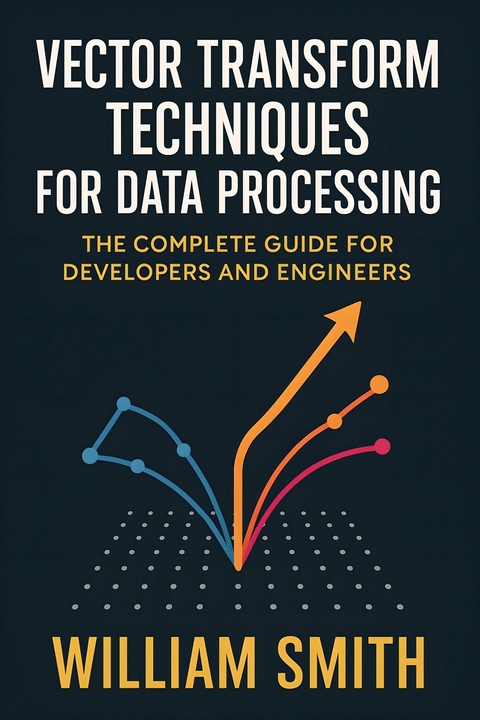
Vector Transform Techniques for Data Processing (eBook)
250 Seiten
HiTeX Press (Verlag)
978-0-00-102951-4 (ISBN)
'Vector Transform Techniques for Data Processing'
'Vector Transform Techniques for Data Processing' is an authoritative and comprehensive exploration of the mathematical foundations and modern applications of vector transform methods in the realm of data analysis. The book opens by systematically building the essential linear algebra concepts, delving into vector spaces, matrices, orthonormality, and the vital properties underpinning effective transformation, stability, and representation. Readers gain a rigorous understanding of how mathematical structures like eigenvalue decompositions, change of basis, and unitary matrices form the backbone of data transformation across diverse coordinate systems.
The text progresses to detailed expositions on classical and advanced transform techniques, including Fourier, cosine, sine, Laplace, wavelet transforms, and multiresolution analysis. By bridging theoretical insights with practical algorithmic implementations, the book demonstrates how these tools empower dimensionality reduction, efficient signal processing, and robust feature extraction. Special attention is given to state-of-the-art topics such as compressed sensing, sparse representations, and statistical signal processing, equipping practitioners with strategies for tackling high-dimensional, noisy, or incomplete data in real-world scenarios.
Further distinguishing itself, the book guides readers through the scalable computational strategies required for contemporary data environments-covering fast algorithms, parallelization, memory optimization, and architectures for real-time analytics. The final chapters extend vector transform methods into the forefront of machine learning and emerging domains, highlighting hybrid deep learning approaches, privacy-preserving techniques, and transformative applications in fields like IoT, bioinformatics, and quantum computing. Poised at the intersection of theory and application, this volume is an indispensable resource for engineers, researchers, and data scientists seeking to harness the full potential of vector transforms in modern data processing.
Chapter 2
Classical Vector Transform Techniques
From the frequency domain revelations of the Fourier transform to the compact data representations enabled by cosine and sine transforms, classical vector transform techniques have long served as the linchpins of modern data and signal processing. This chapter delves into these foundational methods with a rigorous lens, unpacking not just their algorithms, but also the profound insights they provide into the structure, fidelity, and limitations of transformed data.
2.1 Fourier Transform: Theory and Algorithmic Implementation
The Fourier transform constitutes a cornerstone in signal processing and analysis by enabling the decomposition of functions or signals into their constituent frequencies. Central to this theory are the continuous Fourier transform (CFT) and its discrete counterpart, the discrete Fourier transform (DFT), each serving specific roles depending on the signal domain and sampling context.
The continuous Fourier transform of a function x(t) ∈ L1(ℝ) is defined as
where j = and f denotes frequency in Hertz. This integral transform maps the time-domain signal x(t) to its frequency-domain representation X(f), capturing the amplitude and phase distribution of spectral components. The inverse transform reconstructs x(t) from X(f) via
The CFT assumes signals defined on a continuous time axis and infinite duration, often idealized in theory but foundational for understanding frequency content and linear time-invariant system responses.
For digital signal processing, signals are sampled and represented as finite-length sequences. The discrete Fourier transform is applicable here and is defined for a sequence x[n], n = 0,1,…,N − 1, as
where N is the sequence length. The corresponding inverse operation is
The DFT maps N time-domain samples into N frequency bins, discretely sampling the frequency spectrum and inherently assuming periodicity of the sequence with period N. This periodicity leads to considerations around spectral leakage and the choice of windowing functions to manage discontinuities at the boundaries.
Efficient computation of the DFT is critical for real-time and large-scale spectral analysis. The naive computation requires O(N2) operations due to the double summation. This complexity was dramatically reduced by the development of the Fast Fourier Transform (FFT) algorithm, which exploits symmetries and periodicities in the DFT matrix to reduce computational cost to O(N log N).
The Cooley-Tukey algorithm, the most common FFT approach, recursively decomposes an N-point DFT into smaller DFTs by factorizing N, typically into powers of two. This is expressed by splitting the input sequence into even and odd terms:
Recognizing that e−jk2n = e−jkn, the problem reduces to two N∕2-point DFTs plus N twiddle factor multiplications
This recursive divide-and-conquer structure continues until reaching trivial DFT sizes (usually 2-point transforms).
Pseudocode for a radix-2 decimation-in-time FFT is as follows:
N = len(x)
if N <= 1:
return x
even = fft(x[0::2])
odd = fft(x[1::2])
T = [exp(-2j * pi * k / N) * odd[k] for k in range(N//2)]
return [even[k] + T[k] for k in range(N//2)] + /
[even[k] - T[k] for k in range(N//2)]
The FFT’s improved efficiency enables practical exploitation of spectral analysis in myriad applications: audio and image processing, telecommunications, and control systems. Given an adequately sampled signal, the FFT reveals dominant frequency...
| Erscheint lt. Verlag | 19.8.2025 |
|---|---|
| Sprache | englisch |
| Themenwelt | Mathematik / Informatik ► Informatik ► Programmiersprachen / -werkzeuge |
| ISBN-10 | 0-00-102951-7 / 0001029517 |
| ISBN-13 | 978-0-00-102951-4 / 9780001029514 |
| Informationen gemäß Produktsicherheitsverordnung (GPSR) | |
| Haben Sie eine Frage zum Produkt? |
 EPUB (Adobe DRM)
Größe: 1,8 MB
Kopierschutz: Adobe-DRM
Adobe-DRM ist ein Kopierschutz, der das eBook vor Mißbrauch schützen soll. Dabei wird das eBook bereits beim Download auf Ihre persönliche Adobe-ID autorisiert. Lesen können Sie das eBook dann nur auf den Geräten, welche ebenfalls auf Ihre Adobe-ID registriert sind.
Details zum Adobe-DRM
Dateiformat: EPUB (Electronic Publication)
EPUB ist ein offener Standard für eBooks und eignet sich besonders zur Darstellung von Belletristik und Sachbüchern. Der Fließtext wird dynamisch an die Display- und Schriftgröße angepasst. Auch für mobile Lesegeräte ist EPUB daher gut geeignet.
Systemvoraussetzungen:
PC/Mac: Mit einem PC oder Mac können Sie dieses eBook lesen. Sie benötigen eine
eReader: Dieses eBook kann mit (fast) allen eBook-Readern gelesen werden. Mit dem amazon-Kindle ist es aber nicht kompatibel.
Smartphone/Tablet: Egal ob Apple oder Android, dieses eBook können Sie lesen. Sie benötigen eine
Geräteliste und zusätzliche Hinweise
Buying eBooks from abroad
For tax law reasons we can sell eBooks just within Germany and Switzerland. Regrettably we cannot fulfill eBook-orders from other countries.
aus dem Bereich


