


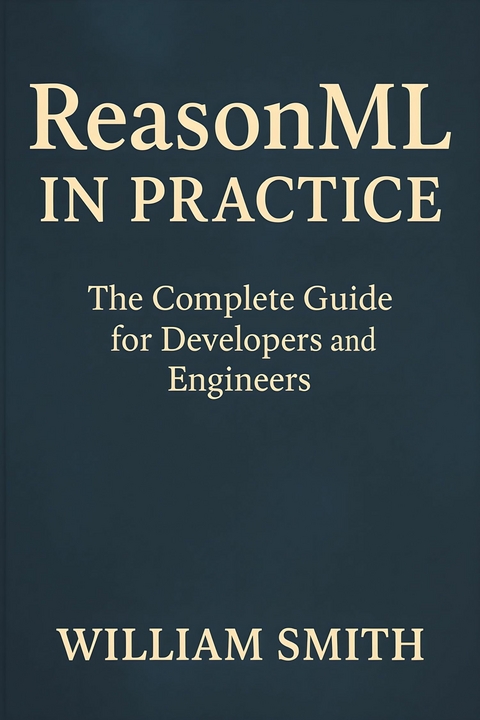
ReasonML in Practice (eBook)
250 Seiten
HiTeX Press (Verlag)
978-0-00-102942-2 (ISBN)
'ReasonML in Practice'
'ReasonML in Practice' is a definitive guide for developers who seek to master the language at every level-from its profound OCaml lineage to advanced patterns, tooling, and deployment strategies. The book opens with a meticulous exploration of ReasonML's core concepts, including its static type system, expressive syntax, and powerful module architecture. Readers receive not only a rigorous introduction to language fundamentals such as pattern matching, parametric polymorphism, and advanced typing techniques, but also an appreciation for ReasonML's unique blend of performance and expressiveness.
Moving beyond the basics, this volume systematically addresses ReasonML's interoperability with the OCaml and JavaScript ecosystems, equipping practitioners to leverage extensive libraries, robust build systems, and smooth integration paths with TypeScript and Node.js. It covers best practices for frontend development with ReasonReact, concurrency and asynchronous programming, as well as the safe management of side effects and error propagation. Real-world chapters on deployment, cloud-native targets, and cross-platform builds ensure that developers are prepared for every practical challenge-from web and server deployments to optimizing and scaling large-scale applications.
Underlying the technical depth is a strong emphasis on maintainability and quality: chapters on advanced testing, debugging, observability, and continuous integration cement ReasonML's reputation for reliability. Through practical tutorials, case studies, and forward-looking discussions, 'ReasonML in Practice' empowers both newcomers and seasoned engineers to architect, evolve, and future-proof sophisticated ReasonML applications for modern development demands.
Chapter 1
Core Concepts and Language Semantics
Unpack the foundational abstractions and semantics that make ReasonML a powerful, pragmatic language for expert developers. This chapter unearths the underlying OCaml-inspired design, traverses ReasonML’s advanced type system, and uncovers key features that uniquely equip you to craft expressive, robust, and scalable applications. Prepare to dive deep into the architecture and reasoning that shape ReasonML at its core.
1.1 ReasonML Origins and OCaml Lineage
ReasonML emerged from the intersection of academic rigor and practical software engineering needs, positioned as a modern evolution of OCaml-a language with deep roots in the functional programming paradigm. OCaml itself descends from the ML family, developed in the early 1970s at the University of Edinburgh, with a particular emphasis on providing a robust framework for theorem proving, language prototyping, and formal verification. OCaml extended the original ML dialect by integrating an efficient native code compiler, a powerful module system, and imperative features, uniting expressiveness with performance in a statically typed setting.
The foundational motivations behind OCaml were shaped by the pursuit of safety and correctness in systems programming. Designed by Xavier Leroy and collaborators at INRIA in the 1990s, OCaml aimed to reconcile the benefits of functional programming-such as higher-order functions and algebraic data types-with the practical demands of real-world software engineering, including efficient compilation and interoperability with low-level code. This duality became a hallmark of OCaml: it combines strong static typing and type inference with imperative constructs and abstract data types, facilitating both rapid prototyping and industrial-strength system development.
ReasonML was created by Jordan Walke and his team at Facebook to leverage OCaml’s powerful type system and abstraction facilities while lowering the barrier to entry for developers accustomed to mainstream languages, primarily JavaScript. The syntactic innovations in ReasonML reflect a key cultural objective: to create a syntax familiar to JavaScript programmers without compromising the expressive power of OCaml’s core semantics. This syntactic redesign was motivated by the desire to broaden adoption and enable smoother integration with existing JavaScript-based technology stacks, notably in frontend development.
The design decisions behind ReasonML’s syntax strike a balance between readability and precision. For instance, whereas OCaml’s native syntax is terse and mathematically inspired-featuring constructs such as pattern matching with concise operator precedences-ReasonML adopts a more JavaScript-like curvilinear brace style and naming conventions closer to camelCase identifiers. This was intended to reduce cognitive friction for developers transitioning from dynamically typed, prototype-based languages, while still preserving the underlying OCaml type inference engine and module system.
Behind this syntactic facade lies the full power of OCaml’s static type system, including parametric polymorphism, algebraic data types, GADTs (Generalized Algebraic Data Types), first-class modules, and a sophisticated module and functor system that supports large-scale abstraction and code reuse. ReasonML inherits these features verbatim, enabling developers to write highly expressive, type-safe code that scales from small utilities to complex applications. Its type safety allows early detection of many classes of errors, ultimately leading to more reliable and maintainable software.
A pivotal aspect of OCaml’s influence is its ecosystem’s tooling and compilation targets. OCaml compilers, such as the original native-code compiler and the bytecode compiler, provide various trade-offs between performance and portability. ReasonML leverages BuckleScript (now ReScript) as its primary compilation backend, translating ReasonML code into highly optimized JavaScript, thus bridging the gap between OCaml’s language strengths and the ubiquitous web development environment. This compilation strategy preserves the static guarantees of the language while allowing seamless interoperation with JavaScript libraries and runtime systems.
OCaml’s functional programming paradigm and algebraic data types have profoundly influenced ReasonML’s approach to state management and side effects. ReasonML encourages idiomatic functional programming techniques, such as immutable data structures and pure functions, but also facilitates controlled mutation and side effects where performance considerations dictate. This interoperability between paradigms provides developers with a pragmatic toolkit, enabling them to write expressive, maintainable code optimized for modern application development.
The cultural roots of ReasonML stem from the intersection of OCaml’s academic community and modern software industry demands. OCaml has historically been embraced by researchers and engineers invested in formal methods, static analysis, and compiler construction, while ReasonML targets a broader developer audience, particularly those building rich client-side interfaces in React, Facebook’s declarative UI framework. The synergy between ReasonML and React is not coincidental; the language’s design complements React’s component model, facilitating strongly typed UI components and enabling improved developer experience through enhanced editor support and refactoring capabilities.
In sum, ReasonML’s lineage is firmly grounded in OCaml’s solid theoretical foundation while simultaneously adapting to contemporary application development workflows. Its syntax and tooling choices reflect a conscious effort to democratize access to OCaml’s advanced features, making them available to a larger community of programmers. By inheriting OCaml’s powerful type system, rich abstraction mechanisms, and efficient compilation strategies, ReasonML positions itself as a modern language that bridges academic sophistication with practical utility across system and application domains. Understanding this historical and conceptual context is vital to appreciating the unique design and capabilities that ReasonML offers to developers today.
1.2 Type System Deep Dive
ReasonML’s type system is a cornerstone of its ability to deliver robust, maintainable, and expressive code. It is statically typed, ensuring that type correctness is verified at compile time, thus preventing an entire class of runtime errors typical in dynamically typed languages. Central to this system are algebraic data types, parametric polymorphism, and intricate notions of type variance, all of which collectively empower developers with both safety and flexibility.
Algebraic data types (ADTs) in ReasonML, modeled through variant types and records, enable expressive modeling of domain concepts. Variant types, also known as tagged unions, allow the definition of a type by enumerating its possible cases, each optionally carrying additional data:
| Circle(float) /* radius */
| Rectangle(float, float) /* width, height */
| Triangle(float, float, float); /* sides */
This structure encapsulates variants in a type-safe manner, enabling exhaustive pattern matching. The compiler enforces that all cases are handled, eliminating the possibility of unhandled variant cases at runtime. Record types similarly model product types—named collections of fields—providing clarity and reducing errors...
| Erscheint lt. Verlag | 19.8.2025 |
|---|---|
| Sprache | englisch |
| Themenwelt | Mathematik / Informatik ► Informatik ► Programmiersprachen / -werkzeuge |
| ISBN-10 | 0-00-102942-8 / 0001029428 |
| ISBN-13 | 978-0-00-102942-2 / 9780001029422 |
| Informationen gemäß Produktsicherheitsverordnung (GPSR) | |
| Haben Sie eine Frage zum Produkt? |
 EPUB (Adobe DRM)
Größe: 783 KB
Kopierschutz: Adobe-DRM
Adobe-DRM ist ein Kopierschutz, der das eBook vor Mißbrauch schützen soll. Dabei wird das eBook bereits beim Download auf Ihre persönliche Adobe-ID autorisiert. Lesen können Sie das eBook dann nur auf den Geräten, welche ebenfalls auf Ihre Adobe-ID registriert sind.
Details zum Adobe-DRM
Dateiformat: EPUB (Electronic Publication)
EPUB ist ein offener Standard für eBooks und eignet sich besonders zur Darstellung von Belletristik und Sachbüchern. Der Fließtext wird dynamisch an die Display- und Schriftgröße angepasst. Auch für mobile Lesegeräte ist EPUB daher gut geeignet.
Systemvoraussetzungen:
PC/Mac: Mit einem PC oder Mac können Sie dieses eBook lesen. Sie benötigen eine
eReader: Dieses eBook kann mit (fast) allen eBook-Readern gelesen werden. Mit dem amazon-Kindle ist es aber nicht kompatibel.
Smartphone/Tablet: Egal ob Apple oder Android, dieses eBook können Sie lesen. Sie benötigen eine
Geräteliste und zusätzliche Hinweise
Buying eBooks from abroad
For tax law reasons we can sell eBooks just within Germany and Switzerland. Regrettably we cannot fulfill eBook-orders from other countries.
aus dem Bereich


