


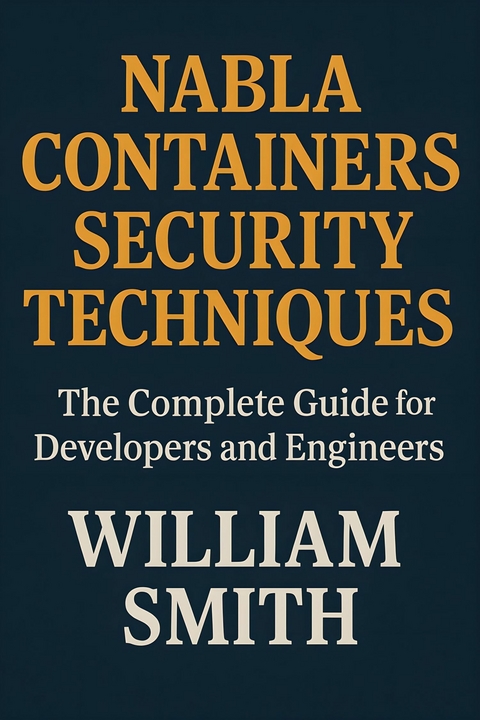
Nabla Containers Security Techniques (eBook)
250 Seiten
HiTeX Press (Verlag)
978-0-00-102939-2 (ISBN)
'Nabla Containers Security Techniques'
'Nabla Containers Security Techniques' is a comprehensive exploration of modern container security, centered on the distinctive architecture and isolation guarantees of Nabla containers. Starting with a foundation in the evolution of container security, the book examines the minimal attack surface philosophy that underpins Nabla's design-drawing influence from unikernel and microVM technologies. Readers gain an in-depth understanding of the technical innovations, deployment environments, and security models that differentiate Nabla from traditional containers and sandboxes, such as Docker, gVisor, and Firecracker-based systems.
The book delves deeply into the threat landscape faced by containerized workloads, offering a rigorous risk assessment for Nabla deployments. Detailed chapters cover Nabla-specific attack vectors, strategies for syscall surface reduction, robust file and network isolation, and advanced mitigation against VM escape attempts. Through case studies and scenario analysis, it addresses both common and high-stakes deployments-such as multi-tenant clouds-equipping practitioners with practical tactics for runtime hardening, anomaly detection, and policy enforcement.
Beyond isolation and runtime defenses, 'Nabla Containers Security Techniques' equips security architects and operators with guidance for secure image supply chains, orchestrator integration, access controls, and secrets management at scale. Specialized sections address compliance, auditing, forensic readiness, and incident response within microVM environments. The book concludes with a forward-looking examination of adaptive defense, community collaboration, and emerging trends in confidential computing-positioning Nabla as a vanguard solution for next-generation cloud-native security.
Chapter 2
Threat Landscape and Risk Assessment
To design effective defenses, it is crucial to comprehend the full spectrum of threats that target containerized environments. This chapter offers a penetrating analysis of risks specific to Nabla containers, intersecting theory and practice to reveal not only what attackers seek, but how Nabla’s unique architecture influences the shape of potential exploits. Readers are challenged to look beyond surface vulnerabilities and develop an adversarial mindset essential for high-assurance cloud-native security.
2.1 Container Security Threat Taxonomy
Containerized environments, while offering operational agility and resource efficiency, introduce a complex attack surface encompassing both general system and cloud-specific threat vectors. A methodical taxonomy is essential to understand and mitigate risks by correlating exploit classes with observed adversary tactics, techniques, and procedures (TTPs). This taxonomy categorizes container threats into four primary domains: privilege escalation, kernel exploits, inter-container interference, and supply chain attacks. Each domain reflects unique vulnerabilities with consequential impacts on container integrity and the broader cloud infrastructure.
Privilege Escalation
Privilege escalation remains a foundational threat class in container security, exploiting weaknesses within container runtime, host OS, or container orchestration layers. Containers typically execute with constrained capabilities; however, misconfigurations-such as excessive privileges granted by –privileged flags or improper Linux capabilities (e.g., CAP_SYS_ADMIN)-serve as enablers for adversaries to break through container isolation. Attackers leverage these permissions to gain unauthorized root access within the container, subsequently escalating to host-level privileges by exploiting vulnerabilities or misconfigurations in container runtimes (e.g., Docker or containerd) or through the host’s mismanaged access controls.
Real-world TTPs documented in frameworks like MITRE ATT&CK describe adversaries using local privilege escalation exploits combined with misconfigured cgroups and namespaces. For example, an attacker may exploit container runtime APIs to execute arbitrary commands on the host or escalate privileges by mounting sensitive host filesystem paths within the container namespace.
Kernel Exploits
The shared kernel model underpinning containers presents a unique vector wherein kernel vulnerabilities serve as pivot points for container breakouts. Unlike traditional virtual machines, containers rely on an underlying Linux kernel that enforces namespace and cgroup isolation. Kernel vulnerabilities-such as memory corruption bugs, race conditions, or logic errors-enable attackers with container-level access to execute arbitrary code at the kernel privilege level, effectively escaping the container boundary.
Kernel-based exploit vectors include, but are not limited to, use-after-free conditions, out-of-bounds writes, and privilege escalation through vulnerable system calls. Attackers actively exploit such weaknesses to deploy rootkits, establish persistent kernel modules, or tamper with kernel data structures that govern namespace isolation. Historical incidents, such as exploitation of the Dirty COW vulnerability (CVE-2016-5195), typify these risk patterns, wherein escalated access facilitated full host compromise from within a container.
Inter-Container Interference
Inter-container interference attacks exploit the multi-tenant nature of container deployments, where distinct applications or microservices coexist on shared hosts or clusters. Despite namespace isolation, containers may inadvertently share resources such as IPC namespaces, network interfaces, or storage volumes, creating subtle channels for attack.
Information disclosure through shared kernel resources or incorrectly managed namespaces can lead to side-channel and covert channel attacks. Adversaries may leverage network namespace overlaps or ARP spoofing to intercept or manipulate traffic between containers. Similarly, shared persistent volumes configured without stringent access controls open opportunities for unauthorized data access or injection of malicious payloads.
A noteworthy category within this domain is container escape via flawed container runtime implementations or orchestration misconfigurations, allowing compromised containers to interact with or influence other containers’ environments. Examples include improper enforcement of network policies in Kubernetes or insufficient pod security constraints, enabling lateral movement across container boundaries.
Supply Chain Attacks
Supply chain attacks affect container platforms by subverting the trust boundary inherent in container image creation, distribution, and deployment processes. Malicious actors inject vulnerabilities or backdoors at various points-including base image fabrication, continuous integration/continuous deployment (CI/CD) pipelines, container registries, or third-party software components.
Compromise of base images is particularly pernicious as they propagate to multiple containers via layering, amplifying the impact of a single infected artifact. Attackers often exploit outdated or unpatched dependencies incorporated in these images to introduce crypto miners, command and control agents, or other malware.
Cloud-specific supply chain attack scenarios involve poisoning of container registries or exploiting weak authentication controls, enabling adversaries to replace legitimate images with trojanized versions. Furthermore, manipulation of signing and verification mechanisms in image registries undermines image provenance and trust assurance, allowing execution of unauthorized code within sensitive environments.
Integration of Threat Domains
While the taxonomy delineates individual threat categories, adversaries frequently combine multiple exploit vectors in campaigns targeting containerized systems. For instance, a supply chain compromise may deliver a malicious container image that exploits kernel vulnerabilities to achieve host-level persistence. Alternatively, privilege escalation within a container may be leveraged to perform inter-container lateral movement, expanding the attack surface.
Consolidated understanding of these exploit classes guides the formulation of layered security controls encompassing runtime protection, vulnerability scanning, policy enforcement, and cryptographic verification. Comprehensive threat modeling informed by active reconnaissance of adversarial TTPs underpins robust defenses and resilient container deployments.
Summary Table of Container Security Threat Categories
| Threat Category | Description and Key Techniques |
| Privilege Escalation | Abuse of privileged container configurations and runtime API flaws to gain root access inside containers and pivot to host access; exploits include misconfigured capabilities and container escape vulnerabilities. |
| Kernel Exploits | Exploitation of kernel-level bugs enabling container breakout and host kernel compromise; common techniques include use-after-free and race condition vulnerabilities in system calls. |
| Inter-Container Interference | Attacks leveraging shared namespaces, network overlaps, and persistent volumes to exfiltrate data or conduct lateral movement across containers; includes namespace misconfigurations and network policy bypass. |
| Supply Chain Attacks | Injection of malicious code through compromised base images, CI/CD pipelines, or container registries; includes image tampering, outdated dependencies,... |
| Erscheint lt. Verlag | 19.8.2025 |
|---|---|
| Sprache | englisch |
| Themenwelt | Mathematik / Informatik ► Informatik ► Programmiersprachen / -werkzeuge |
| ISBN-10 | 0-00-102939-8 / 0001029398 |
| ISBN-13 | 978-0-00-102939-2 / 9780001029392 |
| Informationen gemäß Produktsicherheitsverordnung (GPSR) | |
| Haben Sie eine Frage zum Produkt? |
 EPUB (Adobe DRM)
Größe: 757 KB
Kopierschutz: Adobe-DRM
Adobe-DRM ist ein Kopierschutz, der das eBook vor Mißbrauch schützen soll. Dabei wird das eBook bereits beim Download auf Ihre persönliche Adobe-ID autorisiert. Lesen können Sie das eBook dann nur auf den Geräten, welche ebenfalls auf Ihre Adobe-ID registriert sind.
Details zum Adobe-DRM
Dateiformat: EPUB (Electronic Publication)
EPUB ist ein offener Standard für eBooks und eignet sich besonders zur Darstellung von Belletristik und Sachbüchern. Der Fließtext wird dynamisch an die Display- und Schriftgröße angepasst. Auch für mobile Lesegeräte ist EPUB daher gut geeignet.
Systemvoraussetzungen:
PC/Mac: Mit einem PC oder Mac können Sie dieses eBook lesen. Sie benötigen eine
eReader: Dieses eBook kann mit (fast) allen eBook-Readern gelesen werden. Mit dem amazon-Kindle ist es aber nicht kompatibel.
Smartphone/Tablet: Egal ob Apple oder Android, dieses eBook können Sie lesen. Sie benötigen eine
Geräteliste und zusätzliche Hinweise
Buying eBooks from abroad
For tax law reasons we can sell eBooks just within Germany and Switzerland. Regrettably we cannot fulfill eBook-orders from other countries.
aus dem Bereich


