


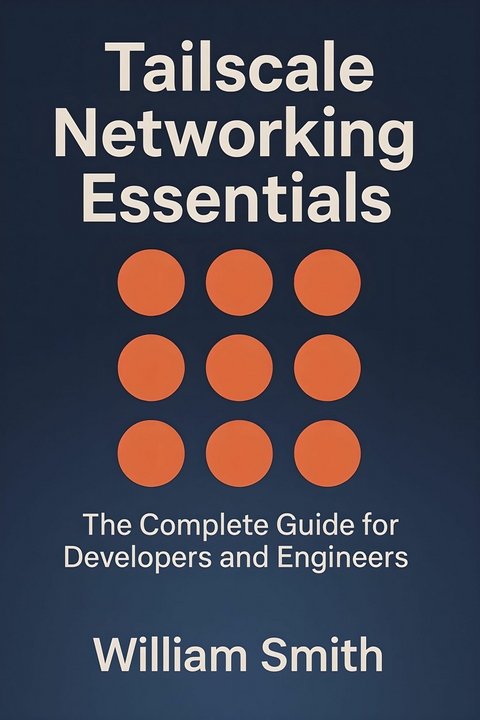
Tailscale Networking Essentials (eBook)
250 Seiten
HiTeX Press (Verlag)
978-0-00-102938-5 (ISBN)
'Tailscale Networking Essentials'
'Tailscale Networking Essentials' is a comprehensive guide to understanding, deploying, and scaling secure networks using Tailscale. This expertly structured book begins by laying a solid foundation in zero trust principles, modern network security paradigms, and the cryptographic backbone of WireGuard. Readers are guided through the essential concepts of decentralized trust, least privilege, and microsegmentation, gaining a deep appreciation for the architectural innovations and risk considerations that underpin Tailscale's overlay approach to modern connectivity.
As the narrative progresses, the book delves into the technical heart of Tailscale-its core architecture, control plane, and sophisticated policy engine-before exploring practical deployment models across diverse platforms and environments. Detailed chapters explain strategies for automating configuration, securely bootstrapping devices, and integrating with popular Infrastructure as Code (IaC) and CI/CD pipelines. Further, advanced network design considerations are unveiled, including DNS, routing, traffic engineering, and performance optimization, empowering engineers to build resilient, scalable, and efficient tailnets.
Security remains a central theme, with dedicated coverage of end-to-end cryptography, granular authentication, compliance mapping, and robust incident response. The book also opens the door to the ecosystem's expansive possibilities: integrating with public cloud, SaaS, and third-party services; customizing networks with APIs and developer tools; and adopting cutting-edge patterns for remote work, IoT, and DevOps. Topped off with forward-looking insights into the Tailscale community and emerging capabilities, 'Tailscale Networking Essentials' is an indispensable resource for practitioners and leaders navigating the future of secure, programmable networking.
Chapter 1
Zero Trust Networking Principles and the Tailscale Paradigm
In a world of persistent threats and cloud-native architectures, the boundaries of trust have shifted dramatically. This chapter explores the evolution from legacy perimeter-based security to zero trust, presents the cryptographic and architectural foundations behind Tailscale, and challenges traditional notions of network protection. Discover how identity, policy, and distributed trust converge to redefine what it means to be secure in modern software-defined networks.
1.1 Revisiting Network Security Models
The evolution of network security architectures reveals a fundamental shift in defensive paradigms, motivated by changing technologies, threat landscapes, and operational environments. Traditional security models, rooted in perimeter defense, were designed to safeguard a clearly delineated boundary separating trusted internal assets from untrusted external entities. This approach, while effective in earlier enterprise environments dominated by on-premises infrastructure and relatively static user populations, faces critical limitations as organizations move towards cloud services, mobile workforces, and ubiquitous connectivity.
Historically, perimeter-based security architectures prominently featured firewalls, intrusion detection and prevention systems (IDPS), demilitarized zones (DMZs), and virtual private networks (VPNs) as core components. The implicit assumption was that entities inside the perimeter could be trusted, whereas those outside required stringent verification and filtering. This “castle-and-moat” defense posture emphasized creating a hardened boundary-referred to as the security perimeter-beyond which all traffic was considered hostile unless explicitly allowed. This model relied heavily on static trust zones, fixed network segments, and trusted endpoints, which aligned well with enterprise data centers and internal networks.
However, modernization in IT infrastructure and increased attack sophistication began to expose weaknesses in the perimeter-based approach. The rise of cloud computing decentralizes application assets from enterprise-controlled data centers into third-party platforms, eroding the traditional notion of a network perimeter. Furthermore, the proliferation of bring-your-own-device (BYOD) policies and remote workforces introduces numerous devices and users operating beyond the traditional perimeter, making static protections inadequate. Advanced persistent threats (APTs), insider attacks, and lateral movement within compromised networks illustrate how an adversary, once inside, could exploit implicit trust granted to internal actors.
These challenges have catalyzed the emergence of zero trust security models, which fundamentally redefine the concept of trust in network environments. Zero trust mandates that no entity-whether internal or external-is inherently trusted. Instead, every access request must be continuously authenticated, authorized, and encrypted based on context and risk. This dynamic, fine-grained approach dismantles static trust zones and static perimeter assumptions, supplanting them with real-time, identity-centric, and policy-driven access controls.
At the heart of zero trust architectures is the principle of “never trust, always verify.” This necessitates comprehensive visibility into users, devices, applications, and data flows, alongside continuous assessment of trustworthiness through risk analytics and behavior monitoring. Access control policies are dynamically adaptive, considering factors such as user identity, device health posture, geolocation, time of access, and sensitivity of the requested resource. Moreover, segmentation-both network and micro-segmentation-plays a critical role by minimizing lateral movement opportunities within the network, thus limiting the blast radius of potential breaches.
Several real-world case studies provide compelling empirical evidence for adopting this architectural shift. For example, the migration of a multinational financial institution from a classical perimeter defense to a zero trust framework significantly improved its security posture against insider threats and data exfiltration. This transformation involved incorporating software-defined perimeters (SDP), identity and access management (IAM) enhancements, and endpoint detection and response (EDR) tools. Continuous verification mechanisms were implemented to enforce least-privilege access policies tailored to dynamic user contexts. Post-implementation audits demonstrated a marked reduction in unauthorized access incidents and lateral traversals within internal networks.
Similarly, a large healthcare provider integrated zero trust principles during its cloud adoption journey. By implementing strict identity verification and device compliance checks before granting access to electronic health records (EHR) systems, the organization mitigated risks posed by compromised credentials and rogue devices. The adoption of micro-segmentation further isolated sensitive workloads, preventing ransomware propagation witnessed in traditional perimeter networks. These proactive measures were critical for compliance with regulatory standards such as HIPAA while maintaining operational agility.
The rationale for moving away from static trust zones towards dynamic, context-aware security models can be encapsulated by the fundamental shift in enterprise computing paradigms:
- Decentralization of resources: Increasing reliance on cloud-native architectures and distributed applications dissolves fixed perimeters.
- User mobility and device diversity: Remote work and BYOD expand the attack surface beyond traditional network boundaries.
- Sophistication of threats: Modern attacks exploit implicit trust inside the network, requiring greater internal visibility and control.
- Regulatory and compliance pressures: Stringent data protection regulations demand granular and auditable access controls.
Transitioning to zero trust architectures is not without challenges. Organizations must overcome complexities in identity management, policy orchestration, legacy system integration, and cultural shifts toward continuous security validation. Nonetheless, zero trust offers a scalable and adaptive framework aligned with contemporary enterprise risk postures.
Revisiting network security models underscores a decisive paradigm shift from static, perimeter-centric defenses toward dynamic, context-aware, zero trust architectures. The abandonment of implicit trust zones in favor of continuous verification mechanisms enhances resilience against modern threat vectors, enabling security to operate effectively in distributed and hybrid ecosystems.
1.2 WireGuard: Cryptographic Underpinnings
WireGuard is a modern, minimalist VPN protocol designed around a clear cryptographic foundation that prioritizes simplicity, security, and high performance. As the underlying technology enabling Tailscale’s secure communications, WireGuard distinguishes itself by the disciplined application of state-of-the-art primitives and an innovative handshake mechanism, resulting in robust security guarantees combined with exceptional efficiency. This section provides a detailed technical analysis of WireGuard’s cryptographic core, encompassing its design philosophy, cryptographic building blocks, handshake protocol, and performance characteristics that justify its role in next-generation overlay networks.
The philosophy guiding WireGuard’s development centers on reducing complexity and attack surface through a small, auditable codebase and a fixed set of highly vetted cryptographic algorithms. WireGuard eschews legacy compatibility and complex negotiation protocols in favor of a minimal suite of algorithms that are both modern and resistant to known weaknesses. This approach significantly reduces the probability of implementation flaws, one of the primary sources of cryptographic vulnerabilities in network protocols.
At the heart of WireGuard’s cryptography lie three fundamental primitives selected for their security, efficiency, and interoperability:
- Curve25519 for Elliptic-Curve Diffie-Hellman (ECDH) key agreement, chosen for constant-time operations and resistance to side-channel attacks.
- ChaCha20 stream cipher for authenticated encryption, offering high speed on processors without dedicated AES instructions and strong cryptographic assurances.
- Poly1305 as the message authentication code (MAC) integrated with ChaCha20 to provide authenticated encryption with associated data (AEAD).
WireGuard’s use of Curve25519 enables the establishment of a shared secret between peers through ECDH, forming the basis for session keys. This primitive provides security equivalent to AES-256 but with better performance on a wide range of hardware, particularly in embedded and mobile environments. The choice directly facilitates forward secrecy and robust resistance against cryptanalytic advances.
The handshake protocol in WireGuard is carefully engineered to be stateless and minimalistic, relying on a variant of the Noise Protocol...
| Erscheint lt. Verlag | 19.8.2025 |
|---|---|
| Sprache | englisch |
| Themenwelt | Mathematik / Informatik ► Informatik ► Programmiersprachen / -werkzeuge |
| ISBN-10 | 0-00-102938-X / 000102938X |
| ISBN-13 | 978-0-00-102938-5 / 9780001029385 |
| Informationen gemäß Produktsicherheitsverordnung (GPSR) | |
| Haben Sie eine Frage zum Produkt? |
 EPUB (Adobe DRM)
Größe: 628 KB
Kopierschutz: Adobe-DRM
Adobe-DRM ist ein Kopierschutz, der das eBook vor Mißbrauch schützen soll. Dabei wird das eBook bereits beim Download auf Ihre persönliche Adobe-ID autorisiert. Lesen können Sie das eBook dann nur auf den Geräten, welche ebenfalls auf Ihre Adobe-ID registriert sind.
Details zum Adobe-DRM
Dateiformat: EPUB (Electronic Publication)
EPUB ist ein offener Standard für eBooks und eignet sich besonders zur Darstellung von Belletristik und Sachbüchern. Der Fließtext wird dynamisch an die Display- und Schriftgröße angepasst. Auch für mobile Lesegeräte ist EPUB daher gut geeignet.
Systemvoraussetzungen:
PC/Mac: Mit einem PC oder Mac können Sie dieses eBook lesen. Sie benötigen eine
eReader: Dieses eBook kann mit (fast) allen eBook-Readern gelesen werden. Mit dem amazon-Kindle ist es aber nicht kompatibel.
Smartphone/Tablet: Egal ob Apple oder Android, dieses eBook können Sie lesen. Sie benötigen eine
Geräteliste und zusätzliche Hinweise
Buying eBooks from abroad
For tax law reasons we can sell eBooks just within Germany and Switzerland. Regrettably we cannot fulfill eBook-orders from other countries.
aus dem Bereich


