


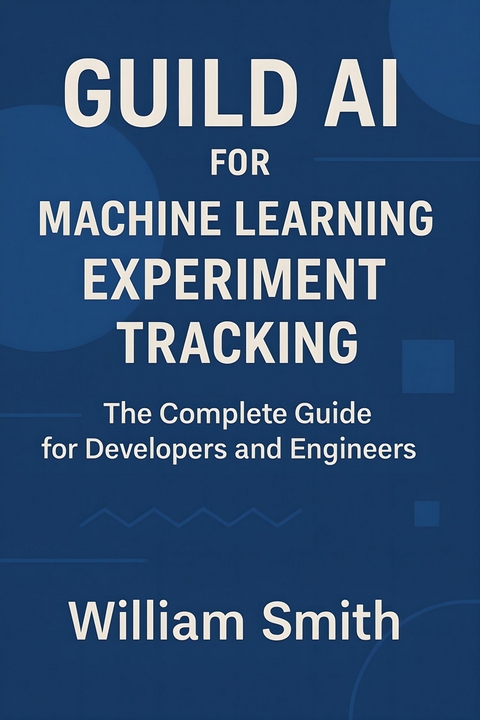
Guild AI for Machine Learning Experiment Tracking (eBook)
250 Seiten
HiTeX Press (Verlag)
978-0-00-102935-4 (ISBN)
'Guild AI for Machine Learning Experiment Tracking'
'Guild AI for Machine Learning Experiment Tracking' is a comprehensive guide for practitioners, researchers, and data science teams seeking to master modern experiment management in machine learning (ML). The book begins by addressing the foundational challenges of reproducibility, accountability, and governance, establishing best practices for experiment versioning, data lineage, and interoperability. Through in-depth exploration of the experiment lifecycle-from initial design to deployment and monitoring-the reader gains critical insight into the evolving landscape of ML experimentation and the principles that underpin seamless, robust tracking.
Central to the book is a detailed exposition of Guild AI, a state-of-the-art platform purpose-built for experiment tracking, orchestration, and automation. Chapters dig into Guild's modular architecture, semantic constructs like runs and flags, extensible plugin framework, and secure, scalable data management. Readers learn step-by-step deployment within diverse computing environments, strategies for artifact management, CI/CD integration, and advanced configurations for both local and distributed workflows. Practical guidance is provided for capturing, structuring, and visualizing metadata, enabling precise analysis, reporting, and comparative insights across large-scale ML initiatives.
Supplemented by real-world case studies and forward-looking perspectives, this volume delivers a holistic view of team-based collaboration, hyperparameter optimization, and enterprise-grade security, privacy, and compliance. Coverage extends from integrating Guild AI with industry-leading tools and standards, to the development of custom plugins and federation of experiment metadata across edge and decentralized ML infrastructures. By combining core concepts with actionable solutions, 'Guild AI for Machine Learning Experiment Tracking' empowers readers to elevate the rigor, scalability, and governance of their ML projects in any organizational setting.
Chapter 2
Guild AI: Architecture and Core Constructs
Explore the engineering philosophy and architectural blueprint behind Guild AI-the experiment tracking system designed to transform your machine learning workflows. This chapter demystifies Guild’s modular foundations, semantic abstractions, and extensibility hooks, revealing how the system delivers exceptional flexibility, traceability, and performance. Through a deep dive into its internals, readers gain a precise mental model for both operating and extending Guild AI for demanding, real-world ML scenarios.
2.1 Guild AI Internal Architecture
Guild AI’s internal architecture is founded on a multi-layered design that orchestrates model training experiments and computational workflows with an emphasis on extensibility, performance, and fault tolerance. The architecture decomposes the complex task of managing machine learning experimentation into modular components that interact through clearly defined interfaces, enabling flexible integration and scalable runtime behavior.
At the highest conceptual level, Guild AI is divided into three core architectural layers: the Experiment Management Layer, the Process Orchestration Layer, and the Storage and Retrieval Layer. Each layer encapsulates related functionalities while exposing APIs to adjacent layers to support a coherent flow of data and control.
The Experiment Management Layer serves as the primary user-facing module, responsible for defining, tracking, and manipulating experiments. It interprets experiment specifications, manages parameter sweeps, and aggregates experiment metadata. This layer encapsulates abstractions for managing experiment runs — discrete executions of training workflows defined by a set of configuration parameters, source code state, and environment conditions. By decoupling experiment definitions from execution details, this layer maximizes reproducibility and auditability.
Beneath this, the Process Orchestration Layer governs the lifecycle of experiment runs. Its responsibilities include spawning, monitoring, and terminating subprocesses that perform the actual computations. Central to this layer is a robust process model encapsulated in the RunController component, which manages state transitions according to observed subprocess signals and external commands. This controller ensures consistency through fault tolerance mechanisms such as automatic retries, checkpoint recovery, and graceful shutdown protocols. Interactions with containerization tools (e.g., Docker) and job schedulers are abstracted here, enabling Guild AI to support heterogeneous runtime environments.
A critical design motivation for the Process Orchestration Layer is to achieve asynchronous, non-blocking execution control while maintaining real-time status updates. To this end, an event-driven communication model is employed, leveraging asynchronous I/O to monitor subprocess outputs and exit statuses without hindering the main control thread. This event-driven model facilitates prompt detection of anomalies and enables reactive scaling policies, such as dynamic resource allocation or parallel run execution based on system load.
The Storage and Retrieval Layer is responsible for persisting experiment metadata, run artifacts, logs, and performance metrics. Designed as a modular storage abstraction, it accommodates various backend implementations — from local file system storage to cloud-native object stores and databases. This flexibility is paramount to ensuring Guild AI’s adaptability across diverse infrastructure setups. The storage layer employs metadata indexing and caching strategies to optimize query performance, making it feasible to manage large experiment histories with minimal latency.
The internal data schema adopted in this layer reflects a normalized yet extensible structure that captures hierarchical experiment relationships, provenance information (e.g., Git commit hashes), and resource configurations. Serialization formats are selected to balance human readability (e.g., YAML or JSON for configurations) with compactness and speed (e.g., Protocol Buffers or optimized binary formats for logs and metrics).
At runtime, the interplay among these layers is orchestrated through a command and event passing subsystem that promotes loose coupling and modular extensibility. Commands originating from the Experiment Management Layer (such as starting a run or modifying parameters) translate into process control actions in the Orchestration Layer, which in turn record state changes and output artifacts via the Storage Layer. Bidirectional communication is maintained through a combination of inter-process messaging, file-based signaling, and event logs.
A distinctive feature of Guild AI’s runtime orchestration is its commitment to fault tolerance. The architecture integrates checkpointing hooks into the process execution pipelines, enabling partial run state to be preserved and resumed in response to failures. This checkpointing is tightly coupled with experiment metadata management, allowing users to recover experimentation workflows to specific points in time and facilitating iterative model development.
To illustrate, the RunController orchestrates state changes through an internal state machine defined by discrete statuses: PENDING, RUNNING, COMPLETED, FAILED, and CANCELLED. Transitions are triggered by subprocess lifecycle events or explicit user commands, each invoking hooks to update metadata and invoke storage operations asynchronously. The state machine’s deterministic design is critical for achieving repeatable experiment lifecycle management and supporting reactive automation scripts that extend Guild AI’s capabilities.
The architectural choice of modularization into loosely coupled components also supports extensibility. Plugins and extensions can hook into event streams or inject custom controllers to support alternative runtime environments, custom signaling protocols, or domain-specific experiment workflows. This is facilitated by a plugin API layer exposed at the Experiment Management Layer, which interacts transparently with the underlying orchestration and storage components.
For high performance, asynchronous execution is augmented with resource monitoring and throttling mechanisms embedded in the Orchestration Layer, allowing Guild AI to efficiently utilize system resources without oversubscription. Integration with system-level monitoring metrics (CPU, memory, GPU usage) provides feedback loops for automatic scaling and alerting, contributing to resilient and performant long-running experimentation pipelines.
Guild AI’s internal architecture embodies a carefully balanced design targeting modular extensibility, high efficiency, and system robustness. The separation into Experiment Management, Process Orchestration, and Storage Layers — coupled with event-driven communication and precisely defined run state controls — provides a powerful foundation for managing complex machine learning experimentation workflows in diverse computational environments.
2.2 Runs, Operations, and Flags: Semantic Building Blocks
Guild AI’s semantic framework for managing machine learning experiments is anchored by three principal abstractions: runs, operations, and flags. These constructs collectively enable precise modeling of complex workflows, explicit intent encoding, and rigorous reproducibility across diverse execution contexts. Understanding their individual semantics as well as their interrelations is critical to mastering Guild AI’s orchestration within the experiment lifecycle.
A run represents a single, isolated execution instance of an experiment. From a conceptual standpoint, each run embodies a unique point in the experiment space, characterized by fixed configuration parameters and an identifiable output snapshot. Runs formalize the execution context, encapsulating metadata such as start and end times, input flags, output artifacts, environment variables, and system state. This encapsulation supports both introspection and provenance tracking, allowing practitioners to retrace and compare historical experiment invocations effectively.
Underlying runs are operations, defined as logically cohesive sets of computational instructions or commands. An operation corresponds to a unit of work within the experimental workflow-typically a script, training routine, or data preprocessing task. Unlike runs, which denote specific executions, operations serve as abstract descriptions or templates that can be parameterized and repeatedly instantiated. They specify the command line invocation, dependencies, output declarations, and other metadata that govern execution semantics. By decoupling what is executed (operations) from when and how it is executed (runs), Guild AI facilitates flexible reuse and systematic exploration of different experimental configurations.
Flags are the principal mechanism for parameterizing operations and runs. Flags define named input parameters with associated...
| Erscheint lt. Verlag | 19.8.2025 |
|---|---|
| Sprache | englisch |
| Themenwelt | Mathematik / Informatik ► Informatik ► Programmiersprachen / -werkzeuge |
| ISBN-10 | 0-00-102935-5 / 0001029355 |
| ISBN-13 | 978-0-00-102935-4 / 9780001029354 |
| Informationen gemäß Produktsicherheitsverordnung (GPSR) | |
| Haben Sie eine Frage zum Produkt? |
 EPUB (Adobe DRM)
Größe: 722 KB
Kopierschutz: Adobe-DRM
Adobe-DRM ist ein Kopierschutz, der das eBook vor Mißbrauch schützen soll. Dabei wird das eBook bereits beim Download auf Ihre persönliche Adobe-ID autorisiert. Lesen können Sie das eBook dann nur auf den Geräten, welche ebenfalls auf Ihre Adobe-ID registriert sind.
Details zum Adobe-DRM
Dateiformat: EPUB (Electronic Publication)
EPUB ist ein offener Standard für eBooks und eignet sich besonders zur Darstellung von Belletristik und Sachbüchern. Der Fließtext wird dynamisch an die Display- und Schriftgröße angepasst. Auch für mobile Lesegeräte ist EPUB daher gut geeignet.
Systemvoraussetzungen:
PC/Mac: Mit einem PC oder Mac können Sie dieses eBook lesen. Sie benötigen eine
eReader: Dieses eBook kann mit (fast) allen eBook-Readern gelesen werden. Mit dem amazon-Kindle ist es aber nicht kompatibel.
Smartphone/Tablet: Egal ob Apple oder Android, dieses eBook können Sie lesen. Sie benötigen eine
Geräteliste und zusätzliche Hinweise
Buying eBooks from abroad
For tax law reasons we can sell eBooks just within Germany and Switzerland. Regrettably we cannot fulfill eBook-orders from other countries.
aus dem Bereich


