


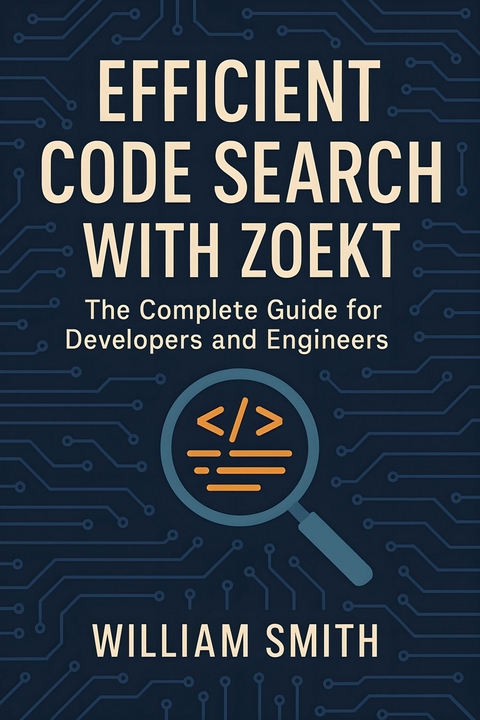
Efficient Code Search with Zoekt (eBook)
250 Seiten
HiTeX Press (Verlag)
978-0-00-102875-3 (ISBN)
'Efficient Code Search with Zoekt'
'Efficient Code Search with Zoekt' offers a comprehensive, in-depth exploration of modern code search principles, with a particular focus on Zoekt, one of the most powerful open-source search engines for source code. Beginning with the foundational role of code search in large-scale software engineering, the book presents essential concepts in information retrieval and evaluates the critical challenges inherent to searching vast, heterogeneous codebases. Readers gain clarity on what constitutes an effective code search system, not only through a comparison of tools but by understanding the unique advantages open-source solutions like Zoekt bring to collaborative development environments.
The core architectural details of Zoekt are meticulously unpacked, covering its indexing pipeline, handling of concurrency and parallelism, and robust query processing capabilities. Practical techniques for efficient indexing, scaling, and integrating Zoekt into enterprise infrastructure are addressed in depth, including strategies for horizontal scaling, distributed deployment, and the management of massive repositories and monorepos. From CI/CD integration to advanced search capabilities-such as regex, structural, and cross-repository search-the book serves as both a technical manual and a practical guide, suitable for developers, DevOps engineers, and technical leaders seeking to extract maximum value from their codebases.
Security, performance optimization, and compliance receive thorough treatment, with pragmatic advice on monitoring, tuning, and safeguarding code search environments within even the most stringent regulatory contexts. The book concludes by looking ahead: exploring semantic and AI-assisted innovations, the evolution of community contributions, and the open challenges shaping the next generation of code search technologies. 'Efficient Code Search with Zoekt' is an essential resource for any organization or individual seeking to master or implement high-performance code search in complex, evolving ecosystems.
Chapter 1
Principles of Modern Code Search
Code is the lifeblood of today’s largest organizations, yet the vastness and diversity of modern repositories often leave even the most experienced developers adrift. This chapter delves into the strategic and technical principles that shape effective code search at scale-illuminating not only why code search is pivotal for engineering productivity, but also how its architectures, algorithms, and practical constraints define the tools we rely on. By exploring the interplay of information retrieval science, scalability challenges, and the open-source ethos, we set the stage for mastering both the art and engineering of modern code search.
1.1 The Role of Code Search in Large-Scale Engineering
The evolution of software development toward massive distributed codebases has fundamentally transformed engineering workflows, placing code search at the core of contemporary software organizations. Historically, codebases remained relatively small and often centralized, permitting manual exploration and direct communication for comprehension and collaboration. However, the exponential proliferation of lines of code, fueled by expanding team sizes and heterogeneous technology stacks, has rendered traditional discovery methods unscalable. In this context, advanced code search tools transition from convenience utilities to critical infrastructure components that enable efficiency, knowledge retention, and risk management.
Large-scale engineering environments frequently involve thousands to millions of source files distributed across numerous repositories, often spanning multiple programming languages and frameworks. This polyglot landscape necessitates code search systems that can parse, index, and query syntactic and semantic elements with precision and speed. Developers rely on such tools not merely for locating identifiers or code snippets, but for intricate tasks such as tracing data flow, identifying dependency trees, or understanding the impact of potential changes. These intricate queries form the backbone of effective onboarding processes, where new engineers must assimilate vast codebases rapidly, reducing ramp-up time by enabling immediate access to relevant implementation patterns, architectural rationales, and associated documentation.
Moreover, in continuous integration (CI) and continuous deployment (CD) pipelines, code search fosters automation and quality assurance. Build systems and code review workflows integrate automated queries to detect idiomatic anti-patterns, deprecated API uses, or non-compliant code fragments before integration. This proactive scanning ensures that code adheres to predefined architectural and security standards without imposing heavy manual overhead on maintainers. For instance, advanced code search can validate the propagation of security patches across all instances of vulnerable code or verify that licensing constraints are respected throughout the codebase, addressing compliance challenges at scale. Such capabilities drastically lower the risk surface by enabling rapid identification and remediation of potentially problematic code segments.
The preservation and transmission of organizational knowledge also hinge fundamentally on effective code search. In large engineering teams, tacit knowledge embedded in code-such as non-obvious inter-module contracts or nuanced bug fixes-can become inaccessible due to personnel turnover or evolving project scopes. Code search tools act as externalized repositories of expertise, allowing discoverability of patterns and historical context through enriched search results that incorporate metadata, version history, and annotations. This reduces cognitive load on engineers by making implicit knowledge explicit and readily retrievable, effectively countering knowledge fragmentation and decay. Consequently, institutional memory is maintained without dependence on informal human networks or siloed documentation.
Beyond the purely technical dimension, code search influences cognitive workflows and collaborative dynamics within engineering organizations. By lowering the barrier to information retrieval, developers achieve a flow state conducive to complex problem-solving, minimizing task-switching costs associated with searching for relevant code or understanding collaborators’ work. The shared access to code insights facilitates more informed and constructive code reviews and architectural discussions, fostering a culture of transparency and collective code ownership. In distributed team settings particularly, where physical isolation impedes spontaneous interaction, code search acts as a leveling medium for communication, bridging gaps created by time zones and organizational layers.
Use cases illustrating the centrality of code search abound across industry sectors. For example, large-scale open-source platforms with sprawling contributor bases depend on universal, language-aware search to coordinate contributions and detect regressions early. Enterprise engineering hubs integrate code search into their developer portals and IDE plugins, tailoring search experiences to project-specific terminology and library ecosystems. Security operations teams employ query-based code search to hunt for potential vulnerabilities and indicator patterns, often in tandem with static analysis tools, to perform threat modeling at the code level. Even in research-driven projects, code search expedites the replication and adaptation of experimental algorithms by offering immediate access to relevant implementations and prior art.
In synthesis, code search transcends its original role as a simple lookup mechanism to become an indispensable engineering tool that aligns with the demands of large-scale, polyglot, and distributed software development. It underpins critical processes such as onboarding, integration, compliance, and knowledge preservation while augmenting cognitive performance and collaborative engagement. Recognizing and investing in sophisticated code search infrastructure and methodology is essential for organizations striving to maintain velocity, quality, and resilience in their engineering practices amidst ever-expanding codebases and team complexity.
1.2 Information Retrieval Fundamentals
Information retrieval (IR) principles form the foundational basis for building effective code search systems, enabling efficient extraction of relevant code snippets from large corpora. While classical IR techniques were originally developed for natural language text, adapting them to source code requires careful consideration of the syntactic and semantic peculiarities inherent to programming languages. This section elaborates on core IR algorithms such as inverted indexing and term weighting schemes like TF-IDF, alongside relevance scoring mechanisms, with a focus on their application in code search. It also explores tokenization strategies tailored for source code, language-specific preprocessing, and the architectural trade-offs encountered during index construction and query execution.
The inverted index remains the seminal data structure for facilitating fast and scalable search. Fundamentally, an inverted index maps each unique term (or token) to a posting list containing identifiers of documents (code files, functions, or snippets) that include the term, sometimes augmented with positional information. For source code, defining a “term” requires more nuanced tokenization than natural language. Tokenizers must handle language-specific lexemes including keywords, identifiers, literals, operators, and comments, while preserving meaningful tokens that contribute to semantic retrieval. Unlike free-form text, code tokens also reflect structural information such as nesting and scoping. Typical tokenization strategies involve lexical analysis according to the language grammar, extracting tokens that represent variable names, function calls, and data types. Additionally, normalization heuristics such as splitting compound identifiers (e.g., camelCase to separate tokens) or handling different naming conventions improve recall by enabling the index to capture semantically related terms that would otherwise diverge lexically.
Term weighting is critical for quantifying the relative importance of tokens within documents and across the corpus. The classical term frequency-inverse document frequency (TF-IDF) metric remains widely adopted, whereby the term frequency (TF) reflects the count of a token in a document, and the inverse document frequency (IDF) penalizes common tokens appearing frequently across many documents. For code, TF-IDF is effective at emphasizing rare, discriminative identifiers or literals, which are more likely to distinguish relevant code fragments. However, certain code tokens, such as language keywords, tend to appear ubiquitously and receive low IDF weights, aligning with intuition that they contribute less to discriminative power. Advanced weighting schemes can integrate additional heuristics, for instance, assigning higher weights to tokens occurring in important code regions like method names or comments, or incorporating semantic embeddings that capture contextual similarity beyond exact token matches.
Relevance scoring models utilize these term weights to rank candidate code documents against user queries. The vector space model...
| Erscheint lt. Verlag | 19.8.2025 |
|---|---|
| Sprache | englisch |
| Themenwelt | Mathematik / Informatik ► Informatik ► Programmiersprachen / -werkzeuge |
| ISBN-10 | 0-00-102875-8 / 0001028758 |
| ISBN-13 | 978-0-00-102875-3 / 9780001028753 |
| Informationen gemäß Produktsicherheitsverordnung (GPSR) | |
| Haben Sie eine Frage zum Produkt? |
 EPUB (Adobe DRM)
Größe: 643 KB
Kopierschutz: Adobe-DRM
Adobe-DRM ist ein Kopierschutz, der das eBook vor Mißbrauch schützen soll. Dabei wird das eBook bereits beim Download auf Ihre persönliche Adobe-ID autorisiert. Lesen können Sie das eBook dann nur auf den Geräten, welche ebenfalls auf Ihre Adobe-ID registriert sind.
Details zum Adobe-DRM
Dateiformat: EPUB (Electronic Publication)
EPUB ist ein offener Standard für eBooks und eignet sich besonders zur Darstellung von Belletristik und Sachbüchern. Der Fließtext wird dynamisch an die Display- und Schriftgröße angepasst. Auch für mobile Lesegeräte ist EPUB daher gut geeignet.
Systemvoraussetzungen:
PC/Mac: Mit einem PC oder Mac können Sie dieses eBook lesen. Sie benötigen eine
eReader: Dieses eBook kann mit (fast) allen eBook-Readern gelesen werden. Mit dem amazon-Kindle ist es aber nicht kompatibel.
Smartphone/Tablet: Egal ob Apple oder Android, dieses eBook können Sie lesen. Sie benötigen eine
Geräteliste und zusätzliche Hinweise
Buying eBooks from abroad
For tax law reasons we can sell eBooks just within Germany and Switzerland. Regrettably we cannot fulfill eBook-orders from other countries.
aus dem Bereich


