


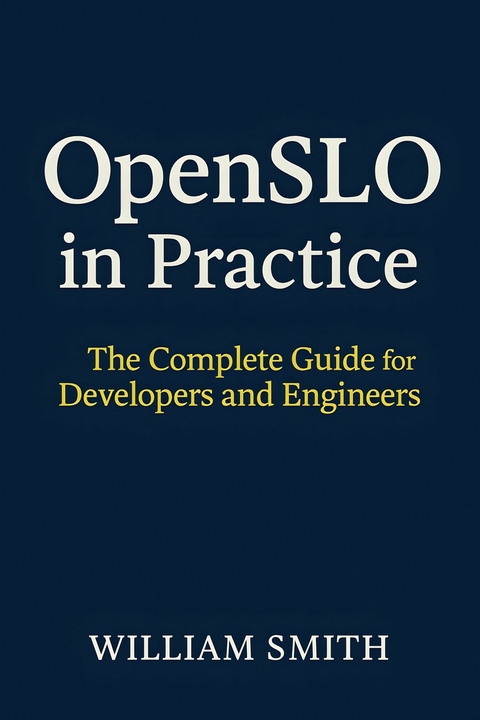
OpenSLO in Practice (eBook)
250 Seiten
HiTeX Press (Verlag)
978-0-00-102873-9 (ISBN)
'OpenSLO in Practice'
'OpenSLO in Practice' is an authoritative and comprehensive guide to implementing, integrating, and scaling Service Level Objectives (SLOs) using the OpenSLO standard in modern reliability engineering. Beginning with foundational concepts, the book delineates the critical distinctions between SLOs, SLIs, and SLAs, and traces the evolution of SLO management within reliability-focused organizations. With precision, it explains the rationale for OpenSLO's creation, demystifying its core elements, community-driven governance model, and the ecosystem that surrounds this emerging specification.
The book expertly traverses the technical landscape of OpenSLO, from detailed YAML schema definitions and compliance checks to advanced integration with leading observability platforms and incident management systems. Practical tutorials walk readers through SLO-as-Code principles-versioning, automated testing, continuous delivery, and security best practices-enabling teams to embed reliability objectives directly into deployment pipelines. Through real-world case studies, the text illuminates patterns for large-scale adoption, enterprise migration strategies, and collaborative SLO management across business units, highlighting the transformative impact OpenSLO can have on both engineering culture and operational excellence.
Beyond implementation, 'OpenSLO in Practice' anticipates future trends in the reliability space, providing a forward-looking perspective on topics such as AI-driven SLO management, cross-provider portability, and policy-as-code unification. Readers will find practical strategies for compliance, auditing, and data sovereignty, as well as insights into contributing to the OpenSLO community and roadmap. Thanks to its blend of conceptual rigor, hands-on guidance, and visionary outlook, this book serves as an indispensable resource for engineers, architects, and leaders striving to elevate service reliability and governance in today's distributed, multi-cloud environments.
Chapter 2
Detailed Specification of OpenSLO
Mastery of OpenSLO begins with a deep technical understanding of its specification. This chapter meticulously unpacks the schema, formats, validation mechanisms, and extensibility hooks that empower OpenSLO to serve as both a linchpin for interoperability and a catalyst for reliability automation. Delve into the technical craftsmanship behind OpenSLO and discover how its design enables robust, auditable, and adaptive SLO management for organizations operating at scale.
2.1 YAML Schemas and Supported Fields
OpenSLO’s primary specification language leverages YAML due to its human-readable structure and ease of integration with automation tools. The specification’s schema defines the arrangement, required fields, optional attributes, and nested objects that form a comprehensive, extensible description of service level objectives (SLOs). Understanding these details is crucial for accurately modeling service reliability data and ensuring interoperability.
At the root level, an OpenSLO YAML document is organized around the slo key, which serves as the primary container for describing a single SLO entity. This root object consolidates metadata, SLO specification parameters, and potential extensions in a unified manner:
name: string (required)
description: string (optional)
service:
name: string (required)
owner: string (optional)
indicator:
...
objective:
...
timeWindow:
...
tags: [string] (optional)
metadata:
...
Inside slo, the name field is mandatory and must be a concise, unique identifier for the service-level objective itself. This is fundamental to ensure clear referencing and aggregation across monitoring and compliance systems. The description is optional but highly recommended to provide semantic context for human readers and automated systems.
The service object anchors the SLO to a particular service domain. It includes a mandatory name to identify the service and an optional owner field, generally containing an email or team name, which facilitates notifications and accountability workflows.
The indicator field is a nested object defining the measurable signal that reflects service reliability. OpenSLO supports several indicator types such as ratio, integer, and availability, each with subtype-specific attributes. For example, a ratio indicator uses numerator and denominator query strings, often Prometheus or SQL, to calculate success ratios:
type: ratio
numerator: query_string
denominator: query_string
All indicator types require their type field to specify the calculation model. This design enforces schema clarity and guards against semantic ambiguity.
The objective component describes the target reliability or performance thresholds. It mandates an operator (>=, <=, >, <) and a target numeric value expressed as a floating-point number between 0 and 1 representing a percentage of success or uptime:
operator: ">="
target: 0.995
Time bounding is managed by the timeWindow object, which confines the measurement period to common units such as 30d (30 days) or 7d (1 week). The field duration is required, and field values must adhere to an ISO 8601 duration subset format:
duration: 30d
Additional optional fields can include tags, a list of arbitrary strings for filtering or classification, and metadata, an open map structure allowing users to embed vendor-specific extensions, policy references, or operational annotations.
Nesting is deliberately shallow to maintain human-readability, yet flexible enough to define hierarchical relationships. For instance, the indicator and objective objects serve as sibling nodes under slo, each encapsulating related attributes without excessive substructure.
OpenSLO specifications encourage the use of comments (#) to elucidate field purposes, rationale behind thresholds, or data source assumptions. These comments enhance maintainability without affecting parsing or validation, supporting collaborative environments and audit processes.
Metadata fields are recommended to be standardized when possible, such as using x- prefixes for vendor extensions to prevent collisions. Utilizing metadata effectively can enable alignment with internal compliance frameworks, automated remediation triggers, and integration with incident management platforms.
Required fields enforce strict schema validation, minimizing ambiguity in SLO interpretation. Optional ...
| Erscheint lt. Verlag | 19.8.2025 |
|---|---|
| Sprache | englisch |
| Themenwelt | Mathematik / Informatik ► Informatik ► Programmiersprachen / -werkzeuge |
| ISBN-10 | 0-00-102873-1 / 0001028731 |
| ISBN-13 | 978-0-00-102873-9 / 9780001028739 |
| Informationen gemäß Produktsicherheitsverordnung (GPSR) | |
| Haben Sie eine Frage zum Produkt? |
 EPUB (Adobe DRM)
Größe: 734 KB
Kopierschutz: Adobe-DRM
Adobe-DRM ist ein Kopierschutz, der das eBook vor Mißbrauch schützen soll. Dabei wird das eBook bereits beim Download auf Ihre persönliche Adobe-ID autorisiert. Lesen können Sie das eBook dann nur auf den Geräten, welche ebenfalls auf Ihre Adobe-ID registriert sind.
Details zum Adobe-DRM
Dateiformat: EPUB (Electronic Publication)
EPUB ist ein offener Standard für eBooks und eignet sich besonders zur Darstellung von Belletristik und Sachbüchern. Der Fließtext wird dynamisch an die Display- und Schriftgröße angepasst. Auch für mobile Lesegeräte ist EPUB daher gut geeignet.
Systemvoraussetzungen:
PC/Mac: Mit einem PC oder Mac können Sie dieses eBook lesen. Sie benötigen eine
eReader: Dieses eBook kann mit (fast) allen eBook-Readern gelesen werden. Mit dem amazon-Kindle ist es aber nicht kompatibel.
Smartphone/Tablet: Egal ob Apple oder Android, dieses eBook können Sie lesen. Sie benötigen eine
Geräteliste und zusätzliche Hinweise
Buying eBooks from abroad
For tax law reasons we can sell eBooks just within Germany and Switzerland. Regrettably we cannot fulfill eBook-orders from other countries.
aus dem Bereich


