


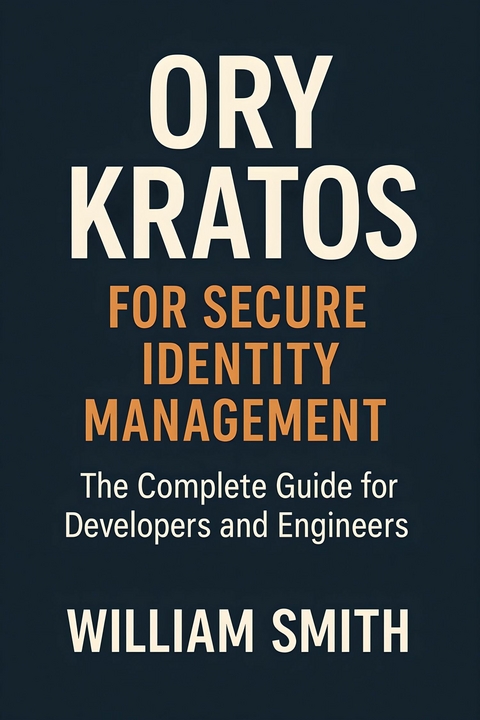
Ory Kratos for Secure Identity Management (eBook)
250 Seiten
HiTeX Press (Verlag)
978-0-00-102866-1 (ISBN)
'Ory Kratos for Secure Identity Management'
'Ory Kratos for Secure Identity Management' is a definitive technical guide tailored for architects, developers, and security professionals seeking to design, deploy, and operate robust digital identity solutions. The book begins by establishing a comprehensive foundation in secure identity management, exploring essential concepts, modern authentication protocols, regulatory compliance requirements, and the principles of zero trust security. Readers are introduced to core threat models and the intricacies of authentication versus authorization, equipping them to anticipate and mitigate evolving security challenges in complex digital landscapes.
The heart of this resource delves into the architecture and feature set of Ory Kratos, an open-source identity and user management system. Through detailed chapters, the book breaks down Kratos' extensible capabilities, protocol support, and integration points-contrasting its offerings with leading IAM platforms such as Keycloak, Auth0, and Okta. Readers gain hands-on insight into customizing registration flows, implementing multi-factor and passwordless authentication, executing adaptive authentication strategies, and integrating rigorous verification and self-service processes. Advanced sections cover token management, session hardening, sensitive data protection, audit logging, and incident response, emphasizing security, privacy, and compliance at every stage.
Recognizing the demands of real-world enterprises, the book offers practical guidance on deploying Kratos natively in cloud environments, integrating with service meshes, legacy systems, and supporting multi-language, federated, and decentralized identity paradigms. Extensive coverage of observability, automation, resiliency, and performance tuning helps teams achieve operational excellence. Drawing on case studies from highly regulated sectors and community best practices, this edition highlights Ory Kratos' unique position in the identity management ecosystem and offers a forward-looking perspective on decentralized identity, privacy innovation, and the evolving standards landscape.
Chapter 1
Principles of Secure Identity Management
Identity is the cornerstone of digital security, but managing it securely is anything but simple. In this chapter, we embark on a deep investigation into the evolving landscape of digital identity-from foundational concepts to the latest protocols and regulatory mandates. Through threat modeling, compliance, and zero trust strategies, you’ll gain both the historical context and advanced perspectives to design identity systems that are robust, scalable, and ready for tomorrow’s challenges.
1.1 Foundations of Digital Identity
A digital identity is an assemblage of data that represents an entity—such as a person, organization, device, or process—in a digital environment. At its core, a digital identity comprises several essential elements: identifiers, attributes, claims, and contexts. Each element provides a different dimension through which identity is constructed and interpreted.
An identifier is a unique symbol or string associated with an entity designed to distinguish it within a particular scope or system. Examples include usernames, email addresses, globally unique identifiers (GUIDs), or decentralized identifiers (DIDs). The uniqueness and persistence of identifiers form the backbone of identity systems, enabling the referencing and management of entities in digital interactions.
Attributes refer to descriptive data points related to the identity. These can be static, such as date of birth or nationality, or dynamic, like login status or device metadata. Attributes are often used to augment identifiers with context-specific information to facilitate authorization, personalization, or auditing. A more formalized version of attributes, known as claims, is typically asserted by an identity provider or issuer about an identity subject. Claims encapsulate assertions such as “user X is over 18,” “device Y is compliant with security policy Z,” or “entity A is a member of organization B.” These claims underpin trust decisions, enabling verifiers to make informed access or interaction choices.
Context refers to the conditions, environment, or parameters under which identity elements are asserted or evaluated. It includes temporal factors, location, transaction intent, and the trust framework in place. Identity is therefore not an absolute but a contextual construct reliant on the interplay between identifiers, claims, and associated trust structures.
Historically, digital identity systems began as manual models, where identity attributes were documented and verified offline, often using paper credentials or local databases. These models commonly exhibited siloed architectures, tightly coupling identity data and authentication mechanisms within isolated applications or organizations. This limited scalability and cross-domain interoperability.
The advent of federated identity models addressed these challenges by introducing frameworks where multiple entities share identity assertions within an agreed trust boundary. Federated systems enable Single Sign-On (SSO) and attribute sharing through protocols such as Security Assertion Markup Language (SAML), OpenID Connect, or OAuth. Here, a central identity provider establishes trust anchors—entities that vouch for the accuracy and authenticity of claims—allowing relying parties to accept identity assertions without redundant enrollment or verification. Although federated models improve usability and flexibility, they often require governance agreements and introduce centralized points of failure or control.
The progressive shift to decentralized identity models attempts to redistribute trust and control from centralized providers to individual identity holders and their agents. Decentralized identifiers (DIDs), blockchain-based verifiable credentials, and distributed ledger technologies exemplify this approach. They enable entities to create self-owned identifiers and digitally sign claims without reliance on intermediary authorities. Trust anchors in this paradigm become consensus mechanisms and cryptographic proofs embedded in the system rather than institutional entities. This model promises enhanced privacy, user autonomy, and resistance to censorship, but also demands rigorous design to address usability, revocation, and scaling challenges.
An integral aspect across identity models is identity lifecycle management, encompassing identity creation, updating, suspension, and deletion. Managing this lifecycle requires consistent policies and mechanisms for verifying, persisting, and revoking identity data and credentials. For instance, attribute updates must propagate securely to all dependent systems, and suspensions must prevent unauthorized access while preserving essential audit trails. Lifecycle management must also consider the expiration or renewal of claims, adapting to changes in the entity’s real-world state.
A critical conceptual distinction in digital identity is the separation of identity from authentication. Identity defines who or what an entity claims to be, whereas authentication confirms the entity’s control over a set of credentials or keys corresponding to that identity at the time of interaction. This decoupling allows identity data to be reused across multiple sessions and contexts, while authentication can employ diverse methods (e.g., passwords, biometrics, cryptographic keys) tailored to specific security requirements.
Trust anchors serve as the linchpin in establishing identity validity within any system. They are the authoritative sources or mechanisms that underpin confidence in identity assertions, whether through organizational certification authorities, public key infrastructures, federated identity providers, or decentralized consensus. The integrity and reputation of trust anchors directly influence the acceptability and security of digital identity transactions.
Collectively, these foundational building blocks define the architecture and operational principles of digital identity systems. Understanding identifiers, attributes, claims, context, and trust anchors, alongside the evolution from manual to federated and decentralized models, equips practitioners to analyze, design, and evaluate identity solutions with a critical and informed perspective, mindful of security, privacy, interoperability, and user empowerment considerations.
1.2 Identity Threat Models
Identity systems form the cornerstone of secure access and personalized services across digital platforms. The evolving threat landscape targeting these systems necessitates a rigorous examination of attack vectors and formal modeling methodologies to anticipate, mitigate, and prevent identity-related compromises.
Common Attack Vectors
- Credential stuffing exploits the reuse of usernames and passwords across multiple services. Attackers leverage large volumes of leaked credentials from prior breaches to automate login attempts on target systems, often utilizing botnets and proxy networks to evade detection. The probability of success correlates with the prevalence of credential reuse and inadequate rate-limiting or multi-factor authentication (MFA) enforcement.
- Phishing remains a predominant tactic, where attackers deceive users into disclosing credentials or multi-factor tokens by masquerading as trusted entities or services. Modern phishing campaigns leverage sophisticated social engineering combined with credential harvesting portals mimicking legitimate login interfaces. The effective execution depends on exploiting user trust and lapses in endpoint or email security.
- Identity theft involves the unauthorized use of another individual’s identity information, often by combining data from multiple breaches or social engineering methods. This threat extends beyond digital accounts, potentially resulting in fraudulent transactions, account takeovers, or reputational damage. Identity theft attacks may also target recovery and authentication workflows by manipulating personal information.
- Privilege escalation occurs when an adversary, either internally or via a compromised account, gains unauthorized access to higher-privilege functions or data. This vector typically exploits software vulnerabilities, misconfigurations, or weak access control policies. Lateral movement within systems may follow, expanding the attacker’s foothold and increasing overall risk.
- Consent phishing represents an advanced social engineering technique where attackers trick users into granting excessive permissions to malicious applications or services, often exploiting OAuth or other federated identity mechanisms. This vector undermines trust frameworks and bypasses traditional credential defenses by leveraging delegated consent.
Case Studies and Real-World Breaches
The 2019 breach of a major social media platform exemplifies credential stuffing’s impact, where adversaries exploited password reuse and lax rate-limiting, resulting in...
| Erscheint lt. Verlag | 20.8.2025 |
|---|---|
| Sprache | englisch |
| Themenwelt | Mathematik / Informatik ► Informatik ► Programmiersprachen / -werkzeuge |
| ISBN-10 | 0-00-102866-9 / 0001028669 |
| ISBN-13 | 978-0-00-102866-1 / 9780001028661 |
| Informationen gemäß Produktsicherheitsverordnung (GPSR) | |
| Haben Sie eine Frage zum Produkt? |
 EPUB (Adobe DRM)
Größe: 949 KB
Kopierschutz: Adobe-DRM
Adobe-DRM ist ein Kopierschutz, der das eBook vor Mißbrauch schützen soll. Dabei wird das eBook bereits beim Download auf Ihre persönliche Adobe-ID autorisiert. Lesen können Sie das eBook dann nur auf den Geräten, welche ebenfalls auf Ihre Adobe-ID registriert sind.
Details zum Adobe-DRM
Dateiformat: EPUB (Electronic Publication)
EPUB ist ein offener Standard für eBooks und eignet sich besonders zur Darstellung von Belletristik und Sachbüchern. Der Fließtext wird dynamisch an die Display- und Schriftgröße angepasst. Auch für mobile Lesegeräte ist EPUB daher gut geeignet.
Systemvoraussetzungen:
PC/Mac: Mit einem PC oder Mac können Sie dieses eBook lesen. Sie benötigen eine
eReader: Dieses eBook kann mit (fast) allen eBook-Readern gelesen werden. Mit dem amazon-Kindle ist es aber nicht kompatibel.
Smartphone/Tablet: Egal ob Apple oder Android, dieses eBook können Sie lesen. Sie benötigen eine
Geräteliste und zusätzliche Hinweise
Buying eBooks from abroad
For tax law reasons we can sell eBooks just within Germany and Switzerland. Regrettably we cannot fulfill eBook-orders from other countries.
aus dem Bereich


