


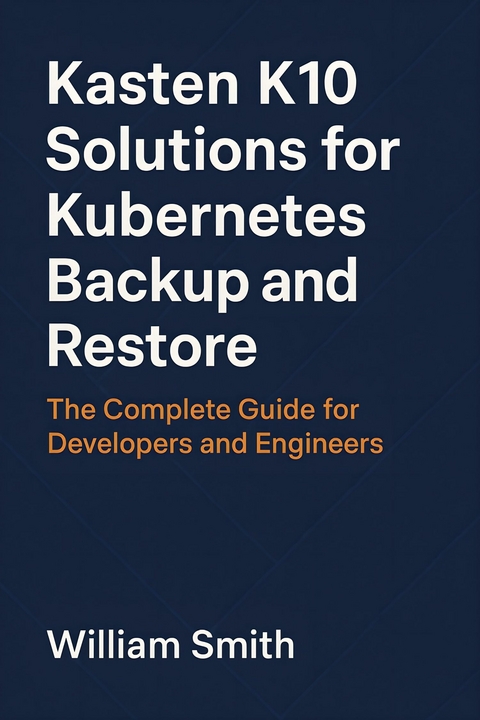
Kasten K10 Solutions for Kubernetes Backup and Restore (eBook)
250 Seiten
HiTeX Press (Verlag)
978-0-00-102861-6 (ISBN)
'Kasten K10 Solutions for Kubernetes Backup and Restore'
In a world where Kubernetes has become the backbone of modern, cloud-native infrastructure, 'Kasten K10 Solutions for Kubernetes Backup and Restore' stands as the definitive guide for securing, managing, and safeguarding valuable data in dynamic containerized environments. This comprehensive resource navigates the core concepts of Kubernetes storage, the critical importance of data protection, and the unique challenges faced by enterprises deploying stateful applications at scale. From foundational concepts such as persistent volumes and data protection mandates, to in-depth exploration of both native and external backup solutions, the book provides a panoramic understanding of the landscape.
The book expertly guides professionals through every phase of deploying and operating Kasten K10, one of the industry's leading Kubernetes backup platforms. Readers receive step-by-step best practices for architecture, installation, and rigorous security hardening, followed by deep dives into automated protection workflows, multi-tenancy, and robust audit controls. Detailed chapters walk through advanced backup strategies, policy-driven management, secure APIs, and smooth integration with both on-premises and multi-cloud storage backends, ensuring every aspect of disaster recovery, compliance, and operational scalability is addressed.
Drawing on real-world enterprise case studies and emerging trends, the text highlights how organizations can harness Kasten K10 to safeguard Kubernetes workloads from outages, data loss, ransomware, and ever-evolving compliance demands. Future-focused sections explore novel workloads-from AI to IoT and air-gapped deployments-while outlining the product roadmap and the future of cloud-native data protection. Whether you are a DevOps engineer, platform architect, or security leader, this book empowers you to deliver resilient, compliant, and future-ready Kubernetes operations.
Chapter 1
Core Concepts of Kubernetes and Data Protection
Modern Kubernetes environments have revolutionized how applications are deployed, but present distinct data protection challenges that can threaten the continuity and integrity of critical workloads. This chapter uncovers the architectural pillars of Kubernetes storage and why robust backup and recovery strategies have become indispensable. By examining the risks, solutions, and evolving compliance mandates, readers will gain the insight needed to safeguard data at scale in even the most demanding environments.
1.1 Kubernetes Storage Paradigms
Kubernetes orchestrates containerized applications with an emphasis on stateless deployments, yet persistent data storage remains a critical requirement for many workloads. The Kubernetes storage architecture addresses this through a layered abstraction, beginning with Persistent Volumes (PVs). A Persistent Volume represents a piece of networked or local storage in the cluster, provisioned by an administrator or dynamically through storage classes. PVs abstract the underlying storage complexity and facilitate decoupling storage lifecycle from that of individual pods.
Access to PVs is gained via Persistent Volume Claims (PVCs), which are requests for storage by users or pods. A PVC specifies parameters such as storage size, access mode (e.g., ReadWriteOnce, ReadOnlyMany, ReadWriteMany), and storage class, guiding the system in binding to an appropriate PV. The PVC abstraction simplifies the usage model, removing the need for developers to interact directly with the underlying storage provisioning details.
Central to modern Kubernetes storage is the concept of Storage Classes, which define a named type of storage available within the cluster. Each storage class encapsulates provisioner information, parameters such as volume type and replication policies, and reclamation policies (e.g., Retain, Delete). When a PVC references a storage class, Kubernetes employs dynamic provisioning to allocate storage on-demand, invoking cloud provider APIs or on-premises storage controllers automatically. This dynamic approach enables elasticity and on-the-fly scaling of storage resources responsive to deployed applications.
The Kubernetes ephemeral container model, while inherently transient, can still require data persistence for certain workloads. For such cases, ephemeral volumes exist like emptyDir that provide storage tied to pod lifetime or ephemeral inline volumes based on CSI ephemeral volume support. However, these do not offer persistence beyond pod termination. Consequently, durability and availability demands dictate the use of PVs attached through PVCs, ensuring state preservation independent of pod lifecycle events such as restarts or rescheduling.
Regarding storage interfaces, Kubernetes supports both block and file storage semantics. Block storage presents raw storage volumes to pods, which handle formatting, mounting, and filesystem management. This model is often preferred for databases and performance-sensitive applications due to low-level control and minimal overhead. In contrast, file storage exposes network file systems such as NFS or cloud-based file shares, enabling concurrent access across multiple pods when supported by access modes. Understanding these modes is crucial, as block devices typically support single-node access, while file storage solutions can scale with multi-node access capabilities.
Topology-awareness in storage allocation is a key factor influencing workload reliability and performance in a distributed cluster. Kubernetes leverages volume topology constraints during both static and dynamic provisioning to ensure storage is placed in compatible zones or nodes aligning with pod scheduling. This affinity reduces latency and prevents cross-zone data access penalties. CSI (Container Storage Interface) drivers advertise supported topologies and constraints that the Kubernetes control plane applies during volume binding. Without topology-aware placement, stateful workloads risk performance degradation, increased failure blast radius, and potential unavailability in multi-zone or multi-region clusters.
An example of topology-aware binding is the volumeBindingMode setting in storage classes. The modes Immediate and WaitForFirstConsumer determine whether volumes are provisioned eagerly at PVC creation or deferred until pod scheduling finalizes target node selection. The deferred allocation enhances zone locality alignment, especially critical for cloud provider-backed disks or network-attached storage.
Kubernetes storage paradigms integrate a comprehensive abstraction model that enables flexible, scalable, and reliable data persistence across containerized environments. Persistent Volumes and Persistent Volume Claims form the core logical interfaces, orchestrated via storage classes enabling dynamic provisioning. The distinctions between block and file storage, paired with topology-aware scheduling, deliver a nuanced balance of performance, durability, and operational complexity tailored to diverse enterprise workloads.
1.2 Criticality of Data Protection in Kubernetes
The architectural characteristics of Kubernetes introduce unique complexities in managing data protection compared to conventional IT environments. Unlike monolithic servers or virtual machines with relatively static storage attachments, Kubernetes enforces container lifecycles that are inherently ephemeral and dynamic. Containers can terminate, be recreated, or be rescheduled on different nodes at any time, which disrupts traditional notions of persistent data locality. This volatility complicates the application of standard data backup and recovery approaches that rely on stable endpoint storage.
Moreover, while early container deployments were predominantly stateless, an increasing shift towards leveraging stateful applications within Kubernetes clusters intensifies the demand for rigorous data protection. Modern microservices architectures, by nature, emphasize modular, independently deployable components but have progressively incorporated stateful workloads such as databases, message queues, and caches. These stateful services depend on Kubernetes features like StatefulSets and persistent volume claims (PVCs) to maintain data durability across pod lifecycle events, yet these mechanisms alone do not guarantee comprehensive protection against data loss or corruption. The abstraction of storage through Container Storage Interfaces (CSI) and dynamic provisioning adds additional layers to the protection challenge, requiring integrated strategies that account for both the orchestration layer and underlying storage subsystems.
Real-world incidents underscore the gravity of insufficient data protection in Kubernetes environments. For instance, a financial services organization experienced cascading failures after an unforeseen node failure caused simultaneous pod evictions of several stateful services. The incident was exacerbated by an absence of regular snapshotting and inadequate validation of backup integrity, leading to significant transaction data loss and prolonged service outages. Similarly, an e-commerce platform’s Kubernetes cluster faced data consistency issues when a misconfigured persistent volume deletion policy resulted in inadvertent erasure of customer order history during routine application updates. Such events illustrate how data loss or inaccessibility in Kubernetes not only disrupts discrete services but can propagate through interconnected microservices, triggering systemic failures that affect business continuity and customer trust.
Data protection in Kubernetes must therefore address multiple dimensions: durability against pod and node failures, consistency across replicated and distributed data stores, and resilience to misconfigurations or operational errors. Unlike traditional environments, where backup windows and maintenance epochs can be tightly controlled, Kubernetes environments often necessitate continuous protection mechanisms that operate seamlessly amid ongoing deployments and scaling operations. Additionally, the diversity of storage backends and cloud-native architectures introduces heterogeneity in snapshot capabilities, recovery granularity, and retention policies, compelling the adoption of standardized yet flexible data protection frameworks.
Overall, the criticality of data protection in Kubernetes is dual: it is more challenging due to the platform’s dynamism and abstraction layers, and simultaneously more essential due to the structural incorporation of stateful services fundamental to modern digital business workflows. Failures in protecting data can reverberate broadly, causing not only immediate operational disruptions but also long-term reputational damage and regulatory non-compliance. Consequently, data protection strategies must evolve beyond traditional paradigms to fully leverage Kubernetes-native constructs and ecosystem tools, ensuring continuity and integrity in this increasingly indispensable computing environment.
1.3 Backup and Restore Requirements for Cloud-Native Workloads
Cloud-native...
| Erscheint lt. Verlag | 20.8.2025 |
|---|---|
| Sprache | englisch |
| Themenwelt | Mathematik / Informatik ► Informatik ► Programmiersprachen / -werkzeuge |
| ISBN-10 | 0-00-102861-8 / 0001028618 |
| ISBN-13 | 978-0-00-102861-6 / 9780001028616 |
| Informationen gemäß Produktsicherheitsverordnung (GPSR) | |
| Haben Sie eine Frage zum Produkt? |
 EPUB (Adobe DRM)
Größe: 830 KB
Kopierschutz: Adobe-DRM
Adobe-DRM ist ein Kopierschutz, der das eBook vor Mißbrauch schützen soll. Dabei wird das eBook bereits beim Download auf Ihre persönliche Adobe-ID autorisiert. Lesen können Sie das eBook dann nur auf den Geräten, welche ebenfalls auf Ihre Adobe-ID registriert sind.
Details zum Adobe-DRM
Dateiformat: EPUB (Electronic Publication)
EPUB ist ein offener Standard für eBooks und eignet sich besonders zur Darstellung von Belletristik und Sachbüchern. Der Fließtext wird dynamisch an die Display- und Schriftgröße angepasst. Auch für mobile Lesegeräte ist EPUB daher gut geeignet.
Systemvoraussetzungen:
PC/Mac: Mit einem PC oder Mac können Sie dieses eBook lesen. Sie benötigen eine
eReader: Dieses eBook kann mit (fast) allen eBook-Readern gelesen werden. Mit dem amazon-Kindle ist es aber nicht kompatibel.
Smartphone/Tablet: Egal ob Apple oder Android, dieses eBook können Sie lesen. Sie benötigen eine
Geräteliste und zusätzliche Hinweise
Buying eBooks from abroad
For tax law reasons we can sell eBooks just within Germany and Switzerland. Regrettably we cannot fulfill eBook-orders from other countries.
aus dem Bereich


