


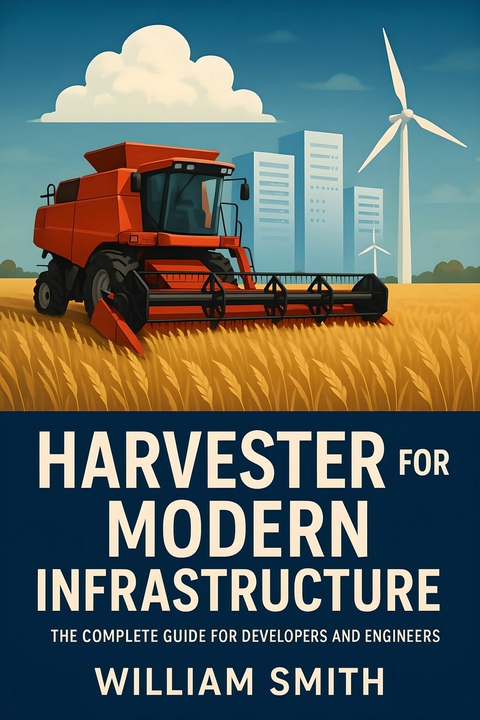
Harvester for Modern Infrastructure (eBook)
250 Seiten
HiTeX Press (Verlag)
978-0-00-102859-3 (ISBN)
'Harvester for Modern Infrastructure'
'Harvester for Modern Infrastructure' offers a comprehensive and in-depth exploration of Harvester, the open-source hyperconverged infrastructure platform revolutionizing modern data center and cloud operations. Tracing the evolution from legacy virtualization to cutting-edge hyperconverged and Kubernetes-native environments, the book positions Harvester as a crucial bridge between traditional and cloud-native workloads. Readers are introduced to Harvester's key features, architectural philosophy, and its growing influence within the open source ecosystem, alongside real-world use cases and competitive differentiators that underscore its production readiness and market relevance.
Delving into the intricacies of Harvester's architecture, the book meticulously examines its control and data plane components, robust storage and networking designs, high-availability mechanisms, and API extensibility. Architectural chapters demystify integration with Kubernetes (via KubeVirt and Longhorn), approaches to scalable and secure multi-tenancy, resilient workload management, and seamless cluster lifecycle automation. Next-generation topics such as observability, distributed logging, performance tuning, security compliance, and disaster recovery are covered through practical frameworks and best practices, empowering professionals to achieve reliability, efficiency, and operational excellence.
The volume extends its focus beyond core infrastructure to advanced scenarios-such as hybrid and multi-cloud deployments, edge computing, and automated DevOps workflows-showcasing Harvester's flexibility in diverse enterprise landscapes. Final chapters highlight enterprise case studies, patterns for scale and uptime, and the ongoing evolution of Harvester through community contributions and forward-looking innovations. This book is a definitive resource for architects, SREs, cloud engineers, and technology leaders seeking to master Harvester's capabilities in building secure, scalable, and future-ready infrastructure.
Chapter 1
Harvester Overview and Modern Infrastructure Landscape
In an era marked by relentless innovation in infrastructure technology, the emergence of Harvester signifies a pivotal evolution in how organizations unify virtualization and cloud-native paradigms. This chapter offers an incisive exploration into Harvester’s genesis, its distinctive positioning within the complex tapestry of modern data centers, and the design philosophies that set it apart. Whether you are seeking to bridge legacy IT with next-generation cloud solutions or to comprehend the forces shaping open infrastructure communities, this chapter will equip you with the analytical perspective required to recognize Harvester’s transformative potential.
1.1 Evolution of Infrastructure Orchestration
Infrastructure orchestration has undergone a profound transformation, moving from rigid, hardware-centric silos to flexible, software-defined environments that unify compute, storage, and networking. Initially, enterprise data centers were structured around discrete physical servers, each dedicated to specific workloads. These silos impeded resource utilization, required extensive manual management, and presented significant challenges in scalability and agility.
The advent of classic hypervisors marked the first major shift in infrastructure management. Products like VMware ESX and traditional KVM environments introduced the capability to virtualize physical servers, abstracting hardware and enabling multiple virtual machines (VMs) to coexist on a single host. This virtualization layer improved hardware utilization and simplified workload deployment but maintained a primarily host-centric view. Orchestration remained limited, often relying on vendor-specific tooling and manual configurations. While VMware’s vSphere suite offered advanced features such as vMotion and Distributed Resource Scheduler (DRS), these solutions operated predominantly within isolated clusters, leaving cross-fabric orchestration and heterogeneous workload management out of reach.
Despite these advancements, several pain points persisted. Managing storage and networking alongside compute remained complex, often requiring separate management consoles and expertise. Scaling beyond individual clusters introduced fragmentation, and heterogeneity in hypervisor technologies complicated lifecycle management and consistency. Additionally, while classical hypervisors excelled at encapsulating traditional monolithic workloads, they struggled to keep pace with the emergent needs of microservices architectures, which called for lightweight, ephemeral environments with rapid provisioning cycles.
The rise of containerization and accompanying orchestration systems catalyzed a paradigm shift toward more granular and dynamic infrastructure management. Kubernetes emerged as the de facto standard, providing a declarative model for deploying and scaling containerized applications. Its pattern for managing distributed workloads across a cluster addressed many operational complexities by automating scheduling, service discovery, scaling, and self-healing. Unlike traditional hypervisors, Kubernetes treated infrastructure as a pool of resources managed via microservices abstractions, better aligned with the evolving application landscape.
However, the coexistence of legacy virtualization and modern container orchestration introduced new integration challenges. Enterprises required platforms capable of managing both VMs and containers without sacrificing operational consistency or performance. This duality highlighted the fragmentation in tools and workflows, often causing duplicated efforts and increased operational overhead. Moreover, container runtimes depended on a well-orchestrated, software-defined infrastructure to deliver on promises of scalability and resilience, emphasizing the need for tightly integrated orchestration layers that spanned the entire stack.
The emergence of hyperconverged infrastructure (HCI) addressed some of the limitations inherent in traditional architectures by consolidating compute, storage, and networking within a unified software-defined platform. By abstracting physical components into pooled resources managed via a single interface, HCI simplified deployment and reduced operational complexity. Vendors like Nutanix and VMware vSAN pioneered this approach, enabling scalable clusters that could be managed holistically. This convergence paved the way for more sophisticated orchestration frameworks that bridged virtualization and containerization paradigms.
Modern orchestration platforms have increasingly sought to unify disparate workload types under a common management fabric, integrating VM and container operations while leveraging software-defined underpinning. This convergence responds to pressing demands: enterprises need to support legacy applications alongside cloud-native services, accommodate varied workload lifecycle requirements, and simplify infrastructure consumption and governance. Platforms such as Harvester embody these principles, offering open-source, Kubernetes-native hyperconverged solutions that harmonize VM orchestration with container-native workflows. By leveraging Kubernetes as the control plane for VMs and containers alike, Harvester breaks down silos and reduces complexity in heterogeneous environments.
The trajectory from hardware-centric silos to hyperconverged, software-defined platforms reflects a critical evolution in infrastructure orchestration. Early virtualization solutions improved utilization but maintained isolated operational models. Container orchestration introduced modularity and automation well suited for dynamic workloads but required integrated infrastructure support. Hyperconvergence unified key infrastructure components under software control, facilitating advanced orchestration capabilities. Today’s systems, exemplified by unified platforms like Harvester, reconcile the disparate requirements of legacy and cloud-native workloads, delivering holistic, scalable, and agile infrastructure orchestration that meets the demands of modern IT ecosystems.
1.2 Harvester in the Context of Cloud-Native Environments
Cloud-native environments are fundamentally characterized by architectural and operational paradigms that prioritize scalability, resilience, and automation. Central to this vision is Kubernetes, the de facto container orchestration platform, which enables declarative management and immutable infrastructure principles. Kubernetes treats infrastructure as code, expressing the desired state of applications and their environment via declarative configurations. This paradigm ensures continuous reconciliation between the actual and desired states, driving reliability and reducing manual intervention.
Immutable infrastructure complements this approach by promoting the deployment of immutable artifacts-containers or images that are not altered post-deployment. Instead of patching or updating live systems, a new version is rolled out, and the outdated instance is terminated, thereby reducing configuration drift and downtime. Declarative management further elevates operational efficiency by enabling infrastructure and application specifications to be captured as code, thus enabling version control, automated testing, and repeatable deployments.
Despite Kubernetes’ transformative impact on containerized environments, a significant gap has persisted between container orchestration and traditional virtualization technologies. Many enterprise workloads continue to rely on virtual machines (VMs) due to factors such as legacy application dependencies, stringent security requirements, or resource isolation needs. Bridging the conceptual and operational divide between containers and VMs has been a longstanding challenge, complicating hybrid cloud strategies that aim to unify diverse workload types.
Harvester addresses this gap by extending cloud-native principles backward into the virtualization layer, effectively converging the management of VMs alongside Kubernetes-managed containers. Architecturally, Harvester is designed as a hyperconverged infrastructure (HCI) solution that integrates virtualization with Kubernetes-native control planes. It employs an open-source virtualization runtime built on KubeVirt, which enables VM lifecycle management through Kubernetes Custom Resource Definitions (CRDs). This approach allows VMs to be treated as first-class Kubernetes resources, subject to the same declarative configuration and reconciliation mechanisms as containers.
Operationally, Harvester unifies the control plane by embedding virtual machine orchestration directly within the Kubernetes ecosystem. Traditional hypervisor management tools often rely on specialized interfaces and isolated workflows, whereas Harvester leverages Kubernetes APIs, enabling seamless integration with existing Kubernetes-native tooling such as kubectl, Helm, and GitOps pipelines. This convergence significantly simplifies the management complexity of mixed workloads and allows practitioners to enforce consistent policies across containers and VMs.
Harvester also embraces immutable infrastructure principles by encapsulating VM images as container-ready artifacts that can be stored, versioned, and deployed declaratively. The underlying storage layer...
| Erscheint lt. Verlag | 20.8.2025 |
|---|---|
| Sprache | englisch |
| Themenwelt | Mathematik / Informatik ► Informatik ► Programmiersprachen / -werkzeuge |
| ISBN-10 | 0-00-102859-6 / 0001028596 |
| ISBN-13 | 978-0-00-102859-3 / 9780001028593 |
| Informationen gemäß Produktsicherheitsverordnung (GPSR) | |
| Haben Sie eine Frage zum Produkt? |
 EPUB (Adobe DRM)
Größe: 837 KB
Kopierschutz: Adobe-DRM
Adobe-DRM ist ein Kopierschutz, der das eBook vor Mißbrauch schützen soll. Dabei wird das eBook bereits beim Download auf Ihre persönliche Adobe-ID autorisiert. Lesen können Sie das eBook dann nur auf den Geräten, welche ebenfalls auf Ihre Adobe-ID registriert sind.
Details zum Adobe-DRM
Dateiformat: EPUB (Electronic Publication)
EPUB ist ein offener Standard für eBooks und eignet sich besonders zur Darstellung von Belletristik und Sachbüchern. Der Fließtext wird dynamisch an die Display- und Schriftgröße angepasst. Auch für mobile Lesegeräte ist EPUB daher gut geeignet.
Systemvoraussetzungen:
PC/Mac: Mit einem PC oder Mac können Sie dieses eBook lesen. Sie benötigen eine
eReader: Dieses eBook kann mit (fast) allen eBook-Readern gelesen werden. Mit dem amazon-Kindle ist es aber nicht kompatibel.
Smartphone/Tablet: Egal ob Apple oder Android, dieses eBook können Sie lesen. Sie benötigen eine
Geräteliste und zusätzliche Hinweise
Buying eBooks from abroad
For tax law reasons we can sell eBooks just within Germany and Switzerland. Regrettably we cannot fulfill eBook-orders from other countries.
aus dem Bereich


