


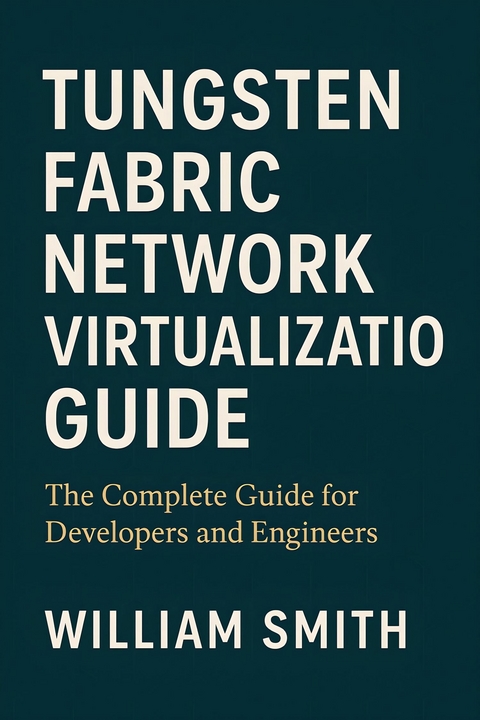
Tungsten Fabric Network Virtualization Guide (eBook)
250 Seiten
HiTeX Press (Verlag)
978-0-00-102854-8 (ISBN)
'Tungsten Fabric Network Virtualization Guide'
The 'Tungsten Fabric Network Virtualization Guide' is a comprehensive resource for professionals and organizations seeking to master software-defined networking (SDN) and virtualized network infrastructures. The book begins by establishing a solid foundation in the evolution, principles, and key technologies that underpin modern network virtualization, such as VXLAN, GRE, MPLS, and Network Functions Virtualization (NFV). Readers are acquainted with the challenges of traditional networking and discover how open-source innovation and community-driven ecosystems have shaped more agile, scalable, and secure network environments.
Diving deeply into Tungsten Fabric's architecture, the guide elucidates its design philosophy, core components-including the vRouter, Controller, and Analytics modules-and critical protocols that enable powerful integrations and automation. Thorough explorations of both data plane and control plane operations empower readers to understand virtual routing, encapsulation, traffic handling, and policy enforcement, as well as high-availability, resilience, and advanced network security models. With dedicated chapters on orchestration, RBAC, analytics, and the interplay between centralized and distributed management, the book provides the tools necessary for robust infrastructure control.
Further, the guide delivers practical expertise for real-world deployment, encompassing seamless integrations with OpenStack, Kubernetes, and public clouds such as AWS, Azure, and GCP. It covers advanced services-load balancing, NAT, firewalling, IPAM, DNS, and service chaining-essential for cloud-native and hybrid environments. With special attention to automation, DevOps integration, extensibility, compliance, and operational excellence (including monitoring, troubleshooting, and disaster recovery), this book is an indispensable manual for network architects, engineers, and administrators committed to building and operating secure, scalable, and future-ready virtualized networks.
Chapter 1
Network Virtualization Concepts and Background
Peering into the foundations of next-generation networking, this chapter traces the technological and conceptual breakthroughs that have redefined how we design, operate, and scale networks. Going beyond surface-level discussions, it reveals the interplay of virtualization paradigms, the evolution of network abstractions, and the critical shifts driving today’s programmable, agile, and cloud-driven infrastructure. By understanding this landscape, advanced practitioners can better architect, troubleshoot, and extend modern virtualized networks.
1.1 The Evolution of Network Virtualization
The transition from traditional, hardware-centric networking to virtualized, software-defined infrastructure has been driven by fundamental shifts in technological capabilities and operational requirements. The initial impetus emerged from the need to overcome the rigidity and inefficiency of legacy networks, which were characterized by physically segmented devices and tightly coupled control and data planes. This evolution was not instantaneous but followed a series of critical milestones that progressively abstracted and decoupled network functions from physical hardware.
One of the earliest and most influential advancements was the introduction of Virtual Local Area Networks (VLANs) in the 1990s. VLANs allowed multiple logical networks to coexist on a single physical switch infrastructure, effectively segmenting traffic without requiring dedicated hardware for each subnet. This innovation provided improved flexibility and resource utilization but remained fundamentally tied to the underlying physical topology and switch capabilities. Network policies and configurations were still managed on a device-by-device basis, limiting scalability and hindering centralized control.
The subsequent rise of hypervisor technologies in the early 2000s, particularly with the popularization of virtualization platforms such as VMware ESX, marked a profound shift. Hypervisors abstracted compute resources, allowing multiple virtual machines to share a single physical server. This decoupling of server infrastructure inspired a parallel movement in networking: virtual switches and virtual network interfaces began to appear within hypervisors, laying the groundwork for network virtualization. These virtual switches enabled dynamic creation and management of isolated network segments within a single physical host, enabling agility in resource allocation at the compute level. However, the network control and data planes remained distributed, often leading to operational complexity and limited end-to-end programmability.
The increasing demand for agile service delivery, rapid provisioning, and automation in large-scale data centers fueled a new generation of network virtualization solutions. Overlay networks emerged as a pivotal technology to address the limitations of VLANs and physical network constraints. Overlays encapsulate tenant traffic into tunnels over an existing IP network fabric, enabling arbitrary topologies and seamless mobility across physical boundaries. Protocols such as VXLAN (Virtual Extensible LAN), NVGRE (Network Virtualization using Generic Routing Encapsulation), and Geneve standardized the encapsulation techniques that allowed networks to scale beyond 4,096 VLANs. Overlays abstracted the Layer 2 connectivity from the underlying Layer 3 infrastructure, providing multi-tenancy, isolation, and greater scalability.
Simultaneously, Software-Defined Networking (SDN) principles advocated for the decoupling of the control plane from the data plane, allowing centralized, programmable control of the network state. The SDN paradigm facilitated increased automation and dynamic policy enforcement, closely aligning with the virtualized compute and storage domains to realize truly software-driven data centers. The OpenFlow protocol and controller platforms such as OpenDaylight and ONOS enabled fine-grained traffic management and adaptation to dynamic workloads, fundamentally changing how networks were designed and operated.
Cloud computing and distributed architectures further accelerated network virtualization. The elasticity and multi-tenancy requirements inherent in public and private cloud environments necessitated highly automated and scalable network provisioning. Virtualized networks became integral to cloud service models, enabling isolation, segmentation, and rapid creation or destruction of network instances in concert with virtual machines or containers. Network Function Virtualization (NFV) extended this paradigm by decoupling traditional network functions-firewalls, load balancers, and routers-from proprietary hardware appliances onto general-purpose servers. This shift reduced capital expenditures and improved service agility, allowing network functions to be chained dynamically and scaled elastically.
Distributed cloud workloads and microservices architectures imposed stringent demands for low-latency, high-bandwidth, and dynamic connectivity. Modern network virtualization platforms integrate with orchestration frameworks (e.g., Kubernetes, OpenStack) to enable seamless service chaining, automated policy enforcement, and telemetry-based performance optimization. The network abstraction layers now support programmability at multiple levels-from physical infrastructure to application-centric policies-enabling sophisticated traffic engineering and service assurance.
The evolution of network virtualization reflects a progression from static, hardware-bound constructs toward dynamic, software-controlled abstractions. Early VLANs introduced logical segmentation; hypervisor-based virtual switches enhanced host-level connectivity; overlays extended network boundaries and scale; and SDN coupled centralized control with automation. Cloud computing and distributed systems have driven virtualization demands toward greater agility, programmability, and elasticity. The convergence of these technologies continues to redefine network architectures, emphasizing flexibility and intelligence to meet the complex challenges of modern applications and services.
1.2 Core Principles of Software-Defined Networking
Software-Defined Networking (SDN) fundamentally redefines traditional network architectures by abstracting the control logic from the underlying hardware. The central tenet of SDN lies in the logical separation of the control plane and data plane, which enables unprecedented agility, programmability, and centralized management of network resources.
In conventional network devices, such as routers and switches, the control plane—responsible for decision-making about where traffic is sent—and the data plane—responsible for forwarding traffic based on these decisions—are tightly coupled within the same physical device. SDN decouples these functions, relocating the control plane to a logically centralized controller, while data plane devices become simple packet forwarding elements governed via software instructions. This architectural shift allows the network control logic to be abstracted as software, facilitating easier modification and automation.
The centralization of control logic in SDN architectures gives rise to two principal controller deployment models: centralized and distributed.
- A centralized controller model consolidates all decision-making in a single logically centralized entity, which simplifies global network visibility, state management, and policy enforcement. However, this approach can introduce scalability and resilience challenges as network size and complexity grow.
- Distributed controller architectures partition control responsibilities across multiple controller instances, often geographically or logically separated but communicating through east-west interfaces to maintain a consistent network state. Such distributed systems improve fault tolerance, reduce latency in control decisions, and enhance scalability, albeit with increased complexity in state synchronization and conflict resolution.
Programmable Application Programming Interfaces (APIs) between the controller and network devices are essential to implement SDN’s vision.
- Southbound APIs, such as OpenFlow, NETCONF, or proprietary extensions, enable granular control over forwarding behavior by specifying flow rules, packet matching criteria, and actions directly to data plane entities.
- Northbound APIs expose abstracted network functions and states to higher-level applications, enabling orchestration platforms, policy engines, and analytics tools to program the network dynamically.
This programmable interface model decouples network management and control from vendor-specific implementations, fostering an ecosystem for rapid innovation and interoperability.
The SDN architectural landscape can be classified into three layers: the infrastructure layer, control layer, and application layer.
- The infrastructure layer consists of physical or virtual switches and routers that forward packets based solely on control instructions.
- The control layer embodies the...
| Erscheint lt. Verlag | 20.8.2025 |
|---|---|
| Sprache | englisch |
| Themenwelt | Mathematik / Informatik ► Informatik ► Programmiersprachen / -werkzeuge |
| ISBN-10 | 0-00-102854-5 / 0001028545 |
| ISBN-13 | 978-0-00-102854-8 / 9780001028548 |
| Informationen gemäß Produktsicherheitsverordnung (GPSR) | |
| Haben Sie eine Frage zum Produkt? |
 EPUB (Adobe DRM)
Größe: 743 KB
Kopierschutz: Adobe-DRM
Adobe-DRM ist ein Kopierschutz, der das eBook vor Mißbrauch schützen soll. Dabei wird das eBook bereits beim Download auf Ihre persönliche Adobe-ID autorisiert. Lesen können Sie das eBook dann nur auf den Geräten, welche ebenfalls auf Ihre Adobe-ID registriert sind.
Details zum Adobe-DRM
Dateiformat: EPUB (Electronic Publication)
EPUB ist ein offener Standard für eBooks und eignet sich besonders zur Darstellung von Belletristik und Sachbüchern. Der Fließtext wird dynamisch an die Display- und Schriftgröße angepasst. Auch für mobile Lesegeräte ist EPUB daher gut geeignet.
Systemvoraussetzungen:
PC/Mac: Mit einem PC oder Mac können Sie dieses eBook lesen. Sie benötigen eine
eReader: Dieses eBook kann mit (fast) allen eBook-Readern gelesen werden. Mit dem amazon-Kindle ist es aber nicht kompatibel.
Smartphone/Tablet: Egal ob Apple oder Android, dieses eBook können Sie lesen. Sie benötigen eine
Geräteliste und zusätzliche Hinweise
Buying eBooks from abroad
For tax law reasons we can sell eBooks just within Germany and Switzerland. Regrettably we cannot fulfill eBook-orders from other countries.
aus dem Bereich


