


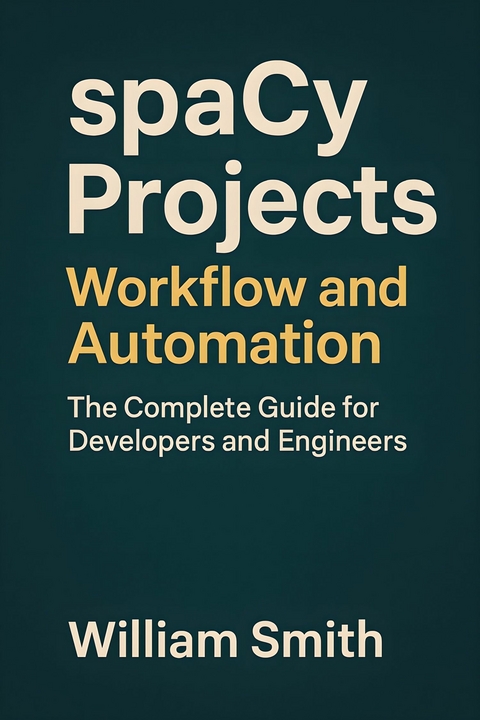
spaCy Projects Workflow and Automation (eBook)
250 Seiten
HiTeX Press (Verlag)
978-0-00-102842-5 (ISBN)
'spaCy Projects Workflow and Automation'
'spaCy Projects Workflow and Automation' is an authoritative guide that explores the intricacies of designing, automating, and operating robust NLP pipelines using spaCy Projects. The book unveils advanced architectural concepts, illuminating the clear advantages of structured workflows over traditional scripting, and offering a deep dive into project metadata management, configuration-driven automation, modular recipe design, and comprehensive dependency resolution strategies. By systematically covering workflow reproducibility and versioning, it empowers practitioners to deliver transparent and traceable NLP systems suitable for both research and industrial environments.
Progressing from foundational principles to production-grade implementations, the book maps out best practices for building scalable, end-to-end pipelines encompassing data preprocessing, training, evaluation, artifact management, and fault tolerance. It details automation techniques ranging from project initialization and command-line orchestration to advanced task scheduling, integration with modern job managers, and continuous model retraining. Furthermore, dedicated chapters on CI/CD, collaboration, experiment tracking, and extensibility demonstrate how spaCy Projects unlocks efficient team workflows, rigorous governance, and rapid iteration-all while ensuring security, compliance, and robust operational monitoring.
Enriched by comprehensive insights into debugging, testing, resilience engineering, and cutting-edge case studies, 'spaCy Projects Workflow and Automation' is the definitive resource for data scientists, ML engineers, and NLP practitioners looking to industrialize natural language workflows. Whether architecting microservice-based solutions, navigating regulatory constraints, or experimenting at scale with LLMs, readers will gain actionable strategies and future-proof patterns to master workflow automation in the evolving world of NLP.
Chapter 2
Building Production-grade NLP Pipelines with spaCy Projects
What does it take to move from lab experiments to resilient, scalable NLP applications running 24/7 in production? This chapter reveals best practices and advanced design patterns for constructing enterprise-class NLP pipelines with spaCy Projects. Discover how to seamlessly integrate multiple pipeline stages, orchestrate artifacts, and engineer resilient workflows that deliver robust, auditable results at scale.
2.1 Constructing End-to-End NLP Workflows
An effective end-to-end natural language processing pipeline integrates distinct stages-data ingestion, preprocessing, modeling, and deployment-into a cohesive, automated workflow that facilitates reproducibility, scalability, and maintainability. Within the spaCy Projects framework, assembling such pipelines requires careful orchestration of interdependent tasks and artifacts, enabling streamlined flow from raw text data to deployed NLP models ready for production use.
Large-scale NLP workflows can become complex quickly, necessitating decomposition into modular units with clear responsibilities. A common architectural pattern employs a layered pipeline consisting of the following modules:
- Data Ingestion Module: Handles raw data acquisition and normalization, including streaming or batch loading from sources such as databases, web APIs, or corpora.
- Preprocessing Module: Performs tokenization, normalization, linguistic annotation (e.g., part-of-speech tagging), and format conversions to prepare data for model training.
- Modeling Module: Covers training, evaluation, and tuning of models, maintaining checkpoints and metrics artifacts.
- Deployment Module: Packages the trained model for inference, manages serving endpoints, and automates integration with client applications or pipelines.
Each module encapsulates independent logic and resources to promote separation of concerns and ease iterative development. Within spaCy Projects, these modules translate into a series of commands and scripts, linked via explicitly declared inputs and outputs in the project.yml file.
Ensuring smooth data and artifact flow between stages necessitates standardized intermediate formats and reliable artifact management. For example, the output data of the ingestion stage should conform to formats directly consumable by the preprocessing stage, such as JSON Lines with consistent schema annotations.
To illustrate, consider the following extract from project.yml specifying command dependencies and artifact flow:
- name: download_data
script: scripts/download_data.py
outputs:
- data/raw/dataset.jsonl
- name: preprocess_data
script: scripts/preprocess.py
inputs:
- data/raw/dataset.jsonl
outputs:
- data/processed/train.spacy
- data/processed/dev.spacy
- name: train_model
script: scripts/train.py
inputs:
- data/processed/train.spacy
- data/processed/dev.spacy
outputs:
- models/model-best
- name: package_model
...
| Erscheint lt. Verlag | 20.8.2025 |
|---|---|
| Sprache | englisch |
| Themenwelt | Mathematik / Informatik ► Informatik ► Programmiersprachen / -werkzeuge |
| ISBN-10 | 0-00-102842-1 / 0001028421 |
| ISBN-13 | 978-0-00-102842-5 / 9780001028425 |
| Informationen gemäß Produktsicherheitsverordnung (GPSR) | |
| Haben Sie eine Frage zum Produkt? |
 EPUB (Adobe DRM)
Größe: 639 KB
Kopierschutz: Adobe-DRM
Adobe-DRM ist ein Kopierschutz, der das eBook vor Mißbrauch schützen soll. Dabei wird das eBook bereits beim Download auf Ihre persönliche Adobe-ID autorisiert. Lesen können Sie das eBook dann nur auf den Geräten, welche ebenfalls auf Ihre Adobe-ID registriert sind.
Details zum Adobe-DRM
Dateiformat: EPUB (Electronic Publication)
EPUB ist ein offener Standard für eBooks und eignet sich besonders zur Darstellung von Belletristik und Sachbüchern. Der Fließtext wird dynamisch an die Display- und Schriftgröße angepasst. Auch für mobile Lesegeräte ist EPUB daher gut geeignet.
Systemvoraussetzungen:
PC/Mac: Mit einem PC oder Mac können Sie dieses eBook lesen. Sie benötigen eine
eReader: Dieses eBook kann mit (fast) allen eBook-Readern gelesen werden. Mit dem amazon-Kindle ist es aber nicht kompatibel.
Smartphone/Tablet: Egal ob Apple oder Android, dieses eBook können Sie lesen. Sie benötigen eine
Geräteliste und zusätzliche Hinweise
Buying eBooks from abroad
For tax law reasons we can sell eBooks just within Germany and Switzerland. Regrettably we cannot fulfill eBook-orders from other countries.
aus dem Bereich


