


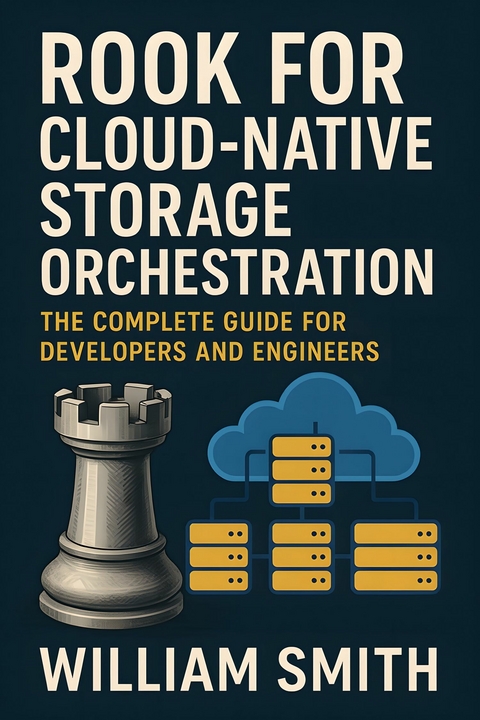
Rook for Cloud-Native Storage Orchestration (eBook)
250 Seiten
HiTeX Press (Verlag)
978-0-00-102800-5 (ISBN)
'Rook for Cloud-Native Storage Orchestration'
'Rook for Cloud-Native Storage Orchestration' is the definitive guide for professionals and architects aiming to master robust, scalable, and secure storage management within dynamic Kubernetes clusters. The book meticulously sets the stage by exploring foundational cloud-native storage concepts, from distributed architectures and persistent workloads to the limitations of traditional storage solutions in modern environments. Readers are led through the evolution and principles of storage orchestration, gaining clarity on the necessity of automation, resilience, and scalability for persistent data in containerized applications.
Delving deep into Rook's architecture, the book unpacks the inner workings of operators, controllers, and pluggable backends, illuminating how Rook seamlessly extends Kubernetes for stateful storage orchestration. Step-by-step guidance on deployment strategies, monitoring, upgrades, and resilience engineering prepare readers to design and operate production-grade storage clusters. Through an extensive exploration of Rook's integration with Ceph and other backends like NFS and Cassandra, the text provides practical insights for tuning, securing, and optimizing high-availability, enterprise-class data platforms tailored to diverse cloud and edge use cases.
Beyond deployment and operations, the book offers a thorough framework for security, compliance, performance troubleshooting, and multi-tenancy, empowering readers to protect mission-critical workloads and streamline audits. The concluding chapters survey emerging trends in storage, intelligent automation with AI, zero-trust security, and federated data governance-culminating in real-world case studies and community-driven innovation pathways. Whether you're designing storage for analytics, big data, or serverless applications, this comprehensive resource positions you to lead in the cloud-native storage frontier with Rook.
Chapter 2
Rook Architecture and Internal Mechanisms
Rook transforms Kubernetes into a fully-featured storage orchestrator by bridging the gap between cloud-native operations and sophisticated, distributed storage systems. This chapter reveals the nuanced machinery behind Rook’s seamless extension of Kubernetes APIs, detailing the modular, resilient, and extensible internal framework that empowers operators to automate, secure, and scale data infrastructure on demand. Prepare to uncover the inner workings that have made Rook central to next-generation cloud storage.
2.1 Operator Patterns and Custom Resource Definitions
Rook exemplifies the power of extending Kubernetes with Operator patterns and Custom Resource Definitions (CRDs), enabling storage to be managed as an integrated, first-class citizen within the Kubernetes ecosystem. The fundamental principle underpinning this architecture is the declarative model, which abstracts the complexity of configuring and operating storage systems by encapsulating them as Kubernetes-native resources.
At the core, Rook defines a suite of CRDs representing the desired state and configuration of various storage backends, such as Ceph, EdgeFS, and Cassandra. These custom resources extend the Kubernetes API, presenting storage concepts and configurations in an idiomatic Kubernetes manner. Through CRDs, Rook transforms traditionally external and manually operated storage infrastructure into Kubernetes-managed entities, thereby aligning storage lifecycle and configuration with the native Kubernetes resource management paradigm.
The declarative nature of CRDs empowers cluster operators and developers to specify the intended state of storage clusters using YAML manifests. This infrastructure-as-code model simplifies reproducibility, versioning, and automation. Once a custom resource is applied, the Operator’s reconciliation loop continuously monitors the current cluster state against the declared state. This event-driven reconciliation process is central to ensuring consistency and self-healing capabilities of the storage system.
The Rook Operator embodies the control loop pattern characteristic of Kubernetes Operators. It watches for events on custom resources—creation, updates, and deletions—and triggers appropriate reconciliation logic. For example, when a CephCluster resource is instantiated, the Rook Operator interprets the specification and performs a series of coordinated actions: provisioning storage daemons, configuring cluster networking, initializing object stores, and establishing monitoring components. These steps are executed incrementally and idempotently, allowing the system to converge toward the desired state even in the presence of transient failures or changes.
The sophistication of these reconciliations reflects the complexity of managing distributed, stateful services such as storage clusters. The Operator must manage intricate lifecycle stages including bootstrap, scale-out, upgrade, failure recovery, and graceful teardown. By embedding domain-specific knowledge into the Operator code, Rook automates these processes in a way that is transparent to the user but deeply integrated within the Kubernetes control plane.
A representative example of such a CRD is the CephCluster resource, which encapsulates configuration parameters like storage device selection, placement strategies, resource allocations, and network settings. Consider the following manifest snippet:
kind: CephCluster
metadata:
name: rook-ceph
namespace: rook-ceph
spec:
cephVersion:
image: ceph/ceph:v16.2.6
dataDirHostPath: /var/lib/rook
mon:
count: 3
allowMultiplePerNode: false
storage:
useAllNodes: true
useAllDevices: false
deviceFilter: "sd."
Upon submission of this resource, the Rook Operator triggers reconciliation, which involves creating the necessary Kubernetes Deployments, DaemonSets, ConfigMaps, and Services to establish and maintain the Ceph storage cluster consistent with the declared specification.
Operational observability is also surfaced through additional custom resources, such as CephBlockPool and CephFilesystem, which represent storage abstractions consumable by cluster workloads. These custom objects facilitate declarative provisioning of block devices and shared file systems, with the Operator ensuring corresponding backend provisioning and health maintenance.
The event-driven reconciliation model inherently supports dynamic interactions with cluster resources. For instance, scaling the number of monitors or OSDs simply entails updating the relevant fields in the custom resource, prompting the Operator to orchestrate rolling updates or the addition of new daemon instances. Similarly, the Operator handles complex dependency management and sequencing required for multi-component storage systems, coordinating tasks such as bootstrapping monitors before OSDs and integrating with Kubernetes storage classes and PersistentVolumeClaims.
Additionally, Rook’s Operator leverages Kubernetes finalizers and owner references to manage resource deletion, ensuring that cluster-wide cleanup actions execute correctly and the storage state is gracefully dismantled when a custom resource is removed. This design prevents orphaned resources and minimizes data loss or inconsistency risks.
Through these mechanisms, Rook effectively transforms Kubernetes into a unified platform where storage is no longer external or auxiliary but an intrinsic component governed declaratively. This approach fosters portability, consistency, and automation, reducing operational overhead while delivering robust, scalable storage solutions aligned with native Kubernetes lifecycle management philosophies.
Rook’s implementation of the Operator pattern and CRDs provides a blueprint for...
| Erscheint lt. Verlag | 20.8.2025 |
|---|---|
| Sprache | englisch |
| Themenwelt | Mathematik / Informatik ► Informatik ► Programmiersprachen / -werkzeuge |
| ISBN-10 | 0-00-102800-6 / 0001028006 |
| ISBN-13 | 978-0-00-102800-5 / 9780001028005 |
| Informationen gemäß Produktsicherheitsverordnung (GPSR) | |
| Haben Sie eine Frage zum Produkt? |
 EPUB (Adobe DRM)
Größe: 829 KB
Kopierschutz: Adobe-DRM
Adobe-DRM ist ein Kopierschutz, der das eBook vor Mißbrauch schützen soll. Dabei wird das eBook bereits beim Download auf Ihre persönliche Adobe-ID autorisiert. Lesen können Sie das eBook dann nur auf den Geräten, welche ebenfalls auf Ihre Adobe-ID registriert sind.
Details zum Adobe-DRM
Dateiformat: EPUB (Electronic Publication)
EPUB ist ein offener Standard für eBooks und eignet sich besonders zur Darstellung von Belletristik und Sachbüchern. Der Fließtext wird dynamisch an die Display- und Schriftgröße angepasst. Auch für mobile Lesegeräte ist EPUB daher gut geeignet.
Systemvoraussetzungen:
PC/Mac: Mit einem PC oder Mac können Sie dieses eBook lesen. Sie benötigen eine
eReader: Dieses eBook kann mit (fast) allen eBook-Readern gelesen werden. Mit dem amazon-Kindle ist es aber nicht kompatibel.
Smartphone/Tablet: Egal ob Apple oder Android, dieses eBook können Sie lesen. Sie benötigen eine
Geräteliste und zusätzliche Hinweise
Buying eBooks from abroad
For tax law reasons we can sell eBooks just within Germany and Switzerland. Regrettably we cannot fulfill eBook-orders from other countries.
aus dem Bereich


