


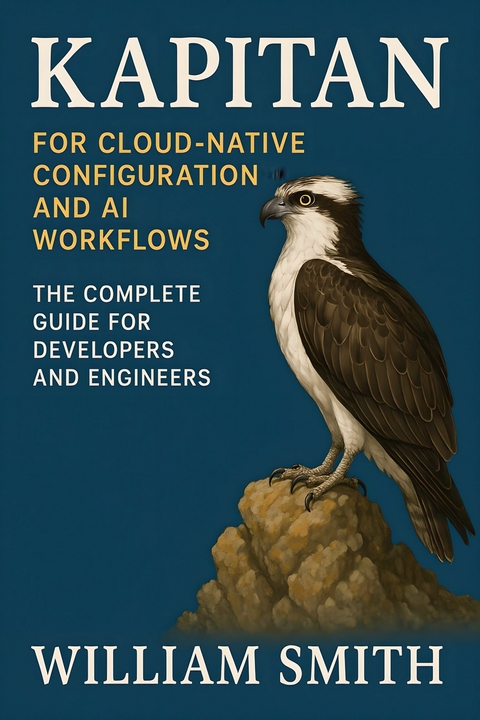
Kapitan for Cloud-Native Configuration and AI Workflows (eBook)
250 Seiten
HiTeX Press (Verlag)
978-0-00-102792-3 (ISBN)
'Kapitan for Cloud-Native Configuration and AI Workflows'
Kapitan for Cloud-Native Configuration and AI Workflows is the definitive guide for technology leaders, architects, and practitioners seeking to master configuration management at scale. This comprehensive resource begins by tracing the evolution from imperative to declarative paradigms, contextualizing current best practices in DevOps, GitOps, and infrastructure as code. Readers build a strong foundation in cloud-native principles-including microservices, container orchestration, and the critical role of configuration as code-before advancing to conquer the challenges of distributed systems, environment consistency, and the unique operational requirements of AI and MLOps pipelines.
Delving deep into the heart of Kapitan, the book provides a detailed exploration of its architecture, templating engines, and advanced features such as hierarchical inventory, parameterization, secret management, and compliance automation. Each chapter offers actionable insights on designing reusable templates, enforcing schema contracts, and orchestrating configuration across diverse cloud environments. Essential enterprise concerns-including security, zero trust, auditing, disaster recovery, and multi-environment deployments-are covered with depth and clarity, empowering readers to maintain robust, compliant, and scalable infrastructure.
The text culminates in practical guidance for integrating Kapitan into modern delivery pipelines, orchestrating complex AI/ML workflows, and extending its capabilities through plugins and interoperability with tools like Terraform and Crossplane. From implementing policy-as-code, identity management, and observability, to future-proofing for emerging AI-augmented automation and community-driven governance, this book is an indispensable companion for navigating the intricacies of cloud-native configuration in the era of intelligent automation.
Chapter 1
Foundations of Cloud-Native Configuration Management
In the ever-shifting terrain of cloud-native systems, configuration is no longer a static concern but the lifeblood of scalable, robust, and automated platforms. This chapter embarks on a journey through the evolution of configuration management, uncovering the principles and operational demands that underpin modern infrastructure, and revealing why mastering these foundations is essential for anyone building future-ready cloud-native or AI-powered environments.
1.1 Evolution of Configuration Management
The trajectory of configuration management has evolved from rudimentary imperative scripts toward sophisticated declarative paradigms, mirroring the maturation of software engineering and system administration disciplines. Early configuration practices were primarily imperative, relying on explicit sequences of commands executed to achieve the desired system state. These scripts, often shell-based or written in scripting languages such as Perl or Python, required administrators to encode step-by-step procedures that left limited room for abstraction or idempotency. Consequently, the fragility and lack of reproducibility hindered scalability and collaboration in complex environments.
Imperative configuration management was characterized by direct control over the execution flow, emphasizing procedural logic and manual intervention. While effective for small-scale systems, this approach struggled under the increasing complexity and dynamism of modern infrastructure. Errors propagated easily due to implicit state dependencies and variations in execution contexts, leading to inconsistent configuration states and operational drift. Furthermore, the intrinsic coupling between instructions and state made declarative reasoning about the desired outcome difficult, complicating automated verification and auditing processes.
The transition to declarative configuration management marked a paradigm shift by separating what the system state should be from how to achieve it. Declarative models describe the target configuration as a desired state or end condition, enabling the management system to determine the necessary actions to attain that state autonomously. This abstraction facilitates idempotency, ensuring that repeated application of configuration yields the same results without unintended side effects. Tools implementing declarative configuration, such as Puppet, Chef’s declarative components, and later Ansible, introduced domain-specific languages (DSLs) and resource modeling to express infrastructure as code (IaC).
Infrastructure as code emerged as a foundational concept in this evolutionary pathway, advocating the treatment of system configurations, environments, and deployment scripts as version-controlled, testable software artifacts. This shift allowed configuration histories to be tracked, audited, and rolled back reliably, enhancing reproducibility and traceability. IaC embraced principles from software engineering-unit testing, continuous integration, and modular design-to infrastructure management, which historically had relied on ad hoc practices. These capabilities became critical as organizations adopted increasingly heterogeneous and distributed architectures, including cloud, hybrid, and containerized environments.
The rise of DevOps culture intertwined closely with these technical advances, promoting synergy between development and operations teams through shared responsibility, automation, and continuous delivery pipelines. DevOps philosophies catalyzed the adoption of declarative IaC tools by embedding configuration management within end-to-end lifecycle processes. By automating provisioning, configuration, and monitoring, DevOps practices reduced manual bottlenecks and accelerated delivery cycles while improving reliability and consistency. This cultural movement emphasized collaboration and transparency, dismantling traditional silos and fostering collective ownership of configuration artifacts.
Building upon DevOps, the GitOps paradigm instituted a more rigorous framework structuring infrastructure and application configuration changes as pull requests within Git repositories. GitOps enforces declarative state management where the live system continuously reconciles itself against the version-controlled declarative manifests stored in Git, effectively making Git the single source of truth. This mechanism enhances auditability by providing immutable records of configuration changes and promotes safe, reviewable, and reversible modifications via standard software development workflows. Architecturally, GitOps leverages controllers and agents-often implemented as Kubernetes operators-to perform automated, event-driven synchronization of cluster state, facilitating real-time observability and self-healing capabilities.
From a change management perspective, the shift toward declarative IaC, DevOps, and GitOps frameworks fundamentally transforms the operational model. Changes are no longer ad hoc scripts or manual procedures but codified, peer-reviewed, and tested alterations to source code repositories. The automated reconciliation between desired states and actual systems reduces configuration drift and accelerates incident remediation through predictable rollbacks. Operational complexity is mitigated by encapsulating configuration logic into composable, reusable modules, promoting standardization.
Collaboration improves markedly as IaC artifacts become first-class versioned entities accessible to cross-functional teams, bridging development, operations, and quality assurance roles. Shared repositories function as both knowledge bases and execution triggers, facilitating asynchronous coordination and continuous feedback loops. The declarative approach also enhances reproducibility by enabling the entire infrastructure footprint to be instantiated consistently across environments, such as development, testing, staging, and production, reducing environment-specific defects and deployment inconsistencies.
Architecturally, adopting declarative configuration management influences system design by encouraging immutable infrastructure, where changes result in new environment instances rather than in-place modifications. This paradigm reduces configuration entropy and simplifies rollback strategies. Moreover, the fine-grained definition of resources enables automated dependency resolution, orchestration, and complex lifecycle management, driving increased automation and operational efficiency.
The evolution from imperative to declarative configuration management-catalyzed by IaC principles, DevOps methodologies, and GitOps workflows-has reshaped the engineering culture and operational landscape. Configuration has transcended from mere system setup instructions into a critical centerpiece of modern robust system design, underpinning repeatability, reliability, and collaborative innovation in contemporary infrastructure management.
1.2 Cloud-Native Architecture Essentials
Cloud-native systems are engineered to harness the capabilities and dynamics of cloud platforms, enabling elasticity, resilience, and rapid evolution. At their core lie architectural building blocks that collectively facilitate scalability, fault isolation, and operational agility. The following analysis systematically dissects these fundamental components: microservices, service discovery, containerization, orchestration, and the attendant configuration complexities inherent to dynamic, multi-tenant environments.
Microservices represent the decomposition of applications into loosely coupled, independently deployable services, each encapsulating specific business capabilities. This architecture contrasts sharply with monolithic designs, emphasizing modularity and the ability to evolve services discretely. Each microservice typically encompasses its own datastore and API, enabling scalability and fault tolerance at the service level. However, this decomposition introduces distributed system challenges, notably inter-service communication, network latency, and consistency management.
Service discovery mechanisms become indispensable within microservice ecosystems to dynamically identify and connect services without hardcoded configurations. Traditional static IP configurations prove inadequate as services are ephemeral, scaling up and down in response to demand. Service discovery solutions categorize into client-side and server-side patterns: client-side discovery involves clients querying a registry to obtain service endpoints, while server-side discovery delegates routing to intermediaries, such as load balancers. Tools like Consul, Etcd, and built-in Kubernetes services integrate service registry and health checks to support accurate and resilient service location.
Containerization abstracts application execution environments, packaging code and dependencies into container images. Containers provide lightweight isolation compared to virtual machines, fostering rapid startup and resource-efficient execution. Docker has emerged as the de facto container runtime standard, enabling consistent deployments across heterogeneous infrastructure. The immutable nature of container images enhances deployment predictability but demands meticulous image management and versioning to...
| Erscheint lt. Verlag | 20.8.2025 |
|---|---|
| Sprache | englisch |
| Themenwelt | Mathematik / Informatik ► Informatik ► Programmiersprachen / -werkzeuge |
| ISBN-10 | 0-00-102792-1 / 0001027921 |
| ISBN-13 | 978-0-00-102792-3 / 9780001027923 |
| Informationen gemäß Produktsicherheitsverordnung (GPSR) | |
| Haben Sie eine Frage zum Produkt? |
 EPUB (Adobe DRM)
Größe: 660 KB
Kopierschutz: Adobe-DRM
Adobe-DRM ist ein Kopierschutz, der das eBook vor Mißbrauch schützen soll. Dabei wird das eBook bereits beim Download auf Ihre persönliche Adobe-ID autorisiert. Lesen können Sie das eBook dann nur auf den Geräten, welche ebenfalls auf Ihre Adobe-ID registriert sind.
Details zum Adobe-DRM
Dateiformat: EPUB (Electronic Publication)
EPUB ist ein offener Standard für eBooks und eignet sich besonders zur Darstellung von Belletristik und Sachbüchern. Der Fließtext wird dynamisch an die Display- und Schriftgröße angepasst. Auch für mobile Lesegeräte ist EPUB daher gut geeignet.
Systemvoraussetzungen:
PC/Mac: Mit einem PC oder Mac können Sie dieses eBook lesen. Sie benötigen eine
eReader: Dieses eBook kann mit (fast) allen eBook-Readern gelesen werden. Mit dem amazon-Kindle ist es aber nicht kompatibel.
Smartphone/Tablet: Egal ob Apple oder Android, dieses eBook können Sie lesen. Sie benötigen eine
Geräteliste und zusätzliche Hinweise
Buying eBooks from abroad
For tax law reasons we can sell eBooks just within Germany and Switzerland. Regrettably we cannot fulfill eBook-orders from other countries.
aus dem Bereich


