


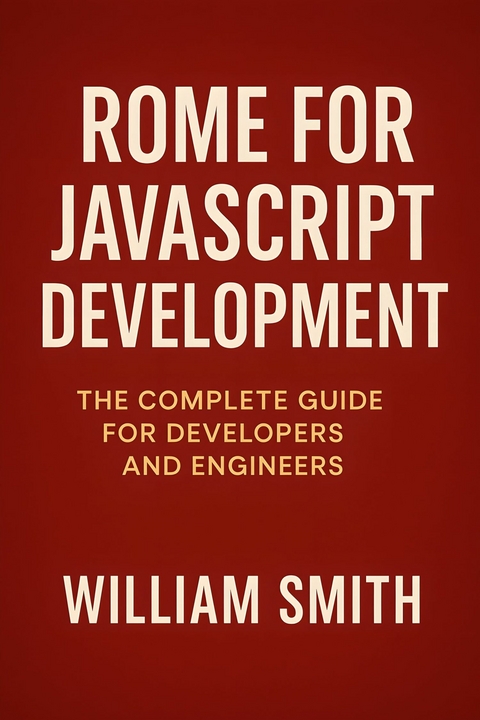
Rome for JavaScript Development (eBook)
250 Seiten
HiTeX Press (Verlag)
978-0-00-102788-6 (ISBN)
'Rome for JavaScript Development'
'Rome for JavaScript Development' is an authoritative and comprehensive guide to one of the most ambitious tooling platforms in the modern JavaScript landscape. Through a deep exploration of Rome's vision, philosophy, and modular architecture, this book provides developers and engineering leaders with the knowledge needed to harness Rome's unified approach - spanning linting, formatting, bundling, static analysis, and security - to their fullest extent. The foundational chapters examine Rome's design rationale, configuration paradigms, and strategic role among established toolchains, setting the stage for advanced technical mastery.
As readers progress, the book offers expert insights into Rome's programmatic APIs, extensibility mechanisms, and service orchestration, complemented by detailed instructions for architecting scalable, multi-package JavaScript codebases. Dedicated sections delve into the intricacies of custom lint and format rules, performance tuning for large-scale repositories, automation in CI/CD workflows, and seamless integration with test runners, static analysis, and code quality gates. The text provides real-world perspectives on technical debt monitoring, continuous improvement, and the integration of security best practices at every stage of the software development lifecycle.
Rounding out its practical focus, 'Rome for JavaScript Development' explores Rome's applicability in enterprise and distributed settings, equipping teams to manage monorepos, distributed builds, organization-wide code governance, and data-driven workflows. Forward-thinking chapters highlight Rome's open-source governance, plugin ecosystem, community growth, and adaptability to future platform shifts. Whether adopting Rome for a greenfield project or migrating complex legacy infrastructure, this book serves as an essential companion, offering both strategic guidance and hands-on technical depth for advancing JavaScript engineering productivity and code quality at any scale.
Chapter 1
Foundations of Rome
Before leveraging Rome as a transformative toolchain for JavaScript development, it is crucial to understand its core motivations and architecture. This chapter sheds light on the principles that inspired Rome, its modern approach to integrating diverse tooling, and its uniquely ambitious aims within the evolving JavaScript ecosystem. We’ll explore how Rome’s foundational ideas pave the way for scalable, maintainable, and future-ready codebases, offering context for the advanced features examined in later chapters.
1.1 Rome’s Vision and Philosophy
Rome emerged as a response to the fragmentation and complexity pervasive in the JavaScript tooling ecosystem. Historically, JavaScript development involved assembling disparate tools for linting, formatting, bundling, testing, and more. Each component often required separate configuration files, inconsistent command interfaces, or ad-hoc integrations that demanded significant manual setup and maintenance. This fragmented landscape contributed to slower development workflows, increased likelihood of configuration errors, and inconsistent developer experiences across teams and projects.
At its core, Rome’s foundational philosophy advocates for the unification of these traditionally siloed toolchains into a single, cohesive platform. This unification is not merely a convenience but a strategic realignment aimed at improving both developer productivity and the quality of codebases. By providing a centralized, configurable system, Rome seeks to eliminate redundant tooling layers, reduce cognitive overhead, and foster consistency across JavaScript projects of varying scale and complexity.
The vision of Rome rests on three interrelated pillars: developer experience, consistency, and performance. Enhancing developer experience entails streamlining toolchain interactions through intuitive command interfaces and robust automation. Rome consolidates multiple workflows-linting, formatting, compilation, and testing-under one roof, thereby minimizing context switching and reducing setup friction. This holistic approach enables developers to focus primarily on application logic rather than the mechanics of tooling orchestration.
Consistency represents a critical enabler of maintainable code and reliable collaboration. Rome enforces standardized configurations and conventions, thereby mitigating typical “works on my machine” issues and divergent stylistic interpretations. By integrating all processes within a unified framework, it ensures that code quality standards and build behaviors remain uniform across diverse environments. Such standardization directly supports scalable team workflows and facilitates onboarding new contributors with minimal configuration overhead.
Performance considerations are embedded from the outset, acknowledging that developer efficiency depends not only on usability but also on tooling responsiveness. Rome is built with an emphasis on speed and incremental computation, incorporating mechanisms like abstract syntax tree (AST) caching and parallel task execution. These optimizations reduce latency in feedback cycles, enabling instantaneous linting or formatting as code changes. This emphasis on responsive tooling directly contributes to more fluid edit-build-test loops essential for modern development demands.
Motivations behind Rome’s inception are multifaceted yet coherent. One driver is the recognition that the JavaScript ecosystem’s combinatorial complexity has long outgrown ad hoc integration strategies. By reimagining tooling as a unified platform rather than a suite of loosely connected utilities, Rome aims to reverse technical debt accumulation pervasive in many projects. Another motivation lies in the growing need for reproducible builds and deterministic behaviors-constraints difficult to guarantee with disparate tools and shifting dependencies. Rome’s centralized control over configuration and execution fosters reproducibility and predictability.
Furthermore, Rome’s open architecture accommodates extensibility without sacrificing its core cohesiveness. Configurability remains a paramount design principle to ensure flexibility without reintroducing fragmentation through uncoordinated plugins or tool forks. This balance is maintained by defining clear extension points and promoting coherent defaults, which encourage customization aligned with overarching principles rather than arbitrary divergence.
The role of Rome within the larger JavaScript ecosystem is as both a catalyst and a foundation. It challenges prevailing assumptions about tool modularity by demonstrating that integrated solutions can be both powerful and adaptable. As a catalyst, it inspires reevaluation of toolchain design philosophies, encouraging other projects to prioritize usability and holistic workflow integration. As a foundation, it aims to evolve into a stable, comprehensive platform upon which the community can reliably build, innovate, and standardize.
Rome’s philosophy also implicitly acknowledges the evolving nature of JavaScript development itself. As frameworks, language features, and runtime environments diversify, tooling must adapt without exacerbating complexity. By abstracting common concerns beneath a unified interface, Rome positions itself as an enabler for future innovations rather than a limiting legacy system. This forward-thinking stance aligns with contemporary best practices of progressive enhancement and modular extensibility, further reinforcing Rome’s strategic relevance.
In summary, Rome’s vision and philosophy encapsulate a deliberate shift toward integrated, consistent, and performant JavaScript tooling. Motivated by the desire to improve developer experience and reduce fragmentation, Rome’s design principles advocate a cohesive platform that harmonizes configuration, automation, and extensibility. Its evolving role in the ecosystem promises to simplify complex workflows, drive standardization, and sustain agile progress in JavaScript development practices.
1.2 Architecture and Design Principles
Rome’s architecture exemplifies a rigorously modular design paradigm, centralizing on separation of concerns to optimize both performance and maintainability. This approach is implemented through core abstractions and layered execution models that effectively decouple independent functionalities while facilitating seamless integration. At the heart of this design lies a strategic choice to implement critical components in Rust, a systems programming language distinguished by its guarantees of memory safety and zero-cost abstractions, thereby ensuring robust performance without compromising security.
The modular design of Rome is grounded on discrete, well-defined components, each encapsulating specific responsibilities. These components interact through clearly specified interfaces, minimizing global state dependencies and enabling isolated testing and development. The highest-level modules orchestrate workflow direction and policy, invoking lower-level systems responsible for file operations, parsing, transformation, and output generation. This hierarchy embodies the principle of separation of concerns, where each module focuses on a singular aspect, mitigating complexity and fostering clearer reasoning about system behavior.
Rust’s ownership and borrowing semantics critically support this modular structure by eliminating classes of concurrency bugs and undefined behaviors at compile time. Such guarantees are invaluable in the context of Rome, where parallelism and low-level system interactions are pervasive. For example, the compiler module responsible for syntax and type analysis benefits from Rust’s strong typing and memory safety, enabling real-time, incremental compilation without unexpected crashes or data races. This also facilitates aggressive optimizations because the compiler can reliably assume memory consistency throughout transformations.
The execution model within Rome is designed to be both incremental and event-driven. Incremental processing minimizes redundant work by tracking dependencies and only reprocessing altered inputs, thus accelerating repeated operations and improving developer feedback loops. The event-driven approach allows asynchronous triggering of tasks, enabling parallel execution fibers that can cooperatively schedule workloads based on resource availability. This model is underpinned by a directed acyclic graph (DAG) of tasks, where each node represents a discrete transformation or analysis stage, and edges denote data dependencies. By leveraging this graph, Rome ensures deterministic execution order while permitting fine-grained parallelism.
Core abstractions in Rome include the representation of source artifacts, transformation pipelines, and execution contexts. Source artifacts are immutable snapshots of code or configuration inputs, encapsulating versioning metadata to support incremental updates. Transformation pipelines are composable sequences of analyzers, optimizers, and emitters, designed as functionally pure operations wherever possible to simplify caching and concurrency. Execution contexts maintain environmental parameters such as target platform, configuration flags, and resource handles, providing a consistent runtime snapshot that governs the behavior...
| Erscheint lt. Verlag | 20.8.2025 |
|---|---|
| Sprache | englisch |
| Themenwelt | Mathematik / Informatik ► Informatik ► Programmiersprachen / -werkzeuge |
| ISBN-10 | 0-00-102788-3 / 0001027883 |
| ISBN-13 | 978-0-00-102788-6 / 9780001027886 |
| Informationen gemäß Produktsicherheitsverordnung (GPSR) | |
| Haben Sie eine Frage zum Produkt? |
 EPUB (Adobe DRM)
Größe: 1,2 MB
Kopierschutz: Adobe-DRM
Adobe-DRM ist ein Kopierschutz, der das eBook vor Mißbrauch schützen soll. Dabei wird das eBook bereits beim Download auf Ihre persönliche Adobe-ID autorisiert. Lesen können Sie das eBook dann nur auf den Geräten, welche ebenfalls auf Ihre Adobe-ID registriert sind.
Details zum Adobe-DRM
Dateiformat: EPUB (Electronic Publication)
EPUB ist ein offener Standard für eBooks und eignet sich besonders zur Darstellung von Belletristik und Sachbüchern. Der Fließtext wird dynamisch an die Display- und Schriftgröße angepasst. Auch für mobile Lesegeräte ist EPUB daher gut geeignet.
Systemvoraussetzungen:
PC/Mac: Mit einem PC oder Mac können Sie dieses eBook lesen. Sie benötigen eine
eReader: Dieses eBook kann mit (fast) allen eBook-Readern gelesen werden. Mit dem amazon-Kindle ist es aber nicht kompatibel.
Smartphone/Tablet: Egal ob Apple oder Android, dieses eBook können Sie lesen. Sie benötigen eine
Geräteliste und zusätzliche Hinweise
Buying eBooks from abroad
For tax law reasons we can sell eBooks just within Germany and Switzerland. Regrettably we cannot fulfill eBook-orders from other countries.
aus dem Bereich


