


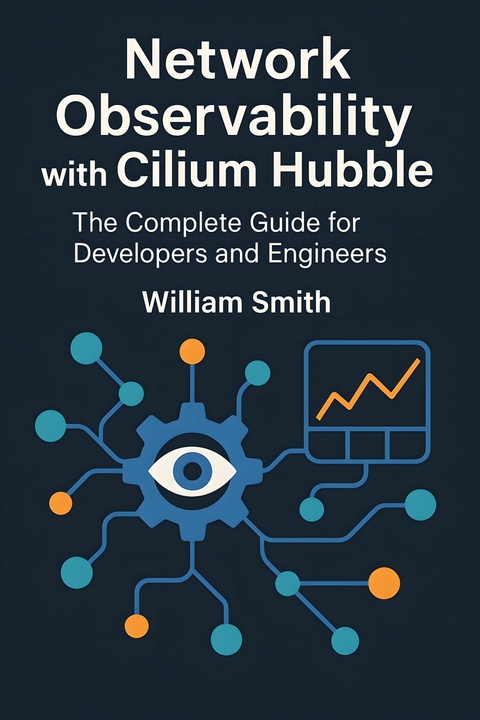
Network Observability with Cilium Hubble (eBook)
250 Seiten
HiTeX Press (Verlag)
978-0-00-102784-8 (ISBN)
'Network Observability with Cilium Hubble'
'Network Observability with Cilium Hubble' is the definitive guide for practitioners architecting, deploying, and operating secure, high-performance networks in today's cloud-native world. The book begins by grounding readers in the evolving landscape of network observability, distinguishing core concepts from traditional monitoring, and navigating the challenges unique to microservices, hybrid environments, and regulated industries. Readers gain a comprehensive understanding of how the visibility provided by observability platforms transforms operational intelligence, security, and compliance, with a clear focus on the critical roles played by Cilium and Hubble in this space.
Building on firm conceptual foundations, the book delves into the technical architecture of Cilium and Hubble, demystifying cutting-edge technologies like eBPF and exploring their pivotal contributions to deep network telemetry. Practical chapters meticulously guide readers through production-grade deployments, configuration, and scaling scenarios-ranging from installation strategies on Kubernetes to high availability, disaster recovery, and multi-cloud operations. Emphasis on advanced visibility tools, protocol dissection, real-time tracing, and powerful integration with observability stacks such as Prometheus and Grafana equips engineers with a robust toolkit for actionable insights and rapid troubleshooting.
The final sections explore the frontiers of extensibility and performance optimization, catering to operators building custom pipelines, managing large scale or multi-tenant deployments, and aligning observability with security, compliance, and operational excellence. Drawing upon real-world case studies, best practices, and emerging trends-such as AI-driven diagnostics-this book is both a practical manual and a visionary resource. Whether you are a platform engineer, SRE, security practitioner, or architect, 'Network Observability with Cilium Hubble' empowers you to deliver resilient, transparent, and future-ready cloud-native networks.
Chapter 1
Network Observability in Modern Cloud-Native Environments
In a world defined by ephemeral microservices, multi-cloud architectures, and relentless business velocity, network observability has emerged as a make-or-break capability. This chapter dives deep into why traditional approaches fall short, unveils the principles powering next-generation observability, and equips you with a modern mental model for understanding, debugging, and securing today’s distributed networks. Whether you operate at scale or architect mission-critical systems, this exploration reveals how observability reshapes operational excellence and risk mitigation in the cloud-native era.
1.1 The Evolution of Network Observability
Network observability has undergone a profound transformation in response to the rapid evolution of IT architectures and operational paradigms. Initially, network visibility was predominantly achieved through legacy monitoring frameworks centered around the Simple Network Management Protocol (SNMP). These frameworks were well-suited to traditional monolithic data center environments characterized by stable static resources and predominantly north-south traffic patterns.
Early SNMP-driven monitoring focused primarily on device-level metrics such as interface status, throughput, error rates, and availability indicators. Network operators relied on polling static device MIBs (Management Information Bases) at fixed intervals, extracting KPI snapshots to assess network health. The major strength of this approach was its simplicity and relative predictability. Network devices exhibited fixed IP addressing and relatively stable workload assignments, often tied to dedicated physical servers and switches. This static topology and traffic flow model allowed for straightforward correlation of metrics to physical infrastructure.
However, the advent of virtualization and containerization introduced fundamental challenges to this paradigm. Virtual machines and containerized workloads exhibited ephemeral lifespans, dynamically allocated IP addresses, and rapidly shifting associations between applications and underlying network interfaces. Furthermore, the shift from monolithic to microservice architectures caused a dramatic increase in east-west traffic—traffic flowing laterally across hosts within the data center—as opposed to traditional client-server north-south traffic patterns. East-west traffic is inherently more complex to observe given its high volume, dynamic routing, and frequent transient endpoints.
Legacy SNMP-based tooling was ill-equipped to address these complexities. Since SNMP polling targets static device configurations, it failed to capture the granularity of interactions occurring at the application level. The rigid polling intervals meant that transient events and short-lived network states were often missed, leading to blind spots and delayed incident detection. Moreover, SNMP lacked the capability to incorporate contextual metadata such as container IDs, pod labels, or cloud instance tags, which are necessary for correlating network behavior to application components in modern environments.
Cloud-native infrastructures further exacerbated the challenges. The pervasive use of dynamic IP assignment through DHCP or overlay networks, combined with orchestrators like Kubernetes that frequently reschedule workloads, rendered fixed IP-based identification unreliable. Workloads now frequently existed as short-lived, autoscaled entities, multiplying the potential telemetry sources exponentially. The network topology became a fluid abstraction rather than a fixed physical construct. This demanded observability solutions capable of real-time adaptation, context enrichment, and support for multi-dimensional querying.
To meet these demands, network observability evolved towards incorporating distributed tracing, flow telemetry, and contextual tagging at the application layer. Open standards such as OpenTelemetry emerged, enabling instrumentation of microservices to produce high-cardinality, context-rich telemetry data that reflects the relationships among distributed components, network flows, and runtime metadata. Telemetry ingestion shifted from periodic polling to continuous streaming to achieve near real-time visibility.
Furthermore, modern observability platforms integrate data across layers—infrastructural (network devices, hosts, containers), application (service calls, API requests), and orchestration (scheduling, scaling events)—to deliver a holistic view. This shift empowers network operators and SRE teams to trace performance degradations across dynamic east-west communications, identify bottlenecks resulting from transient workloads, and validate security postures within highly ephemeral cloud environments.
The transition from static, device-centric visibility to dynamic, context-aware observability reflects the fundamental architectural changes in computing environments. It underscores the necessity for evolving beyond legacy tooling constraints toward scalable, adaptive frameworks that provide granular telemetry enriched by runtime context. This evolution is critical for achieving proactive network management and ensuring reliable service delivery in contemporary distributed systems.
1.2 Observability vs. Monitoring: Core Concepts
The paradigmatic distinction between monitoring and observability is foundational to understanding modern system reliability engineering. Monitoring traditionally refers to the systematic collection, aggregation, and analysis of predefined metrics, logs, and events to track the operational health and performance of a system. It relies on explicitly instrumented signals and pre-established thresholds or rules to detect deviations from expected behavior. In contrast, observability denotes a system’s intrinsic capacity to expose its internal states and dynamic conditions based on external outputs, enabling inference of unknown or unforeseen states from available data.
Fundamentally, monitoring operates on a known unknown basis: it presupposes that certain failure modes, anomalies, or performance degradations are anticipated, and corresponding metrics or alert conditions are crafted to detect them. This approach can be highly effective in relatively static, monolithic environments where system behavior is well-characterized and failure conditions are enumerable. Typical monitoring data sources include CPU utilization, error rates, request latencies, and standard health-check indicators. Tools such as Prometheus, Nagios, and traditional log aggregators exemplify this approach by enabling visibility into predefined parameters and alerting based on preset thresholds.
Observability, by contrast, addresses the challenge of making sense of unknown unknowns-failure modes and emergent behaviors that were neither predicted nor explicitly instrumented for prior detection. In particular, it emphasizes the ability to perform post hoc or exploratory investigation by correlating and contextualizing multi-dimensional telemetry streams. These include distributed traces, service dependencies, high-cardinality logs, and dynamically evolving topology information. An observable system inherently supports flexible queries and analytical techniques that reveal root causes and emergent phenomena even in the absence of explicit instrumentation for specific failure scenarios.
This distinction becomes acute in the context of distributed systems. Unlike monolithic systems, distributed architectures introduce complexity arising from asynchronous communications, partial failures, replication, sharding, and service interdependencies that evolve dynamically. Monitoring tools designed for single-node or well-bounded environments frequently fail to capture these nuances because static metrics and alert conditions cannot encompass the combinatorial explosion of possible emergent states or failure interactions. For example, a network partition may cause cascading timeouts and inconsistent data views that evade detection by simple threshold-based metrics.
Moreover, distributed systems encounter issues such as partial failures, where individual components degrade or fail silently without triggering overt alerts but still impact overall system behavior. These failures often manifest across multiple layers-network, storage, application logic-and require contextual correlation to diagnose. Observability introduces the capability to synthesize and analyze telemetry across these layers and dimensions, including temporal and causal relationships derived from distributed tracing and event correlation.
The increased complexity also demands that observability incorporate high cardinality and high dimensionality data analysis. Traditional monitoring aggregates metrics into averages or counts, discarding variability critical to understanding anomalies in distributed contexts. Observability platforms retain and leverage fine-grained detail such as unique request identifiers, user sessions, geo-location signals, and version metadata, allowing granular hypotheses and deep analytics beyond static dashboards.
From the perspective of system reliability, monitoring provides the...
| Erscheint lt. Verlag | 20.8.2025 |
|---|---|
| Sprache | englisch |
| Themenwelt | Mathematik / Informatik ► Informatik ► Programmiersprachen / -werkzeuge |
| ISBN-10 | 0-00-102784-0 / 0001027840 |
| ISBN-13 | 978-0-00-102784-8 / 9780001027848 |
| Informationen gemäß Produktsicherheitsverordnung (GPSR) | |
| Haben Sie eine Frage zum Produkt? |
 EPUB (Adobe DRM)
Größe: 645 KB
Kopierschutz: Adobe-DRM
Adobe-DRM ist ein Kopierschutz, der das eBook vor Mißbrauch schützen soll. Dabei wird das eBook bereits beim Download auf Ihre persönliche Adobe-ID autorisiert. Lesen können Sie das eBook dann nur auf den Geräten, welche ebenfalls auf Ihre Adobe-ID registriert sind.
Details zum Adobe-DRM
Dateiformat: EPUB (Electronic Publication)
EPUB ist ein offener Standard für eBooks und eignet sich besonders zur Darstellung von Belletristik und Sachbüchern. Der Fließtext wird dynamisch an die Display- und Schriftgröße angepasst. Auch für mobile Lesegeräte ist EPUB daher gut geeignet.
Systemvoraussetzungen:
PC/Mac: Mit einem PC oder Mac können Sie dieses eBook lesen. Sie benötigen eine
eReader: Dieses eBook kann mit (fast) allen eBook-Readern gelesen werden. Mit dem amazon-Kindle ist es aber nicht kompatibel.
Smartphone/Tablet: Egal ob Apple oder Android, dieses eBook können Sie lesen. Sie benötigen eine
Geräteliste und zusätzliche Hinweise
Buying eBooks from abroad
For tax law reasons we can sell eBooks just within Germany and Switzerland. Regrettably we cannot fulfill eBook-orders from other countries.
aus dem Bereich


