


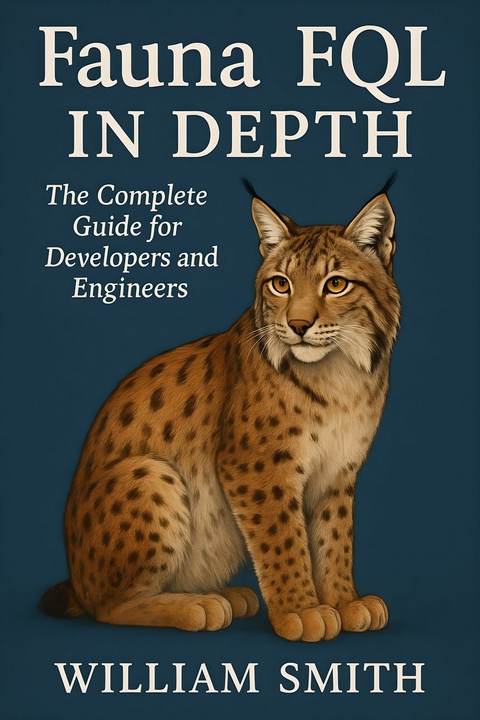
Fauna FQL in Depth (eBook)
250 Seiten
HiTeX Press (Verlag)
978-0-00-102780-0 (ISBN)
'Fauna FQL in Depth'
'Fauna FQL in Depth' is the definitive guide for database professionals, architects, and developers seeking mastery over FaunaDB and its powerful query language, FQL. This comprehensive volume unpacks the distributed, transactional architecture that underpins Fauna, detailing its ACID guarantees, global partitioning strategies, and robust security model. Readers will gain a holistic understanding of how Fauna fits into modern cloud, serverless, and edge environments-supported by a thorough exploration of operational monitoring, observability, and seamless integration practices.
Through a series of focused chapters, the book methodically covers the FQL language, from its functional and declarative paradigms to advanced constructs such as higher-order functions, error handling, and pattern matching. The coverage extends to critical real-world areas such as advanced data modeling, scalable index design, graph-like relationships, and multi-tenant hierarchies. Whether performing transactional CRUD operations, executing analytical aggregates, or composing complex streaming queries, practitioners are guided with best practices for efficiency, maintainability, and clarity.
Security, automation, and operational excellence are treated as first-class concerns, with in-depth guidance on RBAC and attribute-based access control, comprehensive auditing, and building resilient, testable FQL-driven systems. A dedicated treatment of user-defined functions, workflow orchestration, and integration with serverless architectures empowers readers to automate and extend Fauna with confidence. Rounding out the text are proven strategies for debugging, performance tuning, schema evolution, and insight into Fauna's future directions-equipping readers to build reliable, future-ready data solutions with FaunaDB and FQL.
Chapter 2
FQL Language Foundations
At the intersection of functional programming and next-generation databases, Fauna Query Language (FQL) brings expressive power to modern data logic. This chapter unveils the foundational patterns and idioms of FQL, guiding experienced readers through a landscape where queries are code-composable, testable, and decidedly declarative. Discover why mastering FQL isn’t just about querying data, but about architecting intent and reliability into every database interaction.
2.1 Structural Overview of FQL
FQL (Functional Query Language) represents a distinctive fusion of declarative and functional programming paradigms, creating a hybrid environment optimized for expressive data manipulation and robust query formulation. This amalgamation allows FQL to encapsulate complex data retrieval logic while ensuring modularity, composability, and safety within runtime contexts.
The syntax of FQL is designed to reflect both declarative intent and functional rigor. At its core, an FQL statement comprises a declaration phase, a query expression, and an optional compositional wrapping. The declaration phase introduces bindings, schema definitions, or local functional abstractions, enabling the query to be modularly constructed. For example, variables representing intermediate computations or reusable expressions may be declared, facilitating readability and maintainability:
in
recentOrders.select(order => {id: order.id, total: order.amount})
This resembles a functional let-in construct, harnessing lazy evaluation and immutability of bindings. The filter and select function calls showcase higher-order function utilization-typical functional idioms-within a data-centric declarative envelope.
The query expression itself constitutes the declarative component: it specifies what data is desired rather than how to obtain it. FQL queries are typically expressed as chained transformations on collections, mimicking monadic comprehensions or sequence operations. Each transformation (e.g., filter, map, groupBy) triggers construction of an intermediate representation rather than immediate execution. This intermediate form is a directed acyclic graph (DAG) of operations, analogous to an abstract query plan.
The syntax is deliberately designed to minimize boilerplate and emphasize compositional clarity:
.filter(order => order.status == "shipped")
.groupBy(order => order.customerId)
.map(group => {customer: group.key, count: group.size()})
Here, each method call returns a transformed query object, permitting fluent chaining and enabling sophisticated pipelines to be constructed incrementally. The abstraction hides operational complexity behind a functional facade, yet it remains declarative by deferring execution description to the backend engine.
In terms of statement anatomy, FQL statements can roughly be divided into three fundamental components:
- 1.
- Declarations and bindings: Locally bound identifiers to capture intermediate data, facilitate reuse, and impose lexical scope.
- 2.
- Expressions: Compositional query logic built from functions, higher-order operators, and collection transformations.
- 3.
- Annotations and directives: Optional hints or annotations that influence optimization, execution strategy, or schema adaptation, often expressed as metadata or pragmas.
Each component plays a clear role in maintaining orthogonality between the language’s declarative spirit and its functional mechanics. This architecture ensures that queries remain intuitive yet flexible, capable of expressing complex manipulations without sacrificing readability or safety.
Execution in FQL follows a multi-stage pipeline that inherently leverages its hybrid nature. Initially, queries are parsed into abstract syntax trees (ASTs), capturing the syntactic structure. Thereafter, the AST undergoes semantic analysis where types are checked, bindings are resolved, and function signatures are confirmed to guarantee type safety at compile time. This phase prevents runtime type errors, reinforcing FQL’s commitment to strong static type checking.
Subsequently, the AST is lowered into an intermediate logical representation-a query plan-that encodes the operations as a graph of operator nodes. This plan is subject to multiple optimization passes, including predicate pushdown, operation fusion, and redundant computation elimination. Because FQL’s constructs are pure and side-effect free, these transformations preserve correctness and enhance efficiency.
Finally, the optimized query plan is either interpreted directly by an execution engine or compiled into a target runtime language or query dialect (e.g., SQL, Spark, or distributed graph traversal engines). This decoupling between query specification and execution enables FQL to adapt seamlessly to multiple platforms while retaining semantic integrity.
The composability afforded by FQL’s synthesis is critical: queries can be treated as first-class citizens-passed as parameters, returned from functions, and composed dynamically. This capability is a direct consequence of integrating functional abstractions within the declarative framework. For example, reusable query fragments may be defined as higher-order functions producing query components, facilitating modular architecture in complex applications.
Runtime safety emerges naturally from the language’s strong type system, declarative nature, and functional purity. Side effects are carefully controlled or disallowed within query bodies, ensuring deterministic behavior. The strong typing guarantees that only well-formed queries proceed to execution, forestalling a wide class of runtime errors common in loosely typed query languages.
The structural model of FQL enables users to conceive data transformations expressed declaratively but realized through functional composition. This conceptual framework fosters clarity in query construction, encourages reuse and abstraction, and aligns closely with modern requirements for correctness, maintainability, and runtime efficiency.
2.2 Primitives and Literal...
| Erscheint lt. Verlag | 20.8.2025 |
|---|---|
| Sprache | englisch |
| Themenwelt | Mathematik / Informatik ► Informatik ► Programmiersprachen / -werkzeuge |
| ISBN-10 | 0-00-102780-8 / 0001027808 |
| ISBN-13 | 978-0-00-102780-0 / 9780001027800 |
| Informationen gemäß Produktsicherheitsverordnung (GPSR) | |
| Haben Sie eine Frage zum Produkt? |
 EPUB (Adobe DRM)
Größe: 955 KB
Kopierschutz: Adobe-DRM
Adobe-DRM ist ein Kopierschutz, der das eBook vor Mißbrauch schützen soll. Dabei wird das eBook bereits beim Download auf Ihre persönliche Adobe-ID autorisiert. Lesen können Sie das eBook dann nur auf den Geräten, welche ebenfalls auf Ihre Adobe-ID registriert sind.
Details zum Adobe-DRM
Dateiformat: EPUB (Electronic Publication)
EPUB ist ein offener Standard für eBooks und eignet sich besonders zur Darstellung von Belletristik und Sachbüchern. Der Fließtext wird dynamisch an die Display- und Schriftgröße angepasst. Auch für mobile Lesegeräte ist EPUB daher gut geeignet.
Systemvoraussetzungen:
PC/Mac: Mit einem PC oder Mac können Sie dieses eBook lesen. Sie benötigen eine
eReader: Dieses eBook kann mit (fast) allen eBook-Readern gelesen werden. Mit dem amazon-Kindle ist es aber nicht kompatibel.
Smartphone/Tablet: Egal ob Apple oder Android, dieses eBook können Sie lesen. Sie benötigen eine
Geräteliste und zusätzliche Hinweise
Buying eBooks from abroad
For tax law reasons we can sell eBooks just within Germany and Switzerland. Regrettably we cannot fulfill eBook-orders from other countries.
aus dem Bereich


