


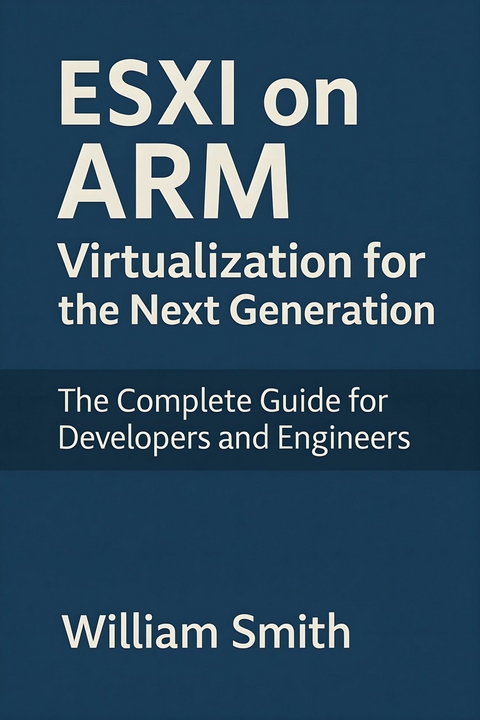
ESXi on ARM: Virtualization for the Next Generation (eBook)
250 Seiten
HiTeX Press (Verlag)
978-0-00-102775-6 (ISBN)
'ESXi on ARM: Virtualization for the Next Generation'
'ESXi on ARM: Virtualization for the Next Generation' is a comprehensive guide that navigates the transformative landscape of virtualization as ARM architecture rises to prominence in enterprise, edge, and IoT computing. The book lays a solid foundation by demystifying core virtualization concepts, clarifying the evolution of ARM microarchitecture, and contrasting it with x86, all while highlighting the unique energy efficiency and security opportunities that ARM platforms bring to modern cloud and edge deployments. Rich technical insights explore virtualization models, hypervisor types, and hardware security, ensuring that readers grasp both the theoretical and practical dimensions of deploying VMware ESXi on ARM servers.
Delving into the internals of ESXi, the text provides a meticulous breakdown of the platform's kernel, resource control, networking stack, and the crucial modifications required for ARM compatibility. Comprehensive chapters detail the supported ARM ecosystems-including Raspberry Pi, Ampere, NXP, and Marvell-offering hardware matrices, peripheral compatibility assessments, and storage/networking integration guidance. Practical deployment techniques are addressed thoroughly, with step-by-step instructions for installation, configuration, monitoring, cluster management, and operational hardening in both enterprise and distributed environments.
Beyond foundational deployment, the book advances into performance optimization, security, and automation, covering virtual machine lifecycle management and advanced tuning on ARM, deep security and compliance strategies, edge and remote deployment patterns, and the vast possibilities unlocked by APIs, SDKs, and open-source contributions. Forward-looking readers will find thought leadership on future trends-such as high-performance computing, AI/ML applications, energy-aware orchestration, and decentralized virtualization-empowering architects, administrators, and researchers to harness ARM's full potential and drive innovation in next-generation virtualization.
Chapter 1
Foundations of Virtualization and ARM Architecture
This chapter unveils the technological roots and architectural innovations that empower virtualization on ARM. By dissecting the evolution of ARM’s microarchitecture and contrasting it with the entrenched x86 paradigm, we reveal why ARM is reshaping the landscape of cloud, enterprise, and edge computing. You’ll explore the nuances of virtualization models, the technical drivers behind energy efficiency and security, and the essentials for building scalable, secure platforms at the hardware-software boundary.
1.1 Virtualization Concepts and Models
Virtualization fundamentally refers to the creation of a virtual version of computing resources, enabling multiple logical environments to coexist on a single physical platform. This multiplicity introduces abstraction and separation layers between hardware and software, facilitating resource sharing, enhanced isolation, and flexibility in system management. The primary virtualization models-hardware virtualization, paravirtualization, full virtualization, and containerization-each embody differing strategies to balance performance, compatibility, and complexity.
Hardware Virtualization
Hardware virtualization abstracts the underlying physical machine by creating one or more virtual machines (VMs) that emulate physical hardware components. A hypervisor, or virtual machine monitor (VMM), intermediates between these VMs and the physical hardware. Two dominant hypervisor architectures exist: Type 1 (bare-metal) hypervisors run directly on host hardware, providing high efficiency and robust isolation, while Type 2 (hosted) hypervisors execute atop a conventional operating system, trading some performance for ease of use.
In hardware virtualization, each VM runs an unmodified guest operating system (OS), relying on the hypervisor’s ability to trap and emulate privileged instructions that would otherwise compromise host integrity. This requires the CPU to support mechanisms such as virtualization extensions (e.g., Intel VT-x, AMD-V) to reduce the overhead of instruction interception and to enable direct execution of most instructions. The guest environment thus perceives a complete hardware stack, including CPU, memory, storage, and network interfaces, encapsulated within the virtual machine abstraction.
Full Virtualization
Full virtualization is a specific form of hardware virtualization whereby the guest OS operates without any modification and is completely unaware that it is running within a VM. The hypervisor traps all sensitive instructions that attempt to access privileged resources and emulates their effects to maintain isolation and correctness.
This approach demands a comprehensive emulation of the underlying hardware environment, often leading to increased complexity and potential performance degradation due to frequent context switches and instruction trapping. However, full virtualization offers maximal compatibility and portability because any commodity OS designed for the native architecture can operate unaltered.
Paravirtualization
By contrast, paravirtualization modifies the guest OS to replace privileged instructions with explicit calls to the hypervisor, known as hypercalls. This cooperation reduces the overhead associated with instruction trapping and emulation, markedly improving performance compared to full virtualization.
The trade-off lies in the requirement for guest OS source code access and adaptation, which may not be feasible for proprietary or closed-source operating systems. Paravirtualization achieves tighter integration with the hypervisor, allowing optimized communication for I/O operations, memory management, and scheduling, thereby fostering higher resource efficiency at the cost of diminished transparency.
Containerization
Containerization diverges from traditional virtualization models by abstracting at the operating system level rather than hardware. Instead of emulating complete hardware stacks or requiring guest OS modifications, containers leverage OS-level namespaces and control groups (cgroups) to isolate processes, resources, and networking within the same host OS kernel.
This approach provides lightweight, portable execution environments with lower overhead, as there is no necessity to boot multiple guest OS instances or emulate hardware devices. Containers share the host kernel but maintain separate user-space environments, achieving an effective balance between resource efficiency and isolation.
The Docker runtime and Kubernetes orchestration exemplify modern container platforms, enabling rapid deployment of microservices with minimal resource duplication. However, the shared kernel implies weaker isolation compared to VM-based models, posing potential risks if container escape vulnerabilities occur.
Comparative Architectural Trade-offs
| Model | Characteristics and Trade-offs |
| Hardware Virtualization (Full) | Maximum compatibility; runs unmodified guest OS; hypervisor overhead due to trapping and emulation; strong isolation; dependent on CPU virtualization features. |
| Paravirtualization | Requires guest OS modification; reduced hypervisor overhead; improved performance; less transparent; tighter coupling with hypervisor implementation. |
| Containerization | Lightweight and fast; shares host kernel; excellent for microservice architectures; lower isolation guarantees; limited to same OS kernel and architecture. |
The choice among these models hinges on the intended use case, security requirements, and workload characteristics. Full virtualization excels in scenarios necessitating heterogeneous OS support and robust security boundaries, whereas paravirtualization prioritizes throughput and efficiency when guest OS customization is feasible. Containerization enables rapid, scalable deployment of application components in a uniform OS environment but requires careful orchestration to mitigate potential isolation breaches.
Isolation and Execution Environment Distinctions
Isolation in virtualization originates from preventing unintended interactions among co-resident workloads. Hardware virtualization establishes isolation at the CPU and memory management unit (MMU) levels, leveraging hardware-supported privilege rings and paging mechanisms. Each VM perceives control over its allocated resources, with page tables translated through nested or shadow mappings maintained by the hypervisor to avoid address space collisions.
Containerization relies on kernel namespaces (e.g., PID, mount, IPC, network) and cgroups to restrict resource visibility and limit consumption without duplicating kernel instances. While this model isolates user-space environments effectively, kernel-level vulnerabilities can blur boundaries.
Execution environments manifest as complete VMs, paravirtualized OSes, or containers with constrained resource views. The abstraction strategies inherently influence portability: full virtualization is architecture agnostic; paravirtualization demands guest collaboration; containers assume homogeneity of OS kernel and system calls.
Theoretical Foundations
Virtualization benefits from the classical requirements posited by Popek and Goldberg, which stipulate that sensitive instructions must either trap to the hypervisor or be non-sensitive to guarantee equivalence between virtualized and physical executions. Full virtualization adheres to these by trapping privileged instructions and emulating them. Paravirtualization relaxes constraints by explicit cooperation between guest and hypervisor.
Container-based virtualization admits a different theoretical standpoint grounded in operating system-level partitioning rather than strict emulation or modification of hardware...
| Erscheint lt. Verlag | 20.8.2025 |
|---|---|
| Sprache | englisch |
| Themenwelt | Mathematik / Informatik ► Informatik ► Programmiersprachen / -werkzeuge |
| ISBN-10 | 0-00-102775-1 / 0001027751 |
| ISBN-13 | 978-0-00-102775-6 / 9780001027756 |
| Informationen gemäß Produktsicherheitsverordnung (GPSR) | |
| Haben Sie eine Frage zum Produkt? |
 EPUB (Adobe DRM)
Größe: 672 KB
Kopierschutz: Adobe-DRM
Adobe-DRM ist ein Kopierschutz, der das eBook vor Mißbrauch schützen soll. Dabei wird das eBook bereits beim Download auf Ihre persönliche Adobe-ID autorisiert. Lesen können Sie das eBook dann nur auf den Geräten, welche ebenfalls auf Ihre Adobe-ID registriert sind.
Details zum Adobe-DRM
Dateiformat: EPUB (Electronic Publication)
EPUB ist ein offener Standard für eBooks und eignet sich besonders zur Darstellung von Belletristik und Sachbüchern. Der Fließtext wird dynamisch an die Display- und Schriftgröße angepasst. Auch für mobile Lesegeräte ist EPUB daher gut geeignet.
Systemvoraussetzungen:
PC/Mac: Mit einem PC oder Mac können Sie dieses eBook lesen. Sie benötigen eine
eReader: Dieses eBook kann mit (fast) allen eBook-Readern gelesen werden. Mit dem amazon-Kindle ist es aber nicht kompatibel.
Smartphone/Tablet: Egal ob Apple oder Android, dieses eBook können Sie lesen. Sie benötigen eine
Geräteliste und zusätzliche Hinweise
Buying eBooks from abroad
For tax law reasons we can sell eBooks just within Germany and Switzerland. Regrettably we cannot fulfill eBook-orders from other countries.
aus dem Bereich


