


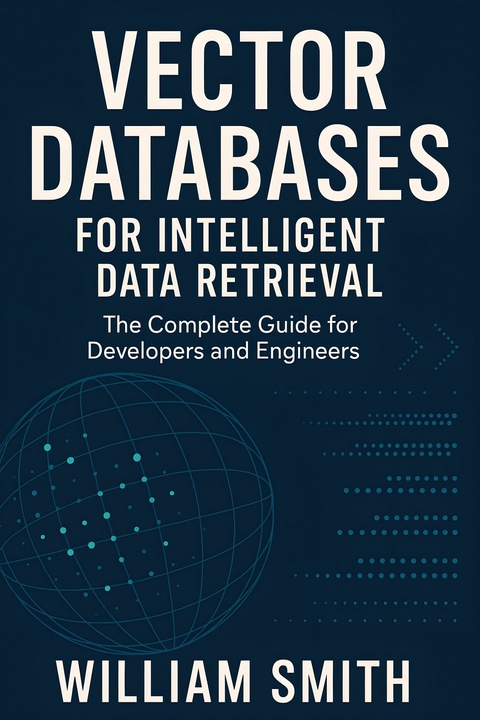
Vector Databases for Intelligent Data Retrieval (eBook)
250 Seiten
HiTeX Press (Verlag)
978-0-00-102759-6 (ISBN)
'Vector Databases for Intelligent Data Retrieval'
'Vector Databases for Intelligent Data Retrieval' is a comprehensive guide that illuminates the pivotal role of vector representations and databases in powering the next generation of intelligent data retrieval systems. Drawing from foundational principles in linear algebra, information theory, and machine learning, this book methodically unpacks how high-dimensional embedding spaces enable more nuanced semantic search across text, images, audio, and mixed-modality data. Readers are equipped with a deep understanding of embedding construction, similarity metrics, and the advanced learning frameworks that underpin effective vector-based retrieval.
The book seamlessly transitions from theory to practice, exploring the architectural core, indexing techniques, and distributed design patterns that provide the backbone for scalable, performant vector database systems. Pragmatic discussions on storage optimization, query interfaces, hybrid filter models, and performance tuning are coupled with advanced topics like GPU acceleration, privacy-preserving computations, and regulatory compliance. Special focus is given to the operational challenges of real-time and batch retrieval, as well as integrating machine learning at every stage-from model deployment and active learning loops to explainable retrieval.
In its final sections, 'Vector Databases for Intelligent Data Retrieval' looks forward, profiling cutting-edge applications such as conversational AI, enterprise semantic search, recommender systems, and anomaly detection. The narrative culminates with a thoughtful survey of future research directions, including exascale and edge scenarios, federation models, responsible AI, and the open-source ecosystem. Suitable for engineers, researchers, and technical leaders, this work serves as both a definitive reference and an inspiration for the evolution of intelligent data retrieval technologies.
Chapter 2
Architectural Essentials of Vector Databases
The architectural design of vector databases forms the backbone of scalable, intelligent search systems that empower real-world AI applications. In this chapter, we peel back the layers on what sets vector databases apart-from ingestion to retrieval-and how each architectural decision enables both speed and flexibility for tomorrow’s data-dependent workflows. Discover the frameworks, structures, and design philosophies that transform raw embeddings into actionable, efficiently accessible knowledge.
2.1 Core Components and System Design
Vector databases fundamentally revolve around three integral components: the storage engine, the vector processing module, and the query planner. Each component contributes distinct capabilities critical to efficient management and retrieval of high-dimensional vector data, while collectively enabling scalable, robust, and extensible system architectures.
The storage engine serves as the foundational layer responsible for persisting raw data and its associated metadata. Unlike traditional relational engines optimized for scalar data, vector storage engines emphasize efficient encoding, compression, and approximate nearest neighbor (ANN) index structures. Common techniques include product quantization, locality-sensitive hashing, and graph-based indices such as Hierarchical Navigable Small World graphs (HNSW). The choice of storage format directly impacts lookup speed, update latency, and memory footprint. Many systems leverage columnar storage variants to optimize vector batch processing and asynchronous data access. Furthermore, persistence mechanisms must provide transactional guarantees and replication strategies to preserve durability under concurrent operations and system failures.
Above the storage layer operates the vector processing module, which implements core algorithms for vector similarity computations, feature transformations, and indexing. It commonly incorporates CUDA-accelerated routines or specialized SIMD operations to expedite distance calculations (e.g., cosine similarity, Euclidean distance) and optimize index maintenance. This module also includes dimensionality reduction techniques, such as Principal Component Analysis (PCA) or autoencoders, enabling adaptive compression without substantial accuracy degradation in retrieval tasks. The processing pipeline must balance precision and recall tradeoffs dynamically, often by applying multi-stage search strategies: an initial coarse candidate filtering followed by re-ranking using exact measurements. Tightly coupling this module with the storage layer allows for incremental updates and online learning to accommodate streaming data scenarios.
The query planner orchestrates how incoming user requests are translated into execution plans that leverage available indices and processing resources. Queries often contain constraints beyond similarity, such as filtering by attributes or range predicates, necessitating hybrid query planning integrating classic database techniques with vector search. Query planners analyze query predicates, cost models of index access paths, and system load to generate optimized execution trees. Adaptive query plans enable workload-aware decisions, depending on vector cardinality, dimensionality, and expected recall thresholds. Additionally, caching mechanisms for intermediate results and query result reuse significantly improve throughput for repeated query patterns.
System architecture choices impose fundamental tradeoffs affecting maintainability, fault tolerance, and extensibility. Two dominant patterns emerge: modular monoliths and microservices.
Modular Monoliths integrate all components within a single process space, enforcing strict module boundaries through well-defined interfaces and dependency injection. This design simplifies inter-component communication and reduces overhead related to network serialization and remote procedure calls. Fault isolation is achieved via exception handling and compartmentalization in code rather than physical separation. Modular monoliths excel in tightly coupled systems where performance demands consistency and low-latency interaction between vector processing and storage. However, upgrades and scaling require coordinated redeployment due to shared runtime contexts.
Microservices Architectures decompose the vector database into independently deployable services, each encapsulating functionalities such as indexing, storage, query planning, or metadata management. These services communicate through lightweight protocols (e.g., gRPC, REST) and often rely on asynchronous messaging patterns for coordination. Microservices enable fault isolation at the service level; a failure in the query planner does not necessarily impact vector storage availability. Horizontal scaling becomes more seamless, as capacity can be provisioned per service according to workload hotspots. Moreover, microservice design facilitates extensibility, allowing new features or alternative implementations (e.g., experimental vector processing algorithms) to be developed and integrated without disrupting core services. Nevertheless, such decoupling introduces complexity in distributed transactions, data consistency, and network latency, which must be counterbalanced by robust service orchestration and observability infrastructures.
Extensibility considerations permeate the entire system design. Plug-in architectures for indexing algorithms, data connectors, and vector similarity functions enable users to tailor the database to evolving domain-specific requirements. Middleware layers abstract heterogeneous hardware accelerators-GPUs, TPUs, or FPGA-based units-allowing the vector processing module to dynamically exploit available computational resources. Furthermore, schema evolution mechanisms and metadata versioning are mandatory to adapt to continuously changing vector feature sets and hybrid data models integrating scalar and unstructured data.
Fault isolation strategies are intricately connected with system availability and consistency guarantees. Vector databases often adopt a multi-tiered approach combining redundancy, circuit breakers, graceful degradation, and backpressure controls to maintain responsiveness under partial failures or traffic surges. In microservices environments, sidecar proxies and service meshes facilitate traffic routing away from unhealthy services, while in modular monoliths, layered exception management and resumption logic constrain failure propagation.
The core components of vector databases-storage engines, vector processing modules, and query planners-must be architected with careful attention to modularity, scalability, and fault tolerance. Architectural patterns such as modular monoliths and microservices present distinct advantages and challenges, with extensibility and fault isolation remaining paramount. Meeting evolving system requirements demands flexible interfaces, hardware-aware optimizations, and adaptive query execution frameworks that collectively ensure efficient, reliable management of large-scale vector data.
2.2 Data Ingestion and Preprocessing Pipelines
Robust data ingestion and preprocessing pipelines form the foundation of any advanced analytics or machine learning system, particularly when dealing with heterogeneous data sources such as text, images, and structured records. The primary challenge lies in transforming these diverse modalities into standardized vector representations suitable for downstream tasks, while ensuring scalability, fault tolerance, and flexibility.
Data ingestion can be broadly categorized into batch and streaming designs. Batch ingestion operates on discrete chunks of data collected over time and is well-suited for environments where latency is less critical and data volumes can be processed in bulk. By contrast, streaming ingestion continuously consumes data as it is generated, enabling real-time or near-real-time analytics and immediate responsiveness to emerging patterns. The choice between these architectures hinges on application requirements, data velocity, and infrastructure capabilities.
In heterogeneous environments, ingestion pipelines begin by integrating multiple data formats originating from diverse sources: unstructured text documents, pixel data from images or videos, and structured records from relational or NoSQL databases. The initial step involves raw data extraction and normalization, which often includes cleaning, deduplication, and format conversions, ensuring a consistent baseline for further processing.
Text Data Ingestion and Embedding
Textual data ingestion starts with tokenization and normalization, such as lowercasing, lemmatization, and removal of stopwords, depending on the use-case complexity. These cleaned tokens are then mapped into continuous vector spaces, typically using pretrained language models or domain-specific embeddings like Word2Vec, GloVe, or contextual embeddings from transformers such as BERT or GPT variants. Embedding transformations vastly reduce the dimensionality of raw text while encoding semantic and syntactic properties.
Embedding pipelines often require fine-tuning pretrained...
| Erscheint lt. Verlag | 20.8.2025 |
|---|---|
| Sprache | englisch |
| Themenwelt | Mathematik / Informatik ► Informatik ► Programmiersprachen / -werkzeuge |
| ISBN-10 | 0-00-102759-X / 000102759X |
| ISBN-13 | 978-0-00-102759-6 / 9780001027596 |
| Informationen gemäß Produktsicherheitsverordnung (GPSR) | |
| Haben Sie eine Frage zum Produkt? |
 EPUB (Adobe DRM)
Größe: 965 KB
Kopierschutz: Adobe-DRM
Adobe-DRM ist ein Kopierschutz, der das eBook vor Mißbrauch schützen soll. Dabei wird das eBook bereits beim Download auf Ihre persönliche Adobe-ID autorisiert. Lesen können Sie das eBook dann nur auf den Geräten, welche ebenfalls auf Ihre Adobe-ID registriert sind.
Details zum Adobe-DRM
Dateiformat: EPUB (Electronic Publication)
EPUB ist ein offener Standard für eBooks und eignet sich besonders zur Darstellung von Belletristik und Sachbüchern. Der Fließtext wird dynamisch an die Display- und Schriftgröße angepasst. Auch für mobile Lesegeräte ist EPUB daher gut geeignet.
Systemvoraussetzungen:
PC/Mac: Mit einem PC oder Mac können Sie dieses eBook lesen. Sie benötigen eine
eReader: Dieses eBook kann mit (fast) allen eBook-Readern gelesen werden. Mit dem amazon-Kindle ist es aber nicht kompatibel.
Smartphone/Tablet: Egal ob Apple oder Android, dieses eBook können Sie lesen. Sie benötigen eine
Geräteliste und zusätzliche Hinweise
Buying eBooks from abroad
For tax law reasons we can sell eBooks just within Germany and Switzerland. Regrettably we cannot fulfill eBook-orders from other countries.
aus dem Bereich


