


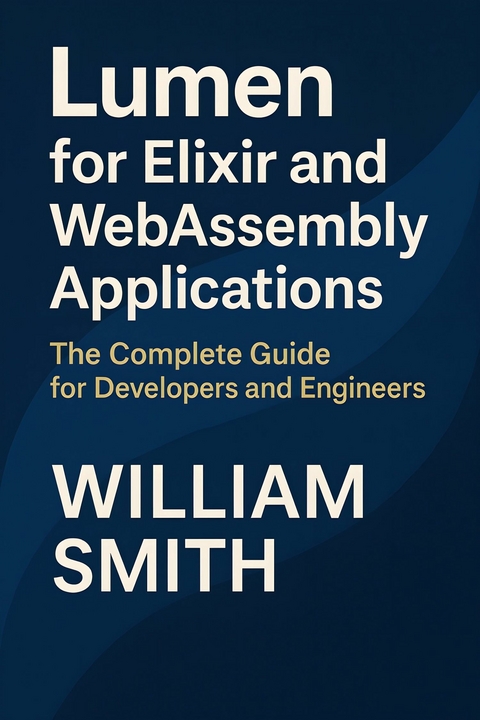
Lumen for Elixir and WebAssembly Applications (eBook)
250 Seiten
HiTeX Press (Verlag)
978-0-00-102758-9 (ISBN)
'Lumen for Elixir and WebAssembly Applications'
'Lumen for Elixir and WebAssembly Applications' is the definitive guide for developers and architects aiming to harness the power of Elixir in modern WebAssembly (WASM) environments. This comprehensive volume explores every facet of the Lumen runtime, from its core architecture, compiler pipeline, and process model, to memory management and system integration. Readers will find detailed, comparative analyses between the BEAM virtual machine and Lumen, gaining insight into the technical nuances, motivations, and performance trade-offs that shape the ecosystem.
The book transitions seamlessly from foundational theory to pragmatic implementation, covering Elixir semantics within WASM, advanced concurrency, fault-tolerance, and the realization of OTP patterns. It provides hands-on guidance for building, optimizing, and deploying Elixir applications across browsers, serverless infrastructures, and edge platforms. Essential topics such as JavaScript interoperability, state management, and integration with popular frontend frameworks are treated with clarity, alongside best practices for tooling, continuous integration, and release management in Lumen-based workflows.
Security, compliance, distributed systems, and performance at scale are focal points, ensuring that readers are equipped not only to develop advanced Lumen applications, but to do so safely and efficiently. Rounding out the text is a forward-looking analysis of WebAssembly standards, open-source community engagement, and strategies for leading high-performance Elixir/WASM teams. With both depth and breadth, this book is an indispensable resource for professionals advancing the future of Elixir-powered WebAssembly.
Chapter 2
Elixir Semantics in Lumen and WASM Context
How do Elixir’s functional idioms and robust concurrency model thrive within the strict, low-level world of WebAssembly? This chapter uncovers the translation of Elixir’s semantics-immutability, lightweight processes, message passing, and dynamic supervision-into the performance-conscious, portable, and sandboxed WASM landscape. Discover how Lumen engineers have reimagined the very DNA of Elixir to unlock new possibilities across browsers, servers, and edge environments.
2.1 Elixir Functional Paradigms on WebAssembly
Elixir, as a functional programming language built on the Erlang Virtual Machine (BEAM), is fundamentally grounded in immutable data structures, first-class functions, and concurrency primitives. Transitioning these core functional principles to the WebAssembly (WASM) execution environment requires careful adaptation due to inherent differences in memory management, execution model, and performance characteristics.
Immutability and Memory Layouts in WASM
Elixir’s reliance on immutable data structures poses unique challenges for WebAssembly, which traditionally offers a linear memory model with a single contiguous, mutable array of bytes. Unlike the BEAM, which natively supports sharing immutable terms through efficient copy-on-write strategies and reference counting, WASM’s memory lacks built-in garbage collection (though GC proposals are underway). Consequently, maintaining Elixir-style immutability on WASM requires explicit memory management and data representation strategies.
Immutable data structures are implemented on WASM by leveraging persistent data structure techniques, such as hash array mapped tries (HAMTs) and structural sharing with reference counting or region-based memory management. Persistent data structures provide efficient access and update operations by preserving shared substructures rather than copying entire data sets. Within the WASM linear memory, this translates to careful pointer management along with metadata to track versions and references.
A typical approach involves allocating nodes of an immutable structure on the WASM memory heap, where each node contains value fields and pointers to sub-nodes. Updates generate new nodes while sharing unchanged subtrees. To minimize copying overhead, reference counting or epoch-based reclamation can be emulated in the host environment or via helper runtimes. This strategy reconciles Elixir’s immutable semantics with WASM’s flat memory layout, albeit at some runtime cost.
First-Class Functions and Closure Representation
Elixir’s treatment of functions as first-class citizens requires closures to encapsulate both code and lexical environment. On BEAM, closures are managed natively with tagged tuples, enabling efficient environment capture and pattern matching. In contrast, WASM’s design focuses on low-level stack-machine semantics without native support for closures or garbage-collected environments.
To model closures in WASM, function pointers are combined with explicit environment blocks allocated on the linear memory. The environment contains captured variables stored consecutively, enabling closures to access free variables at known offsets. Function calls are then indirect using WASM’s table of function references, passing the environment pointer as an additional argument.
Consider a closure capturing two variables; its WASM representation involves an environment structure:
int var1;
float var2;
};
and invocation code resembling:
call_indirect (func_ptr) (env_ptr, other_args...)
This explicit closure encoding requires runtime support for environment lifecycle management, which may be implemented via reference counting or manual allocation. Moreover, tail call optimizations commonly used in Elixir to maintain functional idioms must be emulated through WASM constructs, as WASM itself currently lacks general tail call support, although proposals exist.
Persistence Strategies for Immutable Data Structures
Persistence, the property that previous versions of data structures remain accessible after updates, aligns naturally with Elixir’s immutability and is critical for concurrency and versioned state. WASM’s lack of preemptive multithreading and garbage collection complicates persistence implementation.
To preserve persistence within WASM, the runtime must implement a combination of snapshotting and efficient incremental updates. Snapshotting leverages the linear memory layout by copying or marking regions as immutable, but this is costly for large structures. Incremental updates utilize persistent data structures with structural sharing, reducing the need for full copies.
An example is a persistent vector implemented via trees with bounded branching factors, stored as contiguous nodes in WASM linear memory array segments. When an update occurs, only the path to the modified leaf is copied, while sibling nodes are shared between versions. This method conforms to Elixir’s expectations for efficient persistence:
def updateVector(vec, index, value):
newPath = copyPathToIndex(vec.root, index)
newPath.leaf.value = value
return Vector(newPath)
Reference management within WASM must prevent premature deallocation of shared nodes, typically requiring auxiliary bookkeeping by the host or embedding a lightweight runtime to support functional persistence semantics.
Impact of WASM’s Execution Model on Elixir Idioms and Performance
The WASM execution environment is a low-level virtual machine with a stack-based instruction set but lacks the high-level concurrency, message-passing primitives, and actor model central to Elixir’s runtime. Elixir’s idiomatic patterns such as immutable state passing via message queues, lightweight processes, and fault-tolerant supervision trees cannot be ...
| Erscheint lt. Verlag | 20.8.2025 |
|---|---|
| Sprache | englisch |
| Themenwelt | Mathematik / Informatik ► Informatik ► Programmiersprachen / -werkzeuge |
| ISBN-10 | 0-00-102758-1 / 0001027581 |
| ISBN-13 | 978-0-00-102758-9 / 9780001027589 |
| Informationen gemäß Produktsicherheitsverordnung (GPSR) | |
| Haben Sie eine Frage zum Produkt? |
 EPUB (Adobe DRM)
Größe: 648 KB
Kopierschutz: Adobe-DRM
Adobe-DRM ist ein Kopierschutz, der das eBook vor Mißbrauch schützen soll. Dabei wird das eBook bereits beim Download auf Ihre persönliche Adobe-ID autorisiert. Lesen können Sie das eBook dann nur auf den Geräten, welche ebenfalls auf Ihre Adobe-ID registriert sind.
Details zum Adobe-DRM
Dateiformat: EPUB (Electronic Publication)
EPUB ist ein offener Standard für eBooks und eignet sich besonders zur Darstellung von Belletristik und Sachbüchern. Der Fließtext wird dynamisch an die Display- und Schriftgröße angepasst. Auch für mobile Lesegeräte ist EPUB daher gut geeignet.
Systemvoraussetzungen:
PC/Mac: Mit einem PC oder Mac können Sie dieses eBook lesen. Sie benötigen eine
eReader: Dieses eBook kann mit (fast) allen eBook-Readern gelesen werden. Mit dem amazon-Kindle ist es aber nicht kompatibel.
Smartphone/Tablet: Egal ob Apple oder Android, dieses eBook können Sie lesen. Sie benötigen eine
Geräteliste und zusätzliche Hinweise
Buying eBooks from abroad
For tax law reasons we can sell eBooks just within Germany and Switzerland. Regrettably we cannot fulfill eBook-orders from other countries.
aus dem Bereich


