


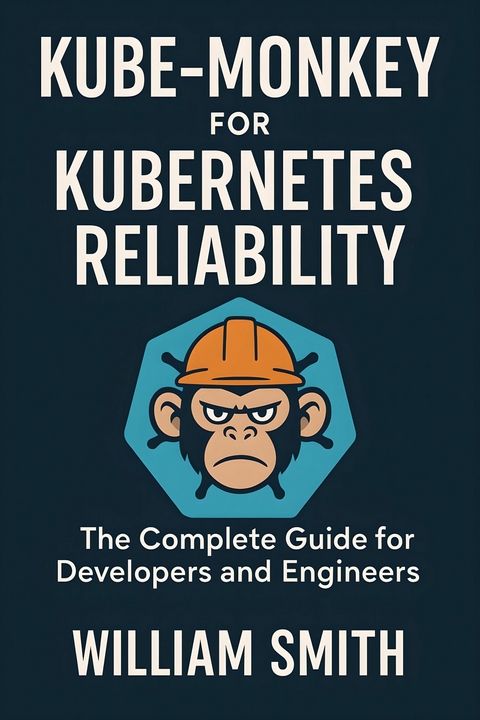
Kube-monkey for Kubernetes Reliability (eBook)
250 Seiten
HiTeX Press (Verlag)
978-0-00-102746-6 (ISBN)
'Kube-monkey for Kubernetes Reliability'
'Kube-monkey for Kubernetes Reliability' is a comprehensive and authoritative guide to fortifying Kubernetes environments through advanced chaos engineering techniques. Beginning with a deep exploration of chaos engineering's historical roots and its unique challenges within cloud-native architectures, the book equips readers with a robust understanding of resilience in modern distributed systems. Through detailed analysis of Kubernetes failure modes and observability foundations, it demystifies the planning, automation, and metrics that underpin effective chaos experiments.
Delving into the inner workings of the Kube-monkey project, the book offers an insightful architectural breakdown, describing how Kube-monkey orchestrates controlled failure events to rigorously test Kubernetes cluster robustness. Practical guidance is provided for secure deployment, policy-driven fault injection, and managing operational parameters-addressing real-world concerns such as RBAC, configuration, secure communications, and resource impact. Advanced chapters cover critical scenarios, including stateless and stateful workload testing, adaptive real-time chaos, multi-stage experiments, and specialized patterns for hybrid and edge cloud deployments.
Emphasizing actionable outcomes, 'Kube-monkey for Kubernetes Reliability' guides readers in designing, executing, and analyzing targeted chaos experiments. It explores the broader implications for organizational resilience, compliance, and cultural transformation, providing strategies for incident response, auditability, and governance. By blending technical mastery with lessons learned from live deployments and community insights, this book empowers engineers, architects, and leaders to embed enduring reliability, adapt to emerging paradigms, and shape the future of chaos engineering in Kubernetes ecosystems.
Chapter 2
Kube-monkey: Architecture and Principles
What does it really take to inject controlled mayhem into your Kubernetes cluster-and transform chaos into wisdom? This chapter opens the black box of Kube-monkey, exposing the intricate engineering and foundational principles behind one of the most audacious tools for cloud-native resilience. Prepare to unravel the mechanics of automated failure, from core design patterns to extensible chaos protocols.
2.1 Kube-monkey Project Overview
The inception of the Kube-monkey project arose from an acute awareness of the complex reliability challenges inherent in modern cloud-native environments, specifically those orchestrated by Kubernetes. As container orchestration matured and adoption proliferated, operational teams grappled with an evolving landscape of failure modes that traditional reliability paradigms inadequately addressed. The project’s origins trace back to a convergence of these factors: a growing recognition of latent fragilities within Kubernetes clusters, the inadequacy of manual failure testing strategies, and an engineering drive to embed resilience through automated, deliberate disruption.
At the core of Kube-monkey’s motivation lies the foundational principle of chaos engineering: proactively injecting controlled failures to uncover weaknesses before incurring unplanned downtime. Contemporary distributed systems manifest complicated interdependencies and nondeterministic behaviors, amplifying the difficulty of anticipating failure impacts purely from theoretical analysis or static testing. Real-world incidents often elude prediction due to subtle timing issues, cascading faults, or resource contention dynamics that remain latent under normal operations. In Kubernetes environments, these phenomena manifest through pod crashes, node outages, network partitions, or configuration drift-each with potential to degrade service continuity.
Prior to the development of Kube-monkey, the available mechanisms for resilience verification in Kubernetes were often fragmented, labor-intensive, or reactive. Conventional simulations or staged failovers lacked the capacity to replicate the stochastic and intermittent nature of genuine failures. Tools focused on monitoring and alerting principally detected issues post facto, without facilitating systematic failure induction to validate remediation strategies. This gap highlighted a compelling need for an automated, repeatable, and configurable approach to disrupt production and staging environments in a manner that emulates realistic failure scenarios.
Kube-monkey emerged with a design philosophy grounded in simplicity, predictability, and seamless integration into Kubernetes-native workflows. Its operation centers on randomized pod termination, echoing the principles introduced by Netflix’s Chaos Monkey for cloud instances, but specialized for Kubernetes’ container orchestration context. By terminating pods at random within targeted namespaces and time windows, Kube-monkey forces applications to withstand unexpected loss of components and validates the robustness of controllers such as ReplicaSets, Deployments, and StatefulSets. The cyclic, stochastic nature of these disruptions encourages teams to build improved self-healing mechanisms and accelerates iterative reliability engineering.
Understanding common failure scenarios was imperative in shaping Kube-monkey’s functional scope. Kubernetes clusters frequently encounter pod evictions triggered by resource saturation, underlying node failures, or network disruptions resulting in transient partitioning. Configuration errors or software bugs can induce cascading crashes or deadlocks. Kube-monkey’s ability to mimic pod failures deliberately recreates conditions akin to these operational anomalies, providing a controlled environment to verify fault tolerance mechanisms including readiness and liveness probes, auto-scaling policies, and rolling update strategies.
Within the broader ecosystem of chaos engineering tools, Kube-monkey occupies a focused niche, emphasizing automated pod-level failure injection tailored to Kubernetes-native constructs. While complementary to more complex fault injection frameworks-such as those generating network latency, CPU stress, or kernel panic events-Kube-monkey addresses the foundational challenge of pod availability and lifecycle management. Its lightweight design facilitates straightforward adoption in continuous deployment pipelines, enabling developers and operators to embed resilience checks directly into application release cycles without extensive infrastructure overhead.
Moreover, the project illustrates a key philosophical shift from failure avoidance to failure tolerance. Rather than striving for exhaustively tested fault-free operation, Kube-monkey encourages acceptance of failure as an inevitable component of distributed systems. This perspective aligns with site reliability engineering practices that emphasize automated recovery and system observability over brittle, manual intervention. By institutionalizing failure induction, Kube-monkey helps teams develop confidence in their Kubernetes clusters’ ability to sustain service levels despite routine pod churn and unpredictable disruptions.
Integration with Kubernetes’ role-based access control (RBAC) and scheduling mechanisms further exemplifies Kube-monkey’s engineering approach-leveraging native APIs to minimize external dependencies and maximize operational transparency. Its configuration flexibility, including namespace scoping, pod label selectors, and scheduling windows, empowers fine-grained control over failure experiments, reducing risks of unintended collateral impact. This responsibility-conscious design reinforces Kube-monkey’s suitability for production environments, balancing the imperative of reliability testing with the operational imperatives of availability and performance.
Kube-monkey is a targeted chaos engineering tool born from the necessity to bridge reliability gaps in containerized, orchestrated systems. Its randomized pod termination strategy operationalizes abstract resilience concepts, enabling detection and remediation of failure modes peculiar to Kubernetes clusters. By fostering a proactive, automated approach to failure testing, Kube-monkey advances the maturation of cloud-native reliability engineering, embodying a philosophy that embraces failure as a catalyst for continuous improvement and architectural robustness.
2.2 Architecture and Core Components
Kube-monkey operates as a sophisticated chaos engineering tool tailored for Kubernetes environments, designed to deliberately introduce pod failures following user-defined schedules and configurations. Its internal architecture manifests a modular yet tightly coupled system composed of three pivotal components: the configuration engine, the event scheduler, and the chaos injector. These functional units collaborate asynchronously yet coherently through well-defined service boundaries to orchestrate, execute, and monitor controlled chaos experiments on targeted pods.
The Configuration Engine is the gateway through which Kube-monkey acquires its operational directives. It aggregates configuration data from multiple sources including CRDs (Custom Resource Definitions), environment variables, and ConfigMaps. This engine parses the specification to determine selection criteria for pods, kill schedules, exclusion rules, and dry-run modes. Employing a layered validation process, it ensures consistency and resolves conflicts before transmitting structured configuration snapshots downstream. The engine’s interface abstracts the configuration management complexity, presenting the scheduler with a refined, immutable set of kill targets and temporal parameters.
Flowing from configuration initialization, the Event Scheduler acts as the internal orchestrator responsible for translating kill specifications into actionable events. At its core, it implements an event-driven architecture leveraging timers and concurrency control primitives to manage chaos injection timing accurately. The scheduler builds an event queue where each event corresponds to a planned pod termination at a defined timestamp. It integrates Kubernetes API queries to continuously reconcile cluster state, validating that target pods remain viable candidates for termination. This dynamic feedback loop enables the scheduler to adapt to cluster changes-such as pod recreation, scaling actions, or label modifications-thus maintaining operational relevance and minimizing unintended collateral impact.
The scheduler’s workflow is illustrated in Figure. Initially, it retrieves the pod kill list from the configuration engine, then evaluates current cluster state to prune to active targets. Next, it calculates randomized kill times constrained by maintenance windows or blackout periods. Following this, the scheduler queues these events, leveraging asynchronous goroutines to monitor timings and dispatch termination commands promptly. Upon event maturation, it invokes the chaos injector for execution, then logs results and reschedules if configured for subsequent cycles.
Central to enacting chaos is the Chaos ...
| Erscheint lt. Verlag | 20.8.2025 |
|---|---|
| Sprache | englisch |
| Themenwelt | Mathematik / Informatik ► Informatik ► Programmiersprachen / -werkzeuge |
| ISBN-10 | 0-00-102746-8 / 0001027468 |
| ISBN-13 | 978-0-00-102746-6 / 9780001027466 |
| Informationen gemäß Produktsicherheitsverordnung (GPSR) | |
| Haben Sie eine Frage zum Produkt? |
 EPUB (Adobe DRM)
Größe: 723 KB
Kopierschutz: Adobe-DRM
Adobe-DRM ist ein Kopierschutz, der das eBook vor Mißbrauch schützen soll. Dabei wird das eBook bereits beim Download auf Ihre persönliche Adobe-ID autorisiert. Lesen können Sie das eBook dann nur auf den Geräten, welche ebenfalls auf Ihre Adobe-ID registriert sind.
Details zum Adobe-DRM
Dateiformat: EPUB (Electronic Publication)
EPUB ist ein offener Standard für eBooks und eignet sich besonders zur Darstellung von Belletristik und Sachbüchern. Der Fließtext wird dynamisch an die Display- und Schriftgröße angepasst. Auch für mobile Lesegeräte ist EPUB daher gut geeignet.
Systemvoraussetzungen:
PC/Mac: Mit einem PC oder Mac können Sie dieses eBook lesen. Sie benötigen eine
eReader: Dieses eBook kann mit (fast) allen eBook-Readern gelesen werden. Mit dem amazon-Kindle ist es aber nicht kompatibel.
Smartphone/Tablet: Egal ob Apple oder Android, dieses eBook können Sie lesen. Sie benötigen eine
Geräteliste und zusätzliche Hinweise
Buying eBooks from abroad
For tax law reasons we can sell eBooks just within Germany and Switzerland. Regrettably we cannot fulfill eBook-orders from other countries.
aus dem Bereich


