


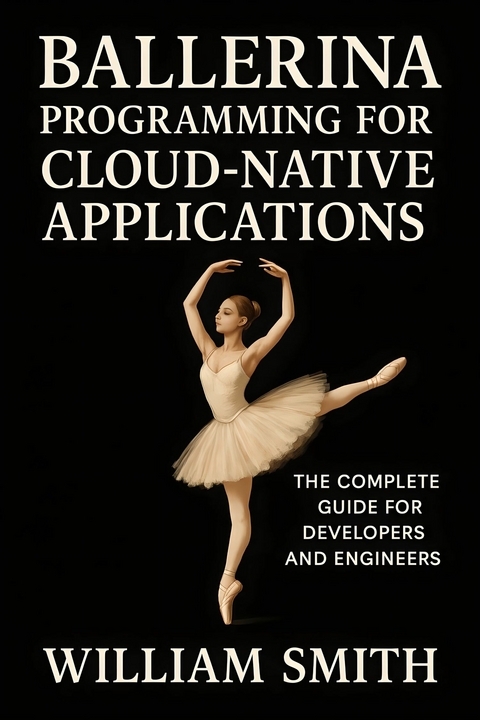
Ballerina Programming for Cloud-Native Applications (eBook)
250 Seiten
HiTeX Press (Verlag)
978-0-00-102741-1 (ISBN)
'Ballerina Programming for Cloud-Native Applications'
'Ballerina Programming for Cloud-Native Applications' is a comprehensive guide for developers and architects committed to building robust, scalable, and maintainable cloud-native systems. The book introduces Ballerina as a next-generation language purpose-built for service-oriented, distributed applications, positioning it among today's most relevant cloud development tools. Readers will gain a thorough understanding of Ballerina's core principles, including its novel type system, service-first approach, and the rich development ecosystem, alongside practical criteria for selecting Ballerina in various technical scenarios.
Delving deeply into the heart of cloud-native programming, the book covers a wide array of essential topics-from defining and composing APIs and services to advanced data integration with cloud databases and messaging platforms. Security and resilience are given significant emphasis, with chapters dedicated to implementing authentication, secure transport, auditing, compliance, and multi-cloud considerations. Furthermore, detailed guidance on deploying and operating Ballerina applications is provided, with best practices for containerization, Kubernetes orchestration, serverless models, and zero-downtime upgrades, ensuring readers are equipped to deliver production-grade solutions.
The latter sections empower practitioners to extend Ballerina's capabilities through custom plugins and connectors, embrace observability with modern monitoring and tracing techniques, and fine-tune applications for high performance and elasticity. Real-world case studies and practical migration strategies illustrate how leading organizations leverage Ballerina to modernize legacy systems, integrate with service meshes, and comply with regulatory requirements. This book is an indispensable resource for professionals aiming to master cloud-native development with Ballerina, blending foundational knowledge, advanced patterns, and actionable insights derived from contemporary industry practices.
Chapter 1
Introduction to Ballerina and Cloud-Native Paradigms
Unravel how Ballerina redefines the boundaries of cloud-native programming by making distributed integration a first-class citizen. This chapter explores the rationale behind Ballerina’s creation, demystifies its unique service-oriented DNA, and establishes why the language is poised to address the complexities of building modern, resilient, and scalable cloud applications. Discover where Ballerina sits in the fast-evolving landscape of programming languages and learn what sets it apart for professionals tackling the future of cloud-native systems.
1.1 The Evolution of Cloud-Native Languages
The progression from monolithic application design to cloud-native architectures has profoundly influenced the landscape of programming languages. Early enterprise software was predominantly crafted as monolithic systems, developed with general-purpose languages such as Java, C++, and C#. These languages emphasized computation, control flow, and object-oriented abstractions, primarily within single-machine contexts. As demands grew for scalable, resilient, and distributed systems, the limitations of these traditional languages in cloud environments became increasingly apparent.
Monolithic architectures consolidate functionality into single deployable units, often resulting in tightly coupled components with intricate dependencies. Traditional languages excelled under this paradigm due to mature tools, extensive libraries, and support for object-oriented and procedural paradigms. However, as applications migrated towards microservices and containerized deployments, the programming models required to design, deploy, and maintain these distributed systems diverged from legacy language strengths.
Cloud-native systems impose unique challenges that stress programming languages along several dimensions: service orchestration, asynchronous communication, fault tolerance, and seamless integration with diverse APIs. The granularity of cloud services demands lightweight, composable components capable of independently scaling and upgrading. Hence, language features enabling concurrent and parallel execution, native support for network protocols, and simple interfacing with external services have moved to the fore.
Traditional general-purpose languages typically lack direct abstractions for distributed communication or integration-specific concerns. To bridge networking gaps, developers often rely on external libraries, middleware, or declarative tools such as Kubernetes manifests and API gateways. This multi-layered approach introduces complexity, fragmentation, and potential performance overhead. Furthermore, traditional concurrency models-based on threads, locks, or callbacks-are error-prone and suboptimal for large-scale asynchronous cloud environments.
Languages such as Go and Rust respond partly to these challenges by emphasizing lightweight concurrency primitives (goroutines in Go, async/await in Rust) and system-level efficiency. Nonetheless, they remain fundamentally general-purpose, requiring considerable developer effort for integration with service meshes, message brokers, and RESTful or GraphQL APIs. Similarly, JavaScript and TypeScript have gained ground in cloud-native applications, especially with Node.js, due to their event-driven, non-blocking nature and ecosystem of integration-focused packages. However, these languages often trade type safety and explicit concurrency control for flexibility and rapid prototyping.
Within this evolving milieu, Ballerina emerges as a domain-specific language explicitly engineered for cloud-native development. It integrates programming constructs that seamlessly address the networking and distributed computing paradigms central to cloud architectures. Ballerina’s design embeds rich abstractions for services, endpoints, and protocols directly into the language syntax, thus reducing reliance on extrinsic tooling and promoting clearer, more maintainable codebases.
A cornerstone of Ballerina’s innovation lies in its native support for structural concurrency. Its workers and asynchronous invocation model enable deterministic concurrency without complex synchronization mechanisms, facilitating scalable parallelism that aligns naturally with the stateless and event-driven character of cloud applications. Moreover, Ballerina treats networked interactions as first-class citizens through built-in support for HTTP, gRPC, WebSockets, and other protocols, allowing API integration and composition to be expressed lucidly within the language itself.
Ballerina’s type system further complements cloud-native requirements with structural typing and sophisticated data mapping capabilities. This enables seamless translation between different data formats (JSON, XML, protobuf) and service contracts, reducing impedance mismatch and serialization overhead common in conventional languages. Such features address critical pain points encountered in distributed service choreography, where heterogeneous systems must interoperate with high fidelity.
In comparison to both established and emerging cloud-oriented languages, Ballerina occupies a distinct niche by unifying programming, integration, and deployment concerns. Unlike general-purpose counterparts that treat these aspects as separate layers, Ballerina’s holistic approach encapsulates them within a single, coherent language framework. Its tooling includes built-in support for observability, tracing, and source-level debugging of distributed transactions, streamlining operational challenges often deferred in traditional language ecosystems.
To contextualize, whereas microservices developed with Java or Go may require complex configurations and additional frameworks for service discovery, load balancing, and communication protocols, Ballerina’s ecosystem emphasizes declarative service definitions ingrained with protocol semantics. This tighter semantic integration reduces cognitive load and accelerates development cycles, aligning with DevOps and continuous delivery paradigms unique to cloud-native operations.
The evolution from monolithic to cloud-native designs has catalyzed a paradigm shift in programming language design and utility. Traditional languages, while foundational and versatile, often fall short when directly confronted with the intricacies of distributed systems integration, concurrency, and native cloud infrastructure interaction. Emerging languages like Ballerina respond to these gaps by embedding cloud-first abstractions and workflow idioms at the language level, thereby advancing developer productivity, code clarity, and system robustness in complex distributed environments. This shift underscores the essential role of language innovation in fully realizing the potential of cloud-native architectures.
1.2 Core Language Principles
Ballerina is architected to seamlessly integrate the demands of modern distributed and service-oriented systems directly into its core syntax and semantics. The language’s foundational design principles embody an explicit alignment with cloud-native paradigms, where concurrency, network interactions, and service compositions are not afterthoughts but intrinsic constructs. This alignment fundamentally reduces the cognitive load on developers by eliminating accidental complexity and enabling expression that closely mirrors the operational realities of distributed applications.
At the heart of Ballerina’s design is concurrency as a first-class concept. Rather than retrofitting concurrency primitives into a sequential programming model, Ballerina treats concurrency as a natural feature of the language. The language adopts asynchronous message passing as the primary communication mechanism between concurrent workers, promoting non-blocking, cooperative multitasking. This is realized through the concept of workers, distinct lightweight concurrent entities within a function scope that communicate explicitly via message channels. The language syntax provides constructs such as worker blocks and send and receive statements that syntactically enforce structured and race-free concurrency.
worker w1 {
// Perform some computation asynchronously
...
| Erscheint lt. Verlag | 20.8.2025 |
|---|---|
| Sprache | englisch |
| Themenwelt | Mathematik / Informatik ► Informatik ► Programmiersprachen / -werkzeuge |
| ISBN-10 | 0-00-102741-7 / 0001027417 |
| ISBN-13 | 978-0-00-102741-1 / 9780001027411 |
| Informationen gemäß Produktsicherheitsverordnung (GPSR) | |
| Haben Sie eine Frage zum Produkt? |
 EPUB (Adobe DRM)
Größe: 674 KB
Kopierschutz: Adobe-DRM
Adobe-DRM ist ein Kopierschutz, der das eBook vor Mißbrauch schützen soll. Dabei wird das eBook bereits beim Download auf Ihre persönliche Adobe-ID autorisiert. Lesen können Sie das eBook dann nur auf den Geräten, welche ebenfalls auf Ihre Adobe-ID registriert sind.
Details zum Adobe-DRM
Dateiformat: EPUB (Electronic Publication)
EPUB ist ein offener Standard für eBooks und eignet sich besonders zur Darstellung von Belletristik und Sachbüchern. Der Fließtext wird dynamisch an die Display- und Schriftgröße angepasst. Auch für mobile Lesegeräte ist EPUB daher gut geeignet.
Systemvoraussetzungen:
PC/Mac: Mit einem PC oder Mac können Sie dieses eBook lesen. Sie benötigen eine
eReader: Dieses eBook kann mit (fast) allen eBook-Readern gelesen werden. Mit dem amazon-Kindle ist es aber nicht kompatibel.
Smartphone/Tablet: Egal ob Apple oder Android, dieses eBook können Sie lesen. Sie benötigen eine
Geräteliste und zusätzliche Hinweise
Buying eBooks from abroad
For tax law reasons we can sell eBooks just within Germany and Switzerland. Regrettably we cannot fulfill eBook-orders from other countries.
aus dem Bereich


