


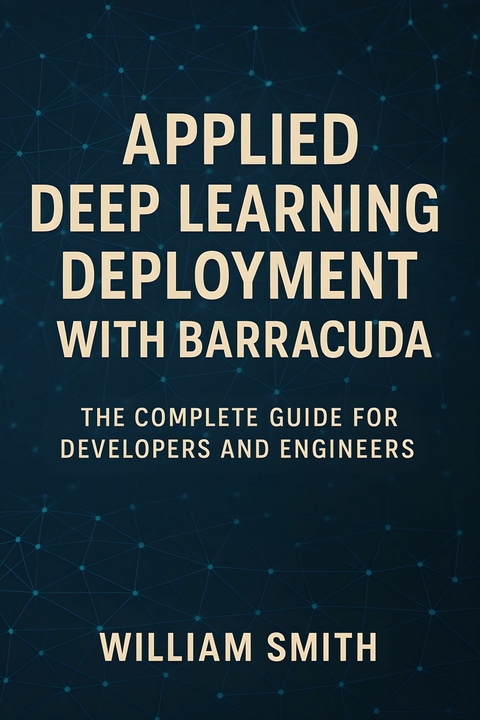
Applied Deep Learning Deployment with Barracuda (eBook)
250 Seiten
HiTeX Press (Verlag)
978-0-00-102740-4 (ISBN)
'Applied Deep Learning Deployment with Barracuda'
'Applied Deep Learning Deployment with Barracuda' is a comprehensive guide to leveraging Unity's Barracuda engine for state-of-the-art deep learning inference and model deployment. This book deftly unpacks Barracuda's architecture, runtime capabilities, ONNX model support, and integration workflows, providing readers with both a foundational and advanced understanding of deploying neural networks across a diverse array of applications. From model formatting and optimization to Unity integration, readers will acquire a robust toolkit for efficient deployment on mobile, cloud, edge, and real-time platforms.
Structured to address the entire lifecycle of machine learning deployment, the book explores model conversion, automated pipelines, profiling, benchmarking, and strategies for optimizing performance and scalability. It offers specific techniques on quantization, pruning, parallelism, and memory management that are crucial for delivering fast, robust inference in interactive and production-grade settings. Dedicated chapters on CI/CD, DevOps, robust testing, and quality assurance ensure the reader is equipped to implement industrial-strength deployment pipelines and maintain the operational integrity of AI-powered systems.
Illustrated with real-world case studies in AR/VR, game AI, speech, healthcare, robotics, and more, 'Applied Deep Learning Deployment with Barracuda' also envisions the future of scalable model delivery, security, and hardware adaptation. This book stands as an indispensable resource for engineers, researchers, and developers seeking to harness the full potential of Barracuda within Unity, ensuring that deep learning models are performant, reliable, and ready for tomorrow's most demanding applications.
Chapter 2
Model Conversion, Optimization, and Compatibility
Unlock the full potential of your neural networks by mastering the art and science of conversion, optimization, and deployment within the Barracuda ecosystem. This chapter delves into the intricacies of transforming raw models into production-ready assets, exposing the hidden challenges and advanced techniques needed to ensure peak performance, reliability, and compatibility in real-world applications.
2.1 Exporting Models to ONNX Format
The Open Neural Network Exchange (ONNX) format serves as a pivotal intermediate representation enabling interoperability among numerous deep learning frameworks. When preparing models for deployment with the Barracuda inference engine, converting PyTorch or TensorFlow models into ONNX is a critical step that demands careful calibration to preserve computation fidelity and runtime efficiency.
From PyTorch, the torch.onnx.export API provides a comprehensive entry point for exporting models. Successful export hinges on supplying a representative input tensor, accurately reflecting the expected data shape and type during inference. This input not only drives the tracing mechanism but also influences graph construction and operator selection. For example, consider a standard convolutional network model:
# model: a trained PyTorch model instance
# dummy_input: tensor matching model input dimensions
torch.onnx.export(
model,
dummy_input,
"model.onnx",
export_params=True, # include trained weights
opset_version=12, # ONNX operator set version
do_constant_folding=True, # optimization pass
input_names=[’input’],
output_names=[’output’],
dynamic_axes={’input’: {0: ’batch_size’}, ’output’: {0: ’batch_size’}}
)
Key parameters such as opset_version control the supported operator set, with newer versions introducing enhanced operators but requiring validation of their support in downstream tools like Barracuda. The dynamic_axes argument addresses the flexibility in input dimensions, enabling batch size variability, which is frequently required in production pipelines. Enabling do_constant_folding reduces runtime overhead by precomputing constant expressions during export.
Common pitfalls arise due to PyTorch’s dynamic nature; some control flow constructs (e.g., Python-side conditionals and loops) can lead to incomplete or incorrect graph representations. Ensuring that all operations remain within the traced graph is essential. Using scripting via torch.jit.script rather than tracing can mitigate such issues but may necessitate refactoring model code to comply with TorchScript requirements.
TensorFlow models, typically represented as SavedModels or Keras models, demand the use of the tf2onnx conversion tool or the built-in TensorFlow ONNX exporter in recent versions. A typical conversion workflow uses the python -m tf2onnx.convert CLI command or equivalent Python API invocation:
import tf2onnx
# Load or build the TensorFlow model
model = tf.saved_model.load("path_to_saved_model")
# Define the inputs signature for the model
...
| Erscheint lt. Verlag | 20.8.2025 |
|---|---|
| Sprache | englisch |
| Themenwelt | Mathematik / Informatik ► Informatik ► Programmiersprachen / -werkzeuge |
| ISBN-10 | 0-00-102740-9 / 0001027409 |
| ISBN-13 | 978-0-00-102740-4 / 9780001027404 |
| Informationen gemäß Produktsicherheitsverordnung (GPSR) | |
| Haben Sie eine Frage zum Produkt? |
 EPUB (Adobe DRM)
Größe: 681 KB
Kopierschutz: Adobe-DRM
Adobe-DRM ist ein Kopierschutz, der das eBook vor Mißbrauch schützen soll. Dabei wird das eBook bereits beim Download auf Ihre persönliche Adobe-ID autorisiert. Lesen können Sie das eBook dann nur auf den Geräten, welche ebenfalls auf Ihre Adobe-ID registriert sind.
Details zum Adobe-DRM
Dateiformat: EPUB (Electronic Publication)
EPUB ist ein offener Standard für eBooks und eignet sich besonders zur Darstellung von Belletristik und Sachbüchern. Der Fließtext wird dynamisch an die Display- und Schriftgröße angepasst. Auch für mobile Lesegeräte ist EPUB daher gut geeignet.
Systemvoraussetzungen:
PC/Mac: Mit einem PC oder Mac können Sie dieses eBook lesen. Sie benötigen eine
eReader: Dieses eBook kann mit (fast) allen eBook-Readern gelesen werden. Mit dem amazon-Kindle ist es aber nicht kompatibel.
Smartphone/Tablet: Egal ob Apple oder Android, dieses eBook können Sie lesen. Sie benötigen eine
Geräteliste und zusätzliche Hinweise
Buying eBooks from abroad
For tax law reasons we can sell eBooks just within Germany and Switzerland. Regrettably we cannot fulfill eBook-orders from other countries.
aus dem Bereich


