


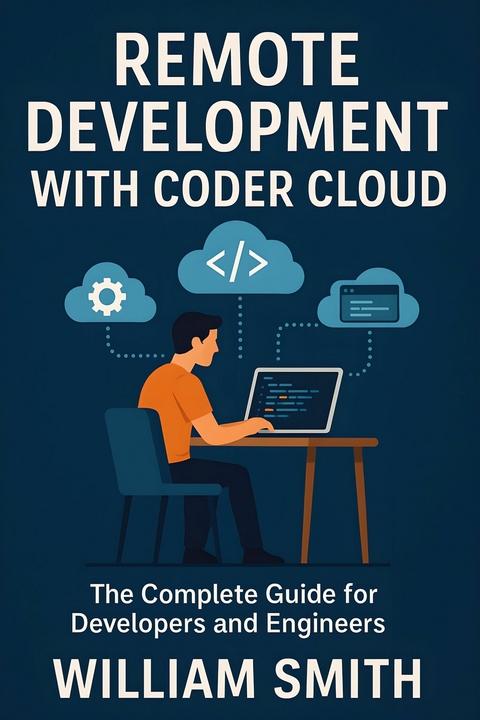
Remote Development with Coder Cloud (eBook)
250 Seiten
HiTeX Press (Verlag)
978-0-00-102738-1 (ISBN)
'Remote Development with Coder Cloud'
'Remote Development with Coder Cloud' is a comprehensive technical guide that explores the evolution, architecture, and best practices of cloud-based software development environments. Through a structured examination, the book details the transition from traditional local setups to remote, cloud-native workspaces, addressing the technological forces driving this shift and unpacking the complexities of connectivity, resource isolation, and security. Readers will gain insight into the scalability requirements and industry adoption patterns, with practical discussions on the benefits, limitations, and security fundamentals essential for organizations embracing distributed development.
Delving into the core aspects of the Coder Cloud platform, the book provides an in-depth analysis of its system architecture, workspace orchestration, networking, storage models, and advanced security mechanisms such as authentication, authorization, and multi-tenancy. It offers actionable guidance on both SaaS and self-hosted deployment models, encompassing setup prerequisites, automation workflows, monitoring, backup strategies, and cost management. For DevOps engineers, administrators, and technical leaders, detailed chapters illuminate strategies for scaling operations, achieving high availability, establishing enterprise governance, and integrating with broader enterprise toolchains and analytics systems.
Beyond platform fundamentals, 'Remote Development with Coder Cloud' addresses the nuances of developer experience, workspace customization, and productivity engineering, including IDE/editor integration, performance optimization, containerization, and CI/CD workflows. The book concludes with forward-looking perspectives on the future of cloud-based development, featuring discussions on AI-driven workflows, serverless workspaces, cutting-edge security paradigms, sustainability, and distributed/edge scenarios. Rich with patterns, checklists, and implementation guidance, this book is an indispensable resource for teams and organizations pioneering the future of remote software development.
Chapter 2
Coder Cloud Platform Architecture
At the heart of every robust remote development platform lies an intricate framework of orchestration, isolation, and security. This chapter pulls back the curtain on the Coder Cloud architecture-revealing how its finely tuned subsystems synchronize to deliver performant, scalable, and secure developer workspaces. Gain a deep, system-level perspective that empowers you to understand, extend, and troubleshoot your remote environments at enterprise scale.
2.1 System Components and Control Plane
The Coder Cloud architecture is fundamentally structured around three core subsystems: the control plane, workspace provisioners, and the agent infrastructure. These elements collectively establish a cohesive, scalable, and reliable platform capable of managing distributed workspaces across diverse cloud environments and clusters. Each subsystem embodies distinct responsibilities yet integrates seamlessly to maintain consistency, extensibility, and operational efficiency.
At the heart lies the control plane, a stateless, event-driven orchestrator responsible for overall governance, lifecycle management, and state reconciliation. Designed under the principle of separation of concerns, the control plane exclusively manages control logic without direct handling of workspace resource execution. This abstraction enables it to remain agnostic to underlying execution environments and physical infrastructure details. State persistence is externalized through a distributed key-value store or an equivalent strongly-consistent metadata service, allowing multiple replicated control plane instances to operate concurrently for high availability and fault tolerance.
The control plane ingests events reflecting desired state changes-such as workspace creation, modification, or deletion-and translates these intents into actionable tasks dispatched to workspace provisioners. This event-driven architecture ensures temporal decoupling between user requests and resource provisioning, enabling smooth concurrency and scalability. Furthermore, reconciliation loops continuously compare actual cluster states with the declared desired state, triggering corrections when divergences occur, thus guaranteeing eventual consistency despite transient failures or network partitions.
Workspace provisioners serve as specialized subsystems tasked with the creation, configuration, and deletion of workspace environments. Each provisioner abstracts a specific target platform or cloud provider, encapsulating the nuances of infrastructure APIs, identity management, networking, and resource quotas. This modular approach fosters extensibility: new provisioners may be integrated to support emerging environments without disrupting the core control plane logic. Provisioners receive declarative intents from the control plane and engage in idempotent operations to instantiate containerized development environments, virtual machines, or ephemeral compute units as required by user workspace specifications.
To coordinate provisioning activities across heterogeneous clusters and cloud providers, the system employs a uniform API contract and event notification mechanisms. Provisioners report status updates and resource metrics back to the control plane, enabling holistic observability and dynamic scaling decisions. Multi-environment cohesion is achieved by decoupling provisioning logic from platform-specific details, ensuring that workspaces exhibit consistent behavior regardless of their hosting cloud or geographic location.
Complementing the control plane and provisioners, the agent infrastructure comprises lightweight agents deployed inside user workspaces and cluster nodes. These agents act as intermediaries that enforce runtime policies, facilitate secure communication, and enable telemetry collection. Agents perform specialized tasks such as metric aggregation, user session management, and runtime configuration adjustments without burdening the centralized control plane. Because agents are embedded within workspace containers or nodes, they empower localized decision-making and responsiveness, reducing latencies and network dependencies.
Agent design prioritizes simplicity and resilience: agents maintain minimal state, recover gracefully from transient faults, and communicate asynchronously with the control plane via secure channels. This architecture supports scenarios involving intermittent connectivity or network segmentation, providing robust operation in edge or hybrid cloud contexts. Additionally, agents expose extension points for custom plugins or scripts, enabling enterprises to tailor monitoring, security, or configuration policies to their unique operational requirements.
The combination of these components embodies a strict separation of concerns. The control plane focuses on declarative orchestration and state management, provisioners specialize in environment-specific resource lifecycle handling, and agents concentrate on runtime enforcement and telemetry. This delineation reduces complexity, eases maintenance, and improves scalability. By externalizing state and adopting stateless control logic, the architecture attains elasticity-instances of control plane services may be elastically scaled or restarted at will without risking service disruption or configuration drift.
Orchestration logic is centrally codified around reconciliation loops and event-driven workflows. These patterns guarantee that each system subsystem acts in response to well-defined signals rather than continuous polling or imperative scripting, minimizing latency and resource consumption. Furthermore, extensibility is naturally supported by the uniform event interface: new provisioners or agents can subscribe to relevant event streams and emit corresponding status updates without modifying the core platform codebase.
In aggregate, these design principles and system divisions establish Coder Cloud’s capacity to provide reliable multi-cloud workspace hosting that is extensible, observable, and resilient. True multi-environment cohesion emerges from the pluggable provisioners and distributed agent model operating under the harmonized control plane, facilitating seamless management of diverse infrastructure assets while abstracting complexity from end users. This architecture exemplifies best practices in cloud-native system design by combining stateless control, event-driven provisioning, and strict modularization to deliver a unified developer experience across heterogeneous environments.
2.2 Workspace Lifecycle and Orchestration
The operational lifespan of a remote workspace within Coder Cloud begins with provisioning, a highly automated process that establishes a new environment based on predefined templates. This procedure integrates resource allocation policies, security posture parameters, and initial configuration states distilled from organizational requirements. Provisioning fundamentally involves orchestrating containerized or virtualized compute instances, enabling a consistent developer environment while abstracting underlying infrastructure complexity.
Upon creation, the workspace undergoes initialization, where template-driven configuration scripts execute to install necessary dependencies, configure environment variables, and preload essential source code repositories or artifacts. These templates are declarative manifests specifying resource constraints, software versions, runtime settings, and integrations. Their immutability ensures reproducibility and traceability, while runtime parameters allow fine-grained customization. Automated tooling applies these templates via reconciliation loops, which continuously compare the desired declared state to the actual cluster state and initiate corrective actions until convergence is achieved.
As utilization patterns evolve, workspaces demand on-demand scaling-horizontal scaling by spinning up additional compute units or vertical scaling by adjusting compute power and memory allocations. Coder Cloud’s orchestration leverages metrics-driven autoscaling controllers that monitor resource consumption and latency thresholds. Scaling decisions are enacted through the control plane, which interfaces with underlying cloud providers or data center APIs to dynamically adjust pod replicas or VM sizes. This elasticity maintains performance SLA adherence while optimizing cost-efficiency.
To safeguard against data loss and facilitate rapid rollback, workspaces employ snapshotting. Snapshots capture the current state of a workspace, encompassing filesystem contents, application state, and in-memory data when supported. Orchestrated snapshot creation is triggered periodically or on demand, using storage providers’ native snapshot APIs integrated via persistent volume abstractions. Snapshots reduce recovery time objectives and enable branching workflows, where developers can experiment without risking the stability of the main environment.
Upgrades to workspace environments involve coordinating rolling updates of the underlying operating system, development toolchains, and preinstalled software packages. The orchestration system adopts blue-green or canary deployment strategies to...
| Erscheint lt. Verlag | 20.8.2025 |
|---|---|
| Sprache | englisch |
| Themenwelt | Mathematik / Informatik ► Informatik ► Programmiersprachen / -werkzeuge |
| ISBN-10 | 0-00-102738-7 / 0001027387 |
| ISBN-13 | 978-0-00-102738-1 / 9780001027381 |
| Informationen gemäß Produktsicherheitsverordnung (GPSR) | |
| Haben Sie eine Frage zum Produkt? |
 EPUB (Adobe DRM)
Größe: 696 KB
Kopierschutz: Adobe-DRM
Adobe-DRM ist ein Kopierschutz, der das eBook vor Mißbrauch schützen soll. Dabei wird das eBook bereits beim Download auf Ihre persönliche Adobe-ID autorisiert. Lesen können Sie das eBook dann nur auf den Geräten, welche ebenfalls auf Ihre Adobe-ID registriert sind.
Details zum Adobe-DRM
Dateiformat: EPUB (Electronic Publication)
EPUB ist ein offener Standard für eBooks und eignet sich besonders zur Darstellung von Belletristik und Sachbüchern. Der Fließtext wird dynamisch an die Display- und Schriftgröße angepasst. Auch für mobile Lesegeräte ist EPUB daher gut geeignet.
Systemvoraussetzungen:
PC/Mac: Mit einem PC oder Mac können Sie dieses eBook lesen. Sie benötigen eine
eReader: Dieses eBook kann mit (fast) allen eBook-Readern gelesen werden. Mit dem amazon-Kindle ist es aber nicht kompatibel.
Smartphone/Tablet: Egal ob Apple oder Android, dieses eBook können Sie lesen. Sie benötigen eine
Geräteliste und zusätzliche Hinweise
Buying eBooks from abroad
For tax law reasons we can sell eBooks just within Germany and Switzerland. Regrettably we cannot fulfill eBook-orders from other countries.
aus dem Bereich


