


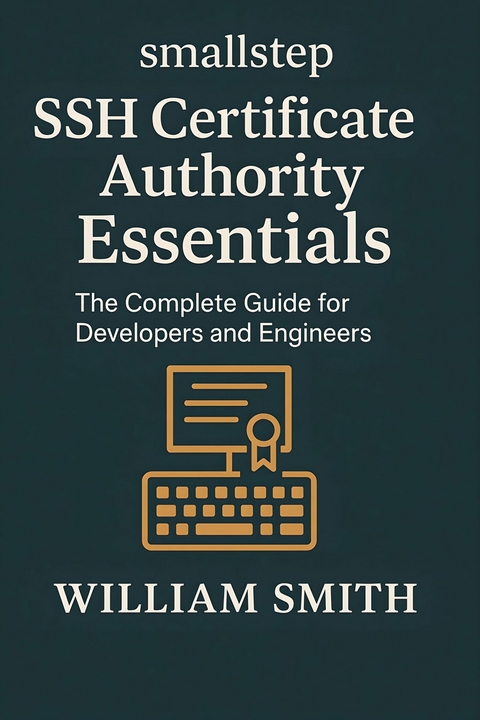
Smallstep SSH Certificate Authority Essentials (eBook)
250 Seiten
HiTeX Press (Verlag)
978-0-00-102736-7 (ISBN)
'Smallstep SSH Certificate Authority Essentials'
'Smallstep SSH Certificate Authority Essentials' offers a comprehensive and practical guide to mastering modern SSH certificate-based authentication with the widely adopted Smallstep CA platform. The book opens with a rigorous exploration of the SSH protocol, security models, and the limitations of static key authentication, providing readers with the foundational knowledge needed to appreciate the transformative impact of SSH certificates. Through clear explanations of certificate structures, trust assumptions, and adversary models, this volume positions SSH CA as a next-generation solution, contrasting its nuanced capabilities with traditional x509 PKI while delving into identity management, constraints, and advanced extensions.
With a deep focus on real-world deployment, the book walks practitioners through the full architecture of Smallstep CA-detailing design principles, core components, and secure workflows for certificate issuance, renewal, and revocation. It covers advanced scenarios including cloud-native, hybrid, and air-gapped environments, alongside strategies for disaster recovery, high availability, and secure key storage leveraging hardware security modules. Readers learn to seamlessly integrate Smallstep SSH CA with contemporary identity architectures, including just-in-time provisioning, MFA, attribute-based access control, and federated workforce and machine authentication, all supported by robust compliance and audit mechanisms.
The narrative extends into automated certificate management, self-service enablement, and policy-driven operations, ensuring organizations can scale their SSH infrastructure efficiently and securely. Chapters dedicated to operational excellence highlight performance optimizations, monitoring, multi-tenancy, and case studies from large-scale deployments. The book concludes with thoughtful coverage of emerging trends-such as protocol innovations, cross-cloud orchestration, IoT and edge use-cases, and privacy-centric configurations-solidifying 'Smallstep SSH Certificate Authority Essentials' as an indispensable reference for security architects, DevOps professionals, and IT leaders seeking to implement or modernize SSH authentication at scale.
Chapter 1
SSH Certificates: Concepts and Security Foundations
What makes SSH certificates the key ingredient in building secure, scalable, and auditable machine and human access in modern environments? Dive into this chapter to unravel the cryptographic underpinnings, trust models, lifecycle mechanics, and risk boundaries that separate static SSH keys from certificate-based architectures-setting the foundation for resilient, manageable infrastructure authentication.
1.1 SSH Protocol Overview and Security Model
The Secure Shell (SSH) protocol is a comprehensive network protocol designed to enable secure communication over unsecured networks. Its core design centers on providing confidentiality, integrity, and authentication in remote access and data exchange scenarios. SSH’s architecture is layered, distinctly partitioning transport, authentication, and connection protocols to facilitate modularity and adaptability while maintaining rigorous security.
At the foundational layer, the SSH Transport Layer Protocol initiates communication by establishing a secure and authenticated channel between client and server. This process begins with version exchange, allowing peers to negotiate protocol versions and supported cryptographic algorithms. The handshake mechanism primarily employs a key exchange (KEX) protocol, most commonly based on Diffie-Hellman methods, to derive a shared secret key securely. This precludes exposure of sensitive keying material over the network and ensures forward secrecy, which guarantees that compromise of long-term keys does not expose past session data.
The KEX process involves each party generating ephemeral key pairs and exchanging public components. The shared secret is then computed independently by both sides, resulting in an identical key without transferring it directly. During this handshake, algorithm negotiation occurs to select suitable key exchange, encryption, message authentication (MAC), and compression algorithms supported by both parties. The negotiated algorithms directly influence the protocol’s confidentiality and integrity assurances for the session. This negotiation mitigates downgrade attacks by requiring mutual agreement on cryptographic primitives before any sensitive data transmission.
Following key exchange, the transport layer authenticates the server via its host key, which is either pre-shared or verified against known hosts to prevent man-in-the-middle (MITM) attacks. The authentication phase depends on this trust anchor: the implicit assumption is that the server’s host key is trustworthy, and the client maintains an accurate and tamper-resistant record of these keys. This assumption underlies the security model of SSH and differentiates it from protocols that rely solely on trusted third-party certificate authorities.
User authentication is layered atop the transport connection via the SSH Authentication Protocol. It supports multiple methods including public-key authentication, password, keyboard-interactive, and host-based mechanisms. The public-key method offers cryptographically strong authentication by proving knowledge of a private key corresponding to a trusted public key without transmitting secrets. Importantly, the authentication methods are encapsulated to operate securely over the encrypted transport channel, preserving user credential confidentiality.
Once user authentication succeeds, the SSH Connection Protocol facilitates multiplexing of multiple logical communication channels within the single secure session. Each channel operates over the cryptographically protected tunnel established by the transport layer. This design supports diverse services such as shell access, file transfer (SFTP), and port forwarding concurrently over one connection, reducing resource overhead and simplifying firewall traversal. Channels utilize sequence numbers and message integrity checks to maintain ordering and data authenticity.
The SSH security model fundamentally depends on explicit trust in the server’s host key and the client’s management of these keys to prevent impersonation. Implicit in the design is the trust in cryptographic primitives’ strength and the correctness of algorithms’ implementation. This trust model imposes a necessity for regular host key verification and careful algorithmic configuration. Users and administrators must ensure host keys are reliably obtained and that legacy or weak algorithms are deprecated promptly in response to cryptanalytic advances or operational vulnerabilities.
Adaptability to evolving threat landscapes is a pivotal strength of SSH. The protocol has undergone iterative extensions to include stronger key exchange methods (e.g., Elliptic Curve Diffie-Hellman), enhanced encryption standards (AES, ChaCha20), improved MAC algorithms (HMAC-SHA2 variants), and resistance to side-channel attacks. Algorithm negotiation allows for smooth transitions without breaking backward compatibility. Additionally, features like rekeying intervals reduce the cryptographic material exposure window, further strengthening session security over long durations.
The comprehensive design and modular layering in SSH thus enable a robust security posture. The transport layer’s confidentiality and integrity mechanisms, combined with flexible and strong user authentication, and the multiplexed channels supporting diverse applications, collectively embody a versatile secure communication protocol. Understanding SSH’s explicit and implicit trust assumptions clarifies operational security policies. Furthermore, analyzing its handshake and negotiation mechanisms reveals the protocol’s strategic approach to establishing resilient secure channels capable of adapting to the continuous evolution of cryptographic standards and threat vectors.
1.2 Shortcomings of Static Key Authentication
Traditional public/private key authentication mechanisms employed in Secure Shell (SSH) environments rely heavily on static cryptographic key pairs. While this approach has established itself as a cornerstone for securing remote access, various operational, security, and scalability limitations have emerged, impeding robust identity validation and system integrity. Understanding these shortcomings is crucial for appreciating the impetus behind next-generation authentication primitives.
From an operational standpoint, the complexity of key distribution and lifecycle management imposes substantial administrative overhead. Each user or system component must generate, securely store, and distribute its public key to all target hosts requiring authentication. This process is typically manual or semi-automated, often resulting in inconsistent or outdated key deployment across environments with many nodes. The absence of centralized key management amplifies challenges, particularly as organizations scale, leading to environments rife with orphaned or duplicated keys.
Lifecycle management is further complicated by the lack of automatic mechanisms for periodic key rotation or expiration. Static keys often remain valid indefinitely unless explicitly revoked; this stasis increases exposure risk as compromised keys may go unnoticed and remain operative indefinitely. The revocation processes for SSH keys are generally fragile, relying on administrators to remove public keys from authorized lists, which is slow and error-prone in dynamic infrastructures.
The static nature of these keys also results in a fundamental limitation concerning identity granularity. Each SSH key pair typically identifies a user or a service, but does not encapsulate contextual information such as role, time-bound access conditions, or deployment-specific attributes. Consequently, access controls must be coarse-grained, either allowing full access or none, without conditional constraints. This increases the risk profile by enabling elevated access privileges that cannot be dynamically tailored or constrained after key distribution.
Key sprawl represents a substantial security hazard in modern, distributed environments. The proliferation of numerous keys across heterogeneous systems leads to difficulties in tracking key ownership and usage patterns. Without sophisticated auditing or orchestration tools, organizations may accumulate thousands of static keys without comprehensive knowledge of their operational status. This sprawl not only complicates compliance efforts but also expands the attack surface exposed to adversaries.
Accidental key exposure is another critical vulnerability intrinsic to static key usage. Private keys stored on user or system devices can be inadvertently leaked through compromised endpoints, mishandling, or inclusion in publicly accessible code repositories. Given the static reuse of keys over long durations, a single exposure event can yield persistent opportunities for unauthorized access. Unlike credential systems involving ephemeral tokens or multi-factor validations, static keys do not inherently enforce periodic renewal or user presence verification, weakening overall security assurances.
From a threat modeling perspective, the weak revocation capability of static SSH keys notably exacerbates post-breach lateral movement. Attackers who obtain a valid private key can pivot across multiple systems seamlessly, as the key’s privileges remain static and broadly...
| Erscheint lt. Verlag | 20.8.2025 |
|---|---|
| Sprache | englisch |
| Themenwelt | Mathematik / Informatik ► Informatik ► Programmiersprachen / -werkzeuge |
| ISBN-10 | 0-00-102736-0 / 0001027360 |
| ISBN-13 | 978-0-00-102736-7 / 9780001027367 |
| Informationen gemäß Produktsicherheitsverordnung (GPSR) | |
| Haben Sie eine Frage zum Produkt? |
 EPUB (Adobe DRM)
Größe: 764 KB
Kopierschutz: Adobe-DRM
Adobe-DRM ist ein Kopierschutz, der das eBook vor Mißbrauch schützen soll. Dabei wird das eBook bereits beim Download auf Ihre persönliche Adobe-ID autorisiert. Lesen können Sie das eBook dann nur auf den Geräten, welche ebenfalls auf Ihre Adobe-ID registriert sind.
Details zum Adobe-DRM
Dateiformat: EPUB (Electronic Publication)
EPUB ist ein offener Standard für eBooks und eignet sich besonders zur Darstellung von Belletristik und Sachbüchern. Der Fließtext wird dynamisch an die Display- und Schriftgröße angepasst. Auch für mobile Lesegeräte ist EPUB daher gut geeignet.
Systemvoraussetzungen:
PC/Mac: Mit einem PC oder Mac können Sie dieses eBook lesen. Sie benötigen eine
eReader: Dieses eBook kann mit (fast) allen eBook-Readern gelesen werden. Mit dem amazon-Kindle ist es aber nicht kompatibel.
Smartphone/Tablet: Egal ob Apple oder Android, dieses eBook können Sie lesen. Sie benötigen eine
Geräteliste und zusätzliche Hinweise
Buying eBooks from abroad
For tax law reasons we can sell eBooks just within Germany and Switzerland. Regrettably we cannot fulfill eBook-orders from other countries.
aus dem Bereich


