


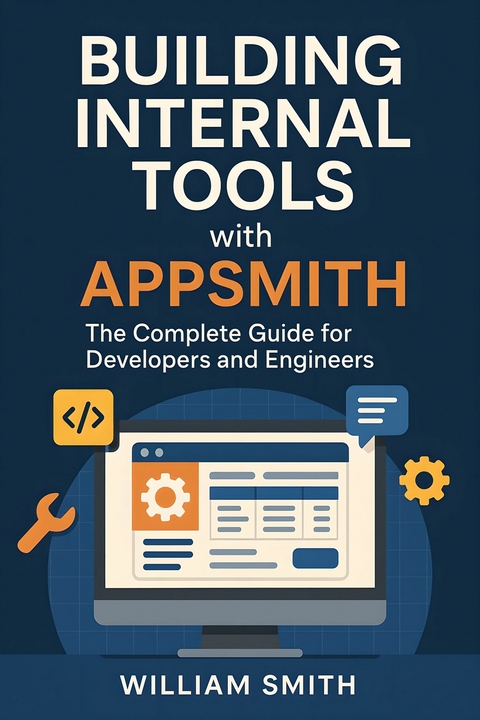
Building Internal Tools with Appsmith (eBook)
250 Seiten
HiTeX Press (Verlag)
978-0-00-102729-9 (ISBN)
'Building Internal Tools with Appsmith'
'Building Internal Tools with Appsmith' is a comprehensive guide that addresses the evolving landscape of enterprise software development through low-code technology. This book begins by exploring the strategic importance of internal tools in modern organizations, detailing how platforms like Appsmith are revolutionizing efficiency, scalability, and responsiveness within businesses. Readers are introduced to the fundamental capabilities and architectural pillars of Appsmith, including its event-driven programming model, robust security features, and the key use cases that underscore its role as a leading solution for operational excellence.
Delving deeper, the book provides a granular examination of Appsmith's extensible architecture, from frontend-backend separation and custom widget development to integrating diverse data sources such as RDBMS, NoSQL, REST, and GraphQL. It offers hands-on patterns for designing adaptive user interfaces, secure credential management, API orchestration, and real-time data synchronization. Additionally, it covers advanced scripting and workflow automation, enabling readers to build dynamic, interactive applications tailored for demanding business requirements-while maintaining high standards of testing, resilience, and maintainability.
The final sections address the crucial dimensions of enterprise security, compliance, and operational governance, presenting actionable frameworks for authentication, RBAC, audit trails, and regulatory alignment (GDPR, HIPAA, SOC 2). With its insights on DevOps integration, CI/CD automation, custom plugin development, and open-source collaboration, 'Building Internal Tools with Appsmith' empowers technology professionals to architect scalable, reliable, and innovative internal tools-supported by real-world case studies and advanced design patterns that capture the realities of enterprise adoption and modernization.
Chapter 2
Deep Dive into Appsmith Architecture
Architecture is the crucible in which both flexibility and reliability are forged. This chapter ventures beneath Appsmith’s intuitive user interface to reveal the sophisticated engineering and modular patterns that power highly customized internal tools at scale. By unraveling the architectural underpinnings, you will unlock new possibilities for extension, integration, and optimization-transforming Appsmith from a platform to an accelerator for technical innovation.
2.1 Frontend-Backend Separation and Communication
The architectural design of modern web applications increasingly favors a clear separation between frontend and backend concerns, a principle that Appsmith rigorously applies. This separation enhances maintainability, scalability, and enables teams to independently evolve application layers. At the core, Appsmith distinguishes the user interface logic from business logic and data management, facilitating a modular approach to development.
Appsmith’s frontend is primarily responsible for rendering the user interface, handling user interactions, and managing the presentation state. Conversely, the backend is tasked with executing business logic, managing persistent data, and interfacing with external APIs and databases. This bifurcation is not merely conceptual but is embedded in the framework’s mechanisms for state sharing, data flow, and event propagation.
State Sharing and Data Flow
State management in Appsmith is architected to preserve the independence of frontend and backend while allowing synchronized interaction. The frontend maintains a transient UI state encompassing widget states, local component variables, and input data. This state is ephemeral, primarily existing within the client’s runtime context.
The backend state consists of persistent data sources-such as database records or API responses-and application-level variables stored in a shared central cache. Communication between frontend and backend state occurs via well-defined data bindings and query results.
Appsmith employs a declarative data-binding system, whereby frontend widgets are linked to backend query results or global variables. This creates a unidirectional data flow: backend queries execute, their results propagate automatically to frontend components, updating relevant UI elements without direct imperative commands. The flow can be formalized as follows:
This pipeline ensures a consistent and predictable state transition, isolating backend data retrieval and processing from direct UI manipulation.
Event Propagation and Inter-Process Communication
Event propagation in Appsmith extends beyond UI interactions to encompass seamless synchronization with backend workflows. When a frontend event-such as a button click or form submission-triggers a backend query, Appsmith initiates an asynchronous inter-process communication (IPC) event. This IPC typically leverages HTTP requests or WebSocket protocols depending on the nature of the backend service.
To manage this asynchronously, Appsmith employs promises and reactive programming patterns within the frontend application. Queries execute in the backend environment isolated from UI threads, returning results or errors upon completion. The frontend listens for these events, and the resultant payload triggers reactive updates in the application state or error handling routines.
Complex event chains, such as conditional query execution followed by UI updates and subsequent triggering of downstream processes, are managed declaratively using Appsmith’s event handlers and action sequences. This modularizes event logic, further decoupling frontend responsibilities from backend procedural workflows.
executeQuery(’fetchUserData’).then(response => {
storeValue(’userData’, response.data);
showAlert(’User data loaded successfully’);
}).catch(error => {
showAlert(’Failed to load user data’, ’error’);
});
}
This pattern demonstrates non-blocking backend communication with subsequent reactive frontend state synchronization.
State Synchronization Strategies
Maintaining consistency between distributed frontend and backend states poses challenges, particularly in multi-user and real-time scenarios. Appsmith adopts several strategies to address this:
- Optimistic UI Updates: The frontend may temporarily update its state to reflect an anticipated successful backend operation, improving user experience by reducing perceived latency. Confirmation and rollback mechanisms ensure synchronization integrity once backend responses arrive.
- Polling and Webhook Integration: Periodic polling of backend services can refresh frontend state for stale or long-lived data. Additionally, webhook or push notification mechanisms allow backend servers to proactively notify Appsmith clients to update their view.
- Centralized Cache and Local Storage: By caching query results and user session data both on the frontend and backend, Appsmith reduces redundant data fetching and manages consistency through versioning or timestamp checks.
- Transactional Queries and Atomicity: Backend operations that involve multiple data changes are wrapped in transactions, ensuring frontend views are presented only after successful completion, thereby avoiding intermediate inconsistent states.
Rationale Behind Decoupling Application Layers
Decoupling frontend from backend responsibilities yields significant architectural advantages. Firstly, it fosters separation of concerns, enabling frontend developers to focus on user experience and interface logic without deep knowledge of data persistence or backend protocol intricacies. Backend engineers can optimize data flows, security policies, and business logic independently.
Secondly, this separation facilitates scalability. Frontend components can be horizontally scaled across numerous client machines or browsers, while backend services can be optimized for computational or storage-intensive operations, potentially distributed across clusters.
Thirdly, it enhances maintainability. Modifications in UI styling or interaction patterns can be implemented without risking unintended side effects on backend workflows. Similarly, backend changes-such as database schema migrations or API refactoring-can be made transparent to the frontend by maintaining stable interfaces and contracts.
Finally, this architecture supports diverse deployment scenarios. Appsmith applications can integrate multiple heterogeneous backend services,...
| Erscheint lt. Verlag | 20.8.2025 |
|---|---|
| Sprache | englisch |
| Themenwelt | Mathematik / Informatik ► Informatik ► Programmiersprachen / -werkzeuge |
| ISBN-10 | 0-00-102729-8 / 0001027298 |
| ISBN-13 | 978-0-00-102729-9 / 9780001027299 |
| Informationen gemäß Produktsicherheitsverordnung (GPSR) | |
| Haben Sie eine Frage zum Produkt? |
 EPUB (Adobe DRM)
Größe: 650 KB
Kopierschutz: Adobe-DRM
Adobe-DRM ist ein Kopierschutz, der das eBook vor Mißbrauch schützen soll. Dabei wird das eBook bereits beim Download auf Ihre persönliche Adobe-ID autorisiert. Lesen können Sie das eBook dann nur auf den Geräten, welche ebenfalls auf Ihre Adobe-ID registriert sind.
Details zum Adobe-DRM
Dateiformat: EPUB (Electronic Publication)
EPUB ist ein offener Standard für eBooks und eignet sich besonders zur Darstellung von Belletristik und Sachbüchern. Der Fließtext wird dynamisch an die Display- und Schriftgröße angepasst. Auch für mobile Lesegeräte ist EPUB daher gut geeignet.
Systemvoraussetzungen:
PC/Mac: Mit einem PC oder Mac können Sie dieses eBook lesen. Sie benötigen eine
eReader: Dieses eBook kann mit (fast) allen eBook-Readern gelesen werden. Mit dem amazon-Kindle ist es aber nicht kompatibel.
Smartphone/Tablet: Egal ob Apple oder Android, dieses eBook können Sie lesen. Sie benötigen eine
Geräteliste und zusätzliche Hinweise
Buying eBooks from abroad
For tax law reasons we can sell eBooks just within Germany and Switzerland. Regrettably we cannot fulfill eBook-orders from other countries.
aus dem Bereich


