


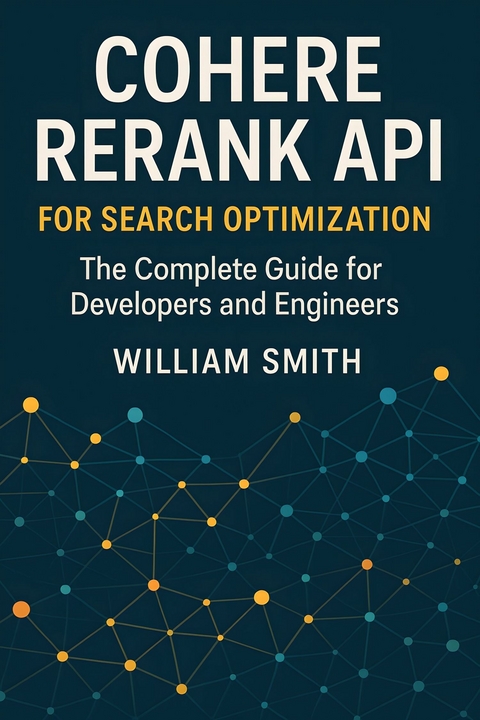
Cohere Rerank API for Search Optimization (eBook)
250 Seiten
HiTeX Press (Verlag)
978-0-00-102726-8 (ISBN)
'Cohere Rerank API for Search Optimization'
Unlock the next evolution in search technology with 'Cohere Rerank API for Search Optimization.' This comprehensive guide traces the remarkable journey from early keyword-based information retrieval to the sophisticated neural ranking systems that power today's applications. Through a clear exploration of traditional limitations and the rise of deep learning, the book provides a foundational understanding of why reranking has become integral to search architectures, addressing both design principles and critical evaluation metrics.
Delving into the technical heart of the Cohere Rerank API, the book combines practical insights with robust best practices for model integration, security, and performance optimization. Readers are guided through the nuances of feature engineering, relevance scoring, and efficient pipeline design, with hands-on advice for deploying reranking services across diverse modern infrastructures. Advanced topics such as prompt engineering, domain adaptation, hybrid ranking techniques, and personalized or multilingual scenarios equip practitioners to tailor search quality for varied requirements and audiences.
Rich with case studies from enterprise knowledge management, e-commerce, healthcare, and cutting-edge conversational search, the book grounds theory in real-world impact. Operational excellence, compliance, and fairness are covered alongside forward-looking chapters on federated learning, explainability, and open research frontiers in AI-powered reranking. Whether you are an engineer, architect, or product leader, this book serves as an authoritative resource for transforming search systems with Cohere's state-of-the-art rerank API.
Chapter 2
Cohere Rerank API: Technical Overview
Delve behind the curtain of modern reranking with an in-depth exploration of the Cohere Rerank API. Beyond its simple interface lies a sophisticated fusion of deep learning architectures, operational engineering, and robust security. This chapter dissects the mechanics and design choices that empower enterprise-grade semantic search, offering advanced readers a blueprint for integrating and leveraging cutting-edge ranking technologies in real-world systems.
2.1 Model Architecture and Training
Cohere’s reranker is engineered upon a transformer-based neural architecture optimized for semantic ranking tasks. Its core leverages bidirectional self-attention mechanisms, akin to those introduced in the Transformer model by Vaswani et al. [?], facilitating a nuanced representation of input text pairs. The architecture is designed to encode query-document pairs jointly, capturing contextual interdependencies critical for semantic matching beyond shallow lexical overlap.
The model backbone consists of multiple layers of transformer encoder blocks, each comprising multi-head self-attention and position-wise feedforward networks. This configuration enables the capture of long-range dependencies and interaction patterns between queries and candidate passages. A key design choice is the concatenation of query and candidate document inputs, separated by a special token, allowing cross-attention signals to emerge organically within the encoder layers. Positional embeddings and segment embeddings distinctly inform the model about token order and source segment, essential for preserving the semantic integrity of each input component.
Pre-training of the reranker utilizes massive, heterogeneous text corpora that encompass a broad spectrum of domains including web documents, scientific articles, and social media content. The objective during pre-training is to learn general-purpose language representations via masked language modeling (MLM) and next sentence prediction (NSP) tasks, closely related to BERT-style pre-training paradigms [?]. This stage instills foundational knowledge about language structure, syntax, and semantic coherence, providing robust initializations for downstream fine-tuning.
Fine-tuning data is curated to maximize semantic sensitivity and domain generalizability. The primary datasets include large-scale annotated ranking corpora such as MS MARCO [?], TREC Deep Learning Track collections, and proprietary data reflecting diverse user information needs. Label signals originate from relevance judgments that rank candidate passages against user queries, enabling supervised learning anchored in real-world retrieval scenarios.
Optimization during fine-tuning employs a pairwise or listwise ranking loss function, with Bayesian Personalized Ranking (BPR) and cross-entropy ranking objectives frequently applied. These losses incentivize the model to assign higher scores to more relevant documents, sharpening its discriminative power in ranking tasks. Training regimes incorporate gradient clipping and learning rate warm-up schedules to stabilize convergence and prevent overfitting. Additionally, regularization techniques such as dropout and weight decay are instrumental in maintaining model generalizability.
To ensure broad domain applicability, contrastive pre-training strategies can be integrated, wherein positive and negative examples span multiple thematic areas. This approach conditions the model to develop embeddings that cluster semantically similar texts irrespective of superficial domain markers, thereby enhancing transfer capabilities. Multi-task learning paradigms are also exploited, incorporating complementary tasks like paraphrase identification and semantic textual similarity, which reinforce the model’s semantic acuity.
Architectural variants introduce lightweight adapters or attention modifications to refine the model’s sensitivity to specific semantic phenomena, such as negation or temporal relationships. These augmentations help mitigate catastrophic forgetting when adapting to target domains without compromising the model’s holistic understanding established during pre-training.
Evaluation protocols rigorously assess both in-domain performance and out-of-domain generalization. Metrics such as Mean Reciprocal Rank (MRR), Normalized Discounted Cumulative Gain (NDCG), and Precision@k quantify retrieval effectiveness. Empirical results demonstrate that Cohere’s reranker maintains high semantic fidelity across heterogeneous datasets, attributed to its carefully calibrated training regimen and architectural design.
Cohere’s reranker synthesizes a transformer-encoder foundation with comprehensive pre-training and targeted fine-tuning methodologies. Its training pipeline is meticulously balanced to nurture a representation space that generalizes across domains while retaining precise semantic discernment, crucial for advancing state-of-the-art retrieval and ranking applications.
2.2 API Specifications and Operation
The Cohere Rerank API is a pivotal component for augmenting search relevancy by sophisticated reranking of candidate items through semantic understanding. It facilitates evaluation and ordering of multiple text candidates in response to a single query, enabling seamless integration into diverse information retrieval frameworks.
Authentication to the Cohere Rerank API requires secure protocols designed to safeguard data integrity and service availability. Authentication is token-based, employing an API key model. Each client must obtain a unique API key via the service’s administrative dashboard. This key must be included in the HTTP request header as an authorization bearer token:
Failure to provide a valid token results in an HTTP 401 Unauthorized response. Best practices include securely storing the API key in environment variables or dedicated vaults and regularly rotating keys to mitigate security risks.
The primary endpoint for invoking reranking operations is:
Content-Type: application/json
Authorization: Bearer YOUR_API_KEY
This endpoint expects a structured JSON payload representing the query and a set of candidate documents. Responses contain evaluative scores reflecting the relevancy of each candidate relative to the query.
The request payload requires precise formatting to enable accurate processing. The core fields include:
- query: A string representing the user’s input or information need.
- candidates: An array of strings, each representing a textual candidate to be ranked against the query.
- Optional top_k: An integer specifying the number of top candidates to return (default and maximum constraints apply based on service tier).
A representative JSON payload appears as follows:
"query": "How to optimize neural network training?",
"candidates": [
...
| Erscheint lt. Verlag | 20.8.2025 |
|---|---|
| Sprache | englisch |
| Themenwelt | Mathematik / Informatik ► Informatik ► Programmiersprachen / -werkzeuge |
| ISBN-10 | 0-00-102726-3 / 0001027263 |
| ISBN-13 | 978-0-00-102726-8 / 9780001027268 |
| Informationen gemäß Produktsicherheitsverordnung (GPSR) | |
| Haben Sie eine Frage zum Produkt? |
 EPUB (Adobe DRM)
Größe: 1,1 MB
Kopierschutz: Adobe-DRM
Adobe-DRM ist ein Kopierschutz, der das eBook vor Mißbrauch schützen soll. Dabei wird das eBook bereits beim Download auf Ihre persönliche Adobe-ID autorisiert. Lesen können Sie das eBook dann nur auf den Geräten, welche ebenfalls auf Ihre Adobe-ID registriert sind.
Details zum Adobe-DRM
Dateiformat: EPUB (Electronic Publication)
EPUB ist ein offener Standard für eBooks und eignet sich besonders zur Darstellung von Belletristik und Sachbüchern. Der Fließtext wird dynamisch an die Display- und Schriftgröße angepasst. Auch für mobile Lesegeräte ist EPUB daher gut geeignet.
Systemvoraussetzungen:
PC/Mac: Mit einem PC oder Mac können Sie dieses eBook lesen. Sie benötigen eine
eReader: Dieses eBook kann mit (fast) allen eBook-Readern gelesen werden. Mit dem amazon-Kindle ist es aber nicht kompatibel.
Smartphone/Tablet: Egal ob Apple oder Android, dieses eBook können Sie lesen. Sie benötigen eine
Geräteliste und zusätzliche Hinweise
Buying eBooks from abroad
For tax law reasons we can sell eBooks just within Germany and Switzerland. Regrettably we cannot fulfill eBook-orders from other countries.
aus dem Bereich


