


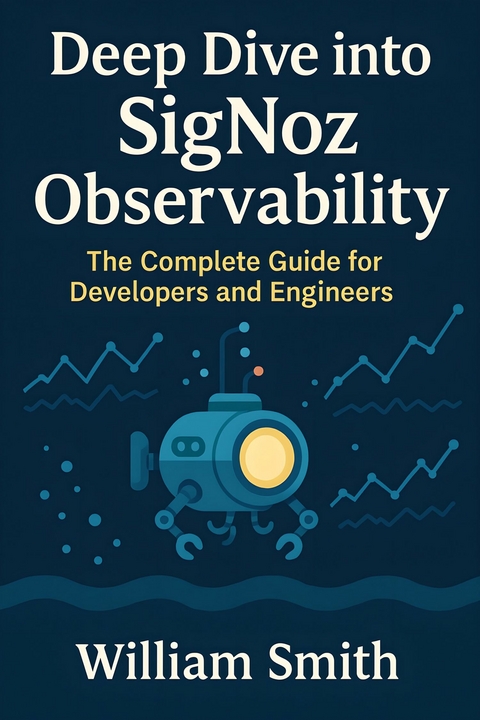
Deep Dive into SigNoz Observability (eBook)
250 Seiten
HiTeX Press (Verlag)
978-0-00-102723-7 (ISBN)
'Deep Dive into SigNoz Observability'
'Deep Dive into SigNoz Observability' is a definitive guide for engineers, architects, and decision-makers seeking to master modern observability practices with a focus on SigNoz-an open-source, full-stack observability platform. The book begins by grounding readers in the evolving landscape of distributed systems monitoring, tracing the shift from legacy monolithic diagnostics to cloud-native telemetry. It systematically explains the core pillars of observability-metrics, traces, and logs-before delving into the architectures, foundations, and best practices that underpin effective, actionable visibility into complex systems. Special emphasis is placed on OpenTelemetry, the CNCF ecosystem, and pragmatic approaches to injecting observability into production applications.
Building on these fundamentals, the book provides a comprehensive exploration of SigNoz's internal architecture, from telemetry collection and storage backends like ClickHouse to its robust querying and visualization layers. Readers will find detailed technical guidance on high-throughput log ingestion, trace correlation, custom dashboards, and advanced tracing scenarios such as service dependency mapping, distributed outlier detection, and automated root cause analysis. Attention is given to real-world considerations, including deployment topologies, scalability, cost optimization, and the ever-critical balance between performance and reliability-empowering teams to confidently operate SigNoz at scale in mission-critical environments.
Rounding out the journey, 'Deep Dive into SigNoz Observability' addresses the broader ecosystem and future of observability. The book guides practitioners through automation, extensibility via plugins and APIs, and the integration of machine learning for predictive analytics and proactive alerting. Security and compliance receive dedicated coverage, with actionable strategies for privacy, regulatory alignment, and organizational security posture. Case studies and emerging trends contextualize SigNoz's role within modern DevOps workflows, while hands-on insights for contributing to the open source community ensure that both new adopters and seasoned professionals are positioned at the forefront of the observability movement.
Chapter 1
Fundamentals of Observability and Telemetry
Step into the world where complex systems reveal their inner workings-not by chance, but by deliberate design. This chapter explores the origins, scientific underpinnings, and practical evolution of observability as it manifests in modern distributed architectures. Here, you will unravel the frameworks and instrumentation strategies that transform hidden, emergent system behaviors into actionable signals, laying an unshakeable foundation for mastering advanced observability.
1.1 Evolution of Observability in Distributed Systems
Traditional system monitoring emerged during the era of monolithic architectures, defined by tightly coupled components running within a single runtime environment. In such settings, observability predominantly focused on system resource usage (CPU, memory, disk I/O) and application-level metrics exposed through in-process instrumentation. Monitoring tools gathered logs, counters, and alerts derived from a limited set of performance indicators, sufficient to diagnose and respond to failures occurring within a relatively constrained operational scope.
The simplicity of monolithic systems allowed for straightforward cause-and-effect tracing: a single log file or a combined stack trace typically sufficed to identify root causes. Operators relied largely on vertically integrated telemetry sources, where the state of the entire system was internalized within one executable image or host machine. The need for holistic instrumentation was less critical as dependencies were implicit and tightly bound.
With the advent of cloud-native computing, polyglot deployments, and microservice architectures, the landscape of observability shifted dramatically. These systems are characterized by distributed components communicating over networks, often asynchronously, and deployed across ephemeral infrastructure managed by container orchestration platforms such as Kubernetes. This architectural evolution fractured the once unified telemetry space into a heterogeneous ecosystem, complicating the correlation and aggregation of diverse signals.
Microservices typically maintain their own independent runtime environments, language stacks, and databases, relying heavily on remote procedure calls (RPC), message queues, and event streams for communication. This decomposition introduces new failure modes that traditional monitoring cannot detect reliably. Network partitions, service mesh misconfigurations, cascading failures, and distributed transaction anomalies now dominate the causes of degradation, requiring a more nuanced and interconnected approach to telemetry.
The shift from vertical to horizontal scaling compounded telemetry challenges. While physical hosts and processes were once static and uniquely identifiable, dynamic orchestration and auto-scaling introduce ephemeral instances whose lifetimes may span seconds to minutes. Traditional log files and static metric endpoints lose meaning without accompanying context linking instances, deployment versions, and request flows. Consequently, observability evolved to emphasize distributed tracing, structured logging with contextual metadata, and metrics enriched with dimensionality to handle cardinality and dynamism.
Failure modes in modern distributed systems manifest as transient latency spikes, partial service unavailability, degraded Quality of Service (QoS), and silent data inconsistencies. Detecting these phenomena requires capturing telemetry that reflects not only the internal state of individual components but also their interactions and dependencies. Inter-service call graphs, client-side error rates, retry behaviors, load balancing decisions, and dynamic configuration changes are critical telemetry dimensions that together compose a meaningful system state.
The motivation for richer telemetry arises from the need to maintain situational awareness at scale. Observability solutions today integrate metrics, logs, and traces into unified platforms capable of performing correlation and causal inference. This integration supports advanced diagnostic techniques such as anomaly detection, root cause analysis, and predictive failure routing. For example, by linking trace data with resource metrics and logs, operators gain the ability to pinpoint bottlenecks along call chains and assess the impact of configuration changes on system behavior in near real-time.
Technologically, the adoption of open standards like OpenTelemetry, combined with vendor-agnostic backends, facilitates interoperability across heterogeneous environments. Instrumentation libraries automatically propagate context metadata throughout request flows, enabling end-to-end observability without manual correlation. Furthermore, the emergence of service meshes and observability sidecars augments telemetry fidelity by capturing communication patterns transparently, reducing instrumentation effort while enhancing signal completeness.
Modern distributed systems impose observability requirements that far exceed traditional monitoring capabilities. The transition from monolithic to cloud-native microservices necessitates the capture of interconnected telemetry-metrics, logs, and traces augmented by contextual metadata-to effectively diagnose complex, emergent failure modes. The evolution of observability reflects broader shifts in software architecture, operational philosophy, and tooling innovation, underscoring the critical role of comprehensive, real-time insights in maintaining resilient and performant distributed applications.
1.2 Core Concepts: Metrics, Traces, and Logs
Observability in modern distributed systems hinges on three fundamental telemetry signal types: metrics, traces, and logs. Each signal category captures orthogonal aspects of system behavior and state, enabling a multi-dimensional understanding essential for diagnosing performance issues, detecting failures, and optimizing system operations. This section expounds on the distinct characteristics, technical representations, and collection mechanisms of these telemetry signals, culminating in their synergistic integration to achieve comprehensive observability.
Metrics: Aggregated Quantitative Measurements
Metrics provide numeric measurements aggregated over fixed time intervals, offering concise, structured, and high-cardinality summaries of system health and performance. Typical metrics include CPU utilization percentages, request counts, error rates, and latency histograms. They are inherently time series data, represented as tuples (t,v,l), where t is the timestamp, v is the measured numerical value, and l denotes a set of key-value pairs called labels or tags that contextualize the metric.
Technical Nuances of Metrics
Metrics are generally pre-aggregated by the monitored system or an instrumentation library before ingestion, minimizing storage and transmission overhead. Aggregation types include counters (monotonically increasing values), gauges (instantaneous measurements), histograms (value distributions), and summaries (quantile approximations). The choice of metric type profoundly affects the granularity and expressiveness of the captured data. For example, histograms enable estimation of latency percentiles with minimal data volume, whereas counters provide efficient event counting.
The collection frequency of metrics poses trade-offs between temporal resolution and processing cost. Short collection intervals improve anomaly detection fidelity but increase ingestion load and storage. Labels enhance multidimensional querying but also cause cardinality explosion if unbounded, necessitating careful design to avoid performance degradation in back-end storage systems.
Traces: Distributed Request Journeys
Traces represent the causal paths of individual requests traversing a distributed system. A trace consists of one or more spans, each representing a logical unit of work such as a function execution, database query, or RPC call. Spans carry metadata including start and end timestamps, operation names, status codes, and contextual tags. Critically, spans link together via parent-child relationships to form a directed acyclic graph that encodes the end-to-end path for a request.
Collection and Representation of Traces
Tracing instrumentation requires propagating unique identifiers (trace IDs and span IDs) across service boundaries, capturing context to ensure correct reconstruction of the causal graph. This often involves middleware or framework integration to record spans with minimal overhead. Traces are inherently event-based and high-cardinality, as every individual request generates a distinct trace, enabling granular root cause analysis and latency breakdown.
Storage and analysis of traces demand large-scale, often NoSQL-based solutions capable of quickly filtering and visualizing chains of spans. Sampling strategies are indispensable to regulate data volumes, including uniform, probabilistic, and adaptive sampling, balancing completeness against cost. Trace data is invaluable for...
| Erscheint lt. Verlag | 20.8.2025 |
|---|---|
| Sprache | englisch |
| Themenwelt | Mathematik / Informatik ► Informatik ► Programmiersprachen / -werkzeuge |
| ISBN-10 | 0-00-102723-9 / 0001027239 |
| ISBN-13 | 978-0-00-102723-7 / 9780001027237 |
| Informationen gemäß Produktsicherheitsverordnung (GPSR) | |
| Haben Sie eine Frage zum Produkt? |
 EPUB (Adobe DRM)
Größe: 1,0 MB
Kopierschutz: Adobe-DRM
Adobe-DRM ist ein Kopierschutz, der das eBook vor Mißbrauch schützen soll. Dabei wird das eBook bereits beim Download auf Ihre persönliche Adobe-ID autorisiert. Lesen können Sie das eBook dann nur auf den Geräten, welche ebenfalls auf Ihre Adobe-ID registriert sind.
Details zum Adobe-DRM
Dateiformat: EPUB (Electronic Publication)
EPUB ist ein offener Standard für eBooks und eignet sich besonders zur Darstellung von Belletristik und Sachbüchern. Der Fließtext wird dynamisch an die Display- und Schriftgröße angepasst. Auch für mobile Lesegeräte ist EPUB daher gut geeignet.
Systemvoraussetzungen:
PC/Mac: Mit einem PC oder Mac können Sie dieses eBook lesen. Sie benötigen eine
eReader: Dieses eBook kann mit (fast) allen eBook-Readern gelesen werden. Mit dem amazon-Kindle ist es aber nicht kompatibel.
Smartphone/Tablet: Egal ob Apple oder Android, dieses eBook können Sie lesen. Sie benötigen eine
Geräteliste und zusätzliche Hinweise
Buying eBooks from abroad
For tax law reasons we can sell eBooks just within Germany and Switzerland. Regrettably we cannot fulfill eBook-orders from other countries.
aus dem Bereich


