


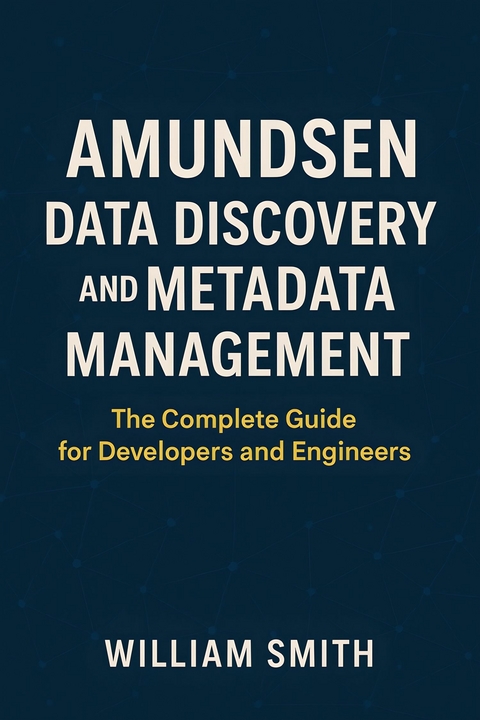
Amundsen Data Discovery and Metadata Management (eBook)
250 Seiten
HiTeX Press (Verlag)
978-0-00-102720-6 (ISBN)
'Amundsen Data Discovery and Metadata Management'
'Amundsen Data Discovery and Metadata Management' offers a comprehensive exploration into the modern challenges and solutions in enterprise metadata management. The book begins by laying a robust foundation, tracing the evolution of metadata systems and emphasizing the critical roles played by technical, business, and operational metadata in today's organizations. Readers are guided through the complexities of scaling metadata platforms in cloud-native environments, the impact of open source innovation, and the urgent need for robust data discovery amidst ever-growing data landscapes.
The heart of the text delves into the architecture, deployment, and operationalization of Amundsen, a leading open-source data discovery platform. Through detailed architectural breakdowns, real-world deployment patterns, and deep dives into scalable ingestion workflows, the book equips data engineers, architects, and platform teams with actionable insights for building resilient, secure, and extensible metadata solutions. Advanced topics such as search optimization, graph-based relationship navigation, automation, and real-time metadata processing are reinforced with best practices for monitoring, logging, and maintaining platform reliability at scale.
Beyond the technical core, the book addresses the broader ecosystem needed for successful data discovery-covering governance, compliance, and user adoption strategies. Drawing on case studies, enterprise success patterns, and future directions in AI-driven metadata, 'Amundsen Data Discovery and Metadata Management' serves as both a practical reference and visionary guide. Whether integrating Amundsen within the modern data stack or advancing toward semantic and federated discovery architectures, this book is an essential resource for data leaders seeking to maximize the value of their organizational knowledge assets.
Chapter 2
Amundsen Architecture
What truly enables data discovery at scale is more than clever indexing or search-it’s the synergy of distributed systems, extensible models, and robust architectural choices. This chapter peels back the layers of Amundsen’s design, exposing how each service, data store, and API harmonizes to transform fragmented metadata into an intuitive, actionable knowledge graph. Through these insights, you’ll see why Amundsen has become a cornerstone for many enterprises in their quest for data clarity and self-service analytics.
2.1 Architectural Overview
Amundsen’s architecture is designed to address the complexities inherent in large-scale metadata discovery and search within enterprise environments. Its core components are structured around clear service boundaries, robust data flows, and foundational design principles that promote maintainability, scalability, and modularity. These characteristics enable Amundsen to adapt fluidly across heterogeneous data landscapes and continuously evolve alongside expanding organizational requirements.
The architecture can be logically decomposed into three principal service domains: metadata ingestion, metadata storage and indexing, and user-facing services. Each domain encapsulates a cohesive set of responsibilities, fostering separation of concerns and minimizing interdependencies.
Metadata Ingestion serves as the primary conduit for acquiring structured metadata from a variety of sources such as data catalogs, databases, business intelligence tools, and data processing pipelines. This ingestion framework is implemented via a combination of decoupled extract-transform-load (ETL) processes and asynchronous messaging systems. Flatbuffers or protobuf APIs frequently mediate communication with upstream data providers, standardizing payload formats to ensure schema consistency. Ingestion pipelines emphasize idempotency and error resilience, allowing frequent, incremental updates without risk of data corruption. A plugin architecture supports extensibility, enabling integration with novel data sources as enterprise environments evolve.
The Metadata Storage and Indexing domain persists enriched metadata and relationships. Amundsen adopts a hybrid model: graph databases (e.g., Neo4j) represent complex entity relationships such as lineage, ownership, and dependency graphs, while document stores or relational databases maintain structured metadata attributes. This partitioning leverages the strengths of each technology to support diverse query patterns. Secondary indexes-implemented with text search engines (e.g., Elasticsearch)-enable fast, full-text retrieval and faceted search capabilities. Regular batch jobs synchronize the graph and document layers to maintain consistency and freshness. The storage layout is designed to efficiently support graph traversal for lineage queries while simultaneously providing rapid filtering for large dataset inventories.
User-facing Services provide the external API endpoints and web interfaces that expose Amundsen’s functionality. This layer is composed of RESTful or GraphQL APIs that abstract underlying complexity from clients, facilitating search, browsing, and metadata enrichment operations. The user interface is a decoupled single-page application, typically authored with React or Angular frameworks, enabling independent development and deployment cycles. Authentication and authorization modules integrate with enterprise identity providers, applying role-based access controls to safeguard sensitive metadata. The UI communicates asynchronously with backend services, supporting reactive updates and dynamic query refinements to enhance user experience.
Data flow between these domains follows asynchronous and event-driven paradigms wherever possible, promoting loose coupling and fault tolerance. For instance, ingestion pipelines emit metadata events onto queues that downstream storage services consume, ensuring backpressure handling and the ability to replay or audit changes. This event-driven design decouples ingestion scalability from storage performance; each subsystem can be independently scaled or upgraded without disrupting overall functionality.
The architectural design of Amundsen is underpinned by three core principles:
- 1.
- Decoupling: Each major component operates with minimal knowledge of others’ internal implementations. Clear interfaces and message contracts allow components to evolve independently. This separation reduces the blast radius of failures and simplifies testing and maintenance.
- 2.
- Scalability: Horizontal scalability is achieved through stateless service designs and distributed storage backends. Compute-intensive tasks such as metadata indexing and lineage graph traversals can be partitioned and parallelized. Autoscaling capabilities in cloud deployments allow resources to align dynamically with workload demands, preserving responsiveness.
- 3.
- Modularity: Amundsen’s plugin-friendly architecture permits customized connectors, enrichers, and user interface components to be integrated without modifying the core codebase. This flexibility supports enterprise-specific requirements, such as bespoke metadata attributes or custom authorization logic, encouraging community-driven extensions.
The convergence of these principles establishes a durable architecture capable of sustained evolution in complex data ecosystems. Notably, the emphasis on asynchronous communication and event sourcing ensures metadata freshness even in the face of intermittent data source availability. Furthermore, by isolating domain concerns, the architecture facilitates parallel development efforts and continuous delivery pipelines, critical in rapidly changing enterprise contexts.
Figure illustrates the high-level architectural components and their interactions. Metadata providers feed ingestion pipelines, which produce normalized metadata events. These events populate the storage layer-composed of graph, document, and search indexes-enabling comprehensive metadata representation. The user-facing APIs query this storage layer and provide interactive access via the web interface secured by authentication services.
By decomposing responsibilities and enabling clear, well-defined data exchanges, Amundsen attains a resilient and adaptable architecture capable of supporting multi-tenant, large-scale metadata management scenarios. The framework’s modularity encourages community contributions and bespoke extensions, while its scalability and decoupling make it appropriate for deployments ranging from small teams to enterprise-wide data ecosystems.
2.2 Service-Oriented Design: Frontend, Metadata, and Search Services
Amundsen’s architecture is fundamentally service-oriented, delineating distinct responsibilities across frontend, metadata, and search services. Each component operates as a loosely coupled microservice, promoting modularity and scalability. This section examines the roles and interactions of these services via their APIs, clarifying how they collectively enable efficient data discovery and exploration.
Frontend Service. The frontend serves as the primary user interface, responsible for rendering data discovery experiences and orchestrating client interactions. It is developed as a React-based single-page application (SPA), designed to communicate exclusively via RESTful APIs. This decoupled frontend approach ensures that UI evolution proceeds independently of backend service changes, fostering agility in feature deployment.
The frontend’s primary responsibilities include querying metadata to construct detailed entity views, presenting search results, and enabling navigation across datasets, tables, dashboards, and other assets. To achieve this, it issues requests to the metadata and search services, retrieves structured JSON responses, and composes the interface accordingly.
Critical to the frontend’s operation is its reliance on well-defined, versioned APIs exposed by the metadata and search services. It delegates all business logic and data aggregation to these backends, ensuring the frontend remains lightweight and focused on user experience rendering.
Metadata Service. The metadata service functions as the authoritative source for data entity definitions and their associated annotations. It aggregates metadata from multiple ingestion pipelines such as database connectors, workflow schedulers, and BI tools, storing the enriched data model in a graph-based or relational backend.
Its API provides endpoints for entity retrieval by unique identifiers, faceted browsing, lineage explorations, and metadata updates. Metadata entities encompass diverse nodes, including tables, databases, columns, dashboards, and users, each represented with extensible schemas.
Internally, the metadata service implements complex resolution logic to consolidate entities and maintain referential integrity. It supports transactional updates and enforces consistency constraints to ensure valid...
| Erscheint lt. Verlag | 20.8.2025 |
|---|---|
| Sprache | englisch |
| Themenwelt | Mathematik / Informatik ► Informatik ► Programmiersprachen / -werkzeuge |
| ISBN-10 | 0-00-102720-4 / 0001027204 |
| ISBN-13 | 978-0-00-102720-6 / 9780001027206 |
| Informationen gemäß Produktsicherheitsverordnung (GPSR) | |
| Haben Sie eine Frage zum Produkt? |
 EPUB (Adobe DRM)
Größe: 852 KB
Kopierschutz: Adobe-DRM
Adobe-DRM ist ein Kopierschutz, der das eBook vor Mißbrauch schützen soll. Dabei wird das eBook bereits beim Download auf Ihre persönliche Adobe-ID autorisiert. Lesen können Sie das eBook dann nur auf den Geräten, welche ebenfalls auf Ihre Adobe-ID registriert sind.
Details zum Adobe-DRM
Dateiformat: EPUB (Electronic Publication)
EPUB ist ein offener Standard für eBooks und eignet sich besonders zur Darstellung von Belletristik und Sachbüchern. Der Fließtext wird dynamisch an die Display- und Schriftgröße angepasst. Auch für mobile Lesegeräte ist EPUB daher gut geeignet.
Systemvoraussetzungen:
PC/Mac: Mit einem PC oder Mac können Sie dieses eBook lesen. Sie benötigen eine
eReader: Dieses eBook kann mit (fast) allen eBook-Readern gelesen werden. Mit dem amazon-Kindle ist es aber nicht kompatibel.
Smartphone/Tablet: Egal ob Apple oder Android, dieses eBook können Sie lesen. Sie benötigen eine
Geräteliste und zusätzliche Hinweise
Buying eBooks from abroad
For tax law reasons we can sell eBooks just within Germany and Switzerland. Regrettably we cannot fulfill eBook-orders from other countries.
aus dem Bereich


