


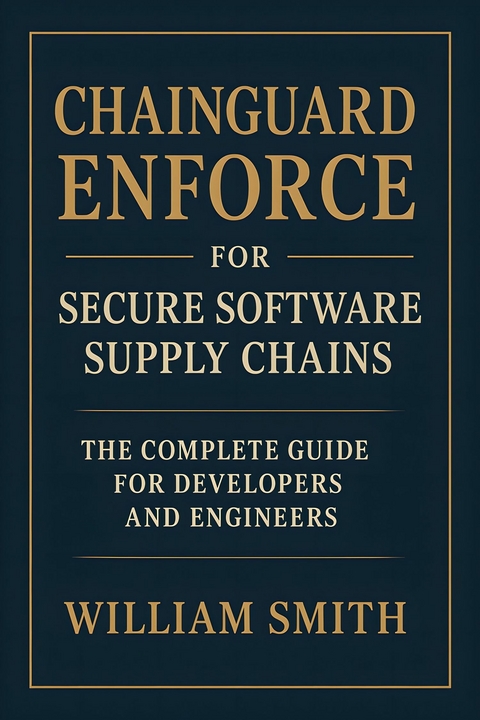
Chainguard Enforce for Secure Software Supply Chains (eBook)
250 Seiten
HiTeX Press (Verlag)
978-0-00-102718-3 (ISBN)
'Chainguard Enforce for Secure Software Supply Chains'
In an era marked by increasingly sophisticated software supply chain threats, 'Chainguard Enforce for Secure Software Supply Chains' offers a comprehensive blueprint for safeguarding the journey from code to deployment. This book examines the evolution of adversary tactics targeting modern delivery pipelines and explores the foundational security principles and standards-such as SLSA and NIST SSDF-that underpin robust software supply chain protection. Through deep dives into attack surfaces, risk measurement, and zero trust methodologies, readers will gain clarity on navigating the ever-changing security landscape of DevOps-driven environments.
At its core, the text introduces Chainguard Enforce's architecture and policy-driven approach, detailing how provenance, attestation, and real-time policy enforcement secure every stage of the development pipeline. Readers are guided through best practices in authoring and managing security policies, combatting policy drift, handling exceptions, and validating controls before live rollout. The integration of Enforce with widely used CI/CD pipelines, container registries, infrastructure-as-code tools, and enterprise DevSecOps ecosystems is illuminated through practical frameworks and technical patterns, empowering organizations to strengthen their security posture while enhancing developer experience.
Beyond day-to-day operation, the book ventures into advanced topics such as forensic-quality auditing, automated incident response, scaling enforcement for global enterprise demands, and compliance automation for regulated industries like FedRAMP, PCI, and HIPAA. It concludes with a forward-looking perspective on emerging trends, from AI-driven security automation to quantum-resistant cryptography and the ethical, societal, and sustainability challenges of protecting next-generation software factories. This is an indispensable resource for security professionals, engineers, and executives seeking to build resilient and future-proof software supply chains.
Chapter 2
Chainguard Enforce: Architecture and Core Concepts
Unveiling the technical bedrock of Chainguard Enforce, this chapter offers readers a rare, inside-out exploration of how policy-driven supply chain security is architected for maximal resilience and flexibility. Prepare to dissect the internal workings, integration surfaces, and enforcement mechanisms that empower organizations to build tamper-resistant pipelines-regardless of complexity or scale.
2.1 System Architecture Overview
The architectural design of Chainguard Enforce exemplifies modern cloud-native principles by distinctly separating the control and data planes, facilitating scalability, resiliency, and operational clarity. This delineation, combined with microservices architecture, declarative configuration, and horizontal scaling, underpins the system’s ability to enforce security policies effectively across dynamic distributed environments.
At a high level, Chainguard Enforce operates through two fundamental planes: the control plane, responsible for policy orchestration and management, and the data plane, which enforces security decisions at runtime within the infrastructure. The control plane manages declarative security policies expressed in YAML or JSON, enabling users to define desired security states without imperative scripting. These policies are stored in a central repository, with version control integration, supporting auditability and traceability.
The control plane comprises several modular microservices, each implementing a specialized function such as policy validation, conflict resolution, and policy distribution. Communication among these microservices and with the data plane is carried out over secured RESTful APIs, utilizing mutual TLS authentication to safeguard integrity and confidentiality.
Key microservices include:
- Policy Management Service: Accepts, stores, and validates incoming policy definitions. It employs schema validation and rule syntax checking to prevent misconfigurations.
- Policy Decision Service: Computes the effective policy for target workloads by reconciling multiple policy inputs and resolving conflicts through predefined precedence rules.
- Policy Distribution Service: Pushes computed policies to the data plane components using an event-driven architecture, ensuring consistency across distributed enforcement points.
Horizontal scaling is intrinsic to these services. Leveraging container orchestration platforms such as Kubernetes, each microservice can be independently scaled based on load metrics, ensuring high availability and fault tolerance. For instance, the Policy Decision Service, often the most resource-intensive, can be scaled out during peak configuration updates, preventing bottlenecks in policy computation.
The data plane is deployed as lightweight agents embedded within the service mesh or node-level proxies, close to the application workloads. These enforcement points execute policy decisions in real time, filtering and controlling traffic or resource interactions according to the prescribed rules. The decoupled nature of the data plane ensures minimal performance latency since enforcement is executed locally without the need for synchronous calls to the control plane.
The agents receive policy updates asynchronously via a streaming mechanism-commonly implemented through gRPC or message queues-allowing prompt and reliable dissemination of security rules. Upon receipt, the agents reconcile policy versions and apply them atomically to maintain system consistency.
Tracing the lifecycle of a security policy request begins with a user submitting a declarative policy manifest to the Policy Management Service:
- 1.
- Submission and Validation: The manifest is parsed and validated for syntactic correctness and semantic feasibility. Any violations trigger detailed error responses.
- 2.
- Conflict Resolution: The Policy Decision Service integrates the new policy with the existing set, identifying and resolving any conflicts using a priority scheme contextualized by scopes such as namespace and workload selectors.
- 3.
- Distribution: The final resolved policy is distributed asynchronously to all data plane agents through the Policy Distribution Service, leveraging event-driven notifications to minimize propagation delay.
- 4.
- Enforcement: Each data plane agent updates its local policy cache and applies the latest rules to intercept and enforce security decisions in user traffic or resource accesses.
- 5.
- Monitoring and Feedback: Runtime events and enforcement metrics are continuously reported back to the control plane, enabling observability and facilitating adaptive policy tuning.
This request flow illustrates core cloud-native design patterns: declarative configuration simplifies complex policy management, microservices ensure modularity and ease of maintenance, and horizontal scaling caters to dynamic workloads and system resilience.
Furthermore, the system incorporates advanced patterns such as sidecar proxies within service meshes, which provide transparent enforcement with minimal intrusion, and controller loops, which reconcile desired and actual system states continuously, ensuring convergence even under transient failures or rapid configuration changes.
In deployment scenarios, these architectural decisions support multi-tenant environments where isolation between policy domains is critical. The control plane’s design accommodates namespaces or organizational units, enabling scoped policy application and billing segregation without sacrificing efficiency.
From an operational perspective, the architecture also supports blue-green and canary deployments of policy updates, achieved by versioning policies and selectively rolling them out to subsets of data plane agents. This promotes safer transitions and reduces the risk of widespread policy errors.
In totality, the Chainguard Enforce system architecture integrates cloud-native design patterns with an explicit control-data plane separation, distributed microservices, declarative configuration, and elasticity through horizontal scaling. This integration provides a robust, scalable, and maintainable foundation for enforcing security policies at scale in complex, dynamic environments.
2.2 Policy Engine and Enforcement Model
At the core of Chainguard Enforce lies a sophisticated policy engine designed to provide robust, flexible, and extensible governance over container and supply chain artifacts. This engine orchestrates the evaluation of policies through a layered model incorporating both static and dynamic strategies. The underlying architecture supports fine-grained rule definitions, expressive constraints, structured exception handling, and predefined remediative workflows, ensuring that security and compliance requirements are enforced rigorously without compromising operational agility.
The evaluation process operates on two principal stages: static policy evaluation and dynamic policy evaluation. Static evaluation occurs at build or pre-deployment time, where immutable artifacts such as container images, configurations, and provenance data are analyzed against a corpus of predefined rules. This early interrogation detects violations in metadata signatures, provenance integrity, vulnerability constraints, and compliance markers before artifacts enter runtime environments. Dynamic evaluation, conversely, inspects runtime states and environment contexts, including orchestration events, container interactions, and network behaviors. This dichotomy enables a defense-in-depth approach, where security controls persist throughout the lifecycle of an artifact.
Policy rules in Chainguard Enforce are defined with remarkable granularity. Each rule encapsulates a target resource selector, condition predicates, evaluation triggers, and consequences. Selectors leverage pattern matching over artifact attributes, registry locations, and label sets, allowing precise targeting. Conditions employ a domain-specific expression language that supports logical operators, set membership, temporal constraints, and cryptographic assertion checks. This expressive predicate framework accommodates complex policy constructs such as allowable image base layers, signed build pipelines, and vulnerability thresholds conditioned on severity and exploitability metrics.
Constraints in this model are modular and composable. They are formed as atomic logical units that can be combined to represent multifactor compliance scenarios. For instance, a constraint might require that signed images must have been built from a trusted pipeline and have passed static vulnerability scans with no critical findings. This conjunctive and disjunctive flexibility translates to policy definitions that closely adhere to nuanced organizational risk models without introducing blind spots or over-blocking.
Exception handling mechanisms...
| Erscheint lt. Verlag | 20.8.2025 |
|---|---|
| Sprache | englisch |
| Themenwelt | Mathematik / Informatik ► Informatik ► Programmiersprachen / -werkzeuge |
| ISBN-10 | 0-00-102718-2 / 0001027182 |
| ISBN-13 | 978-0-00-102718-3 / 9780001027183 |
| Informationen gemäß Produktsicherheitsverordnung (GPSR) | |
| Haben Sie eine Frage zum Produkt? |
 EPUB (Adobe DRM)
Größe: 792 KB
Kopierschutz: Adobe-DRM
Adobe-DRM ist ein Kopierschutz, der das eBook vor Mißbrauch schützen soll. Dabei wird das eBook bereits beim Download auf Ihre persönliche Adobe-ID autorisiert. Lesen können Sie das eBook dann nur auf den Geräten, welche ebenfalls auf Ihre Adobe-ID registriert sind.
Details zum Adobe-DRM
Dateiformat: EPUB (Electronic Publication)
EPUB ist ein offener Standard für eBooks und eignet sich besonders zur Darstellung von Belletristik und Sachbüchern. Der Fließtext wird dynamisch an die Display- und Schriftgröße angepasst. Auch für mobile Lesegeräte ist EPUB daher gut geeignet.
Systemvoraussetzungen:
PC/Mac: Mit einem PC oder Mac können Sie dieses eBook lesen. Sie benötigen eine
eReader: Dieses eBook kann mit (fast) allen eBook-Readern gelesen werden. Mit dem amazon-Kindle ist es aber nicht kompatibel.
Smartphone/Tablet: Egal ob Apple oder Android, dieses eBook können Sie lesen. Sie benötigen eine
Geräteliste und zusätzliche Hinweise
Buying eBooks from abroad
For tax law reasons we can sell eBooks just within Germany and Switzerland. Regrettably we cannot fulfill eBook-orders from other countries.
aus dem Bereich


