


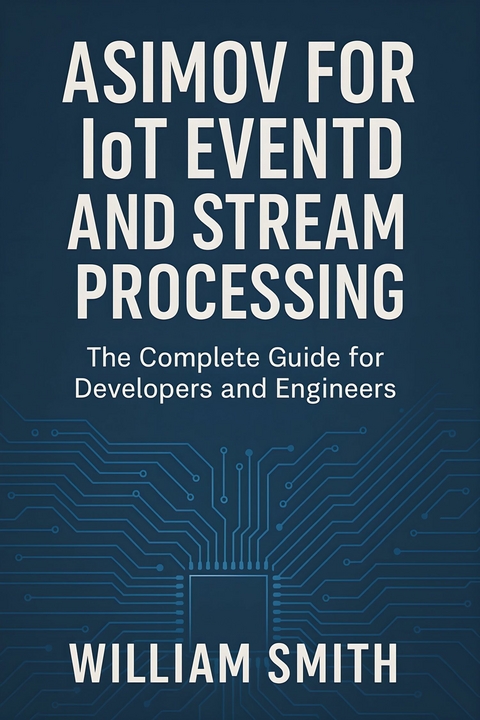
Asimov for IoT Event and Stream Processing (eBook)
250 Seiten
HiTeX Press (Verlag)
978-0-00-102714-5 (ISBN)
'Asimov for IoT Event and Stream Processing'
'Asimov for IoT Event and Stream Processing' is a comprehensive guide designed for architects, engineers, and decision-makers seeking to master event-driven infrastructures and real-time analytics within the Internet of Things. With a foundation built on architectural principles, the book explores the nuances of event and stream processing specific to IoT environments-addressing the diversity, scale, and complexity of device-generated data. Readers are introduced to modern frameworks, protocols, and platform selection criteria, along with deep insights into partitioning strategies that span edge, fog, and cloud, while rigorously considering security and privacy imperatives.
The core of the text is an in-depth exploration of the Asimov framework-an advanced platform purpose-built for event processing in large-scale IoT deployments. The chapters walk through Asimov's history, architecture, and distinguishing features, offering practical guidance on orchestrating workflows, integrating with device and protocol adapters, enforcing schema, and managing pipelines for high-throughput ingestion and normalization. Readers benefit from extensive coverage of developer tooling, deployment patterns, lifecycle management strategies, and best practices for building robust, scalable event-processing pipelines that incorporate advanced analytics and machine learning at both the edge and in the cloud.
Rounding out its scope, the book addresses the full operational lifecycle of Asimov deployments, including monitoring, observability, automated remediation, security, regulatory compliance, and case studies from diverse industrial and smart environments. With dedicated chapters on horizontal and vertical scaling, high-availability design, elasticity, and integration with broader data ecosystems, 'Asimov for IoT Event and Stream Processing' is an invaluable resource for organizations driving innovation in IoT through intelligent, resilient, and future-ready event streaming solutions.
Chapter 2
Introduction to Asimov: Capabilities and Core Concepts
What if your IoT stream processing could adapt as dynamically as the data it ingests? This chapter offers a guided deep dive into Asimov, the advanced event processing platform purpose-built for tomorrow’s scalable, analytics-driven IoT environments. Unpack, from the inside out, how Asimov’s unique architecture, flexible integration options, and developer-centric tooling make it a foundation for robust event-driven systems that evolve alongside real-world connected deployments.
2.1 Overview of the Asimov Framework
The Asimov Framework emerged as a strategic response to the escalating demands of Internet of Things (IoT) ecosystems and the complexities inherent in real-time analytics. Traditional stream processing engines, while effective in established data pipelines, increasingly demonstrated limitations when confronted with the massive heterogeneity, velocity, and distributed nature characteristic of modern IoT deployments. Recognizing these gaps, Asimov was architected to offer a comprehensive, adaptable solution that integrates deeply with dynamic data environments while maintaining rigorous performance and scalability standards.
Historically, real-time analytical systems have evolved from monolithic, domain-specific designs toward more modular and extensible platforms. Early solutions emphasized batch processing or simple, low-latency stream processing; however, they often lacked the flexibility necessary to adapt to unpredictable IoT workloads or to support seamless integration across diverse hardware and communication protocols. Asimov’s inception was aligned with a paradigm shift toward leveraging modularity and pluggability as foundational principles, enabling it to operate effectively across varying system topologies from edge to cloud.
At its architectural core, Asimov employs a layered design that distinctly separates concerns yet ensures cohesive interaction across layers. The lowest layers handle raw ingestion of high-velocity sensor data and telemetry streams, incorporating adaptive buffering and backpressure mechanisms tailored for IoT contexts. Above this, the processing layer encapsulates a collection of composable operators structured into directed acyclic graphs (DAGs), allowing dynamic reconfiguration without service interruption. These operators are designed for extensibility; developers can introduce new processing components as independent plugins adhering to well-defined interfaces, thus promoting rapid innovation and integration with emerging analytics algorithms or machine learning models.
Modularity within Asimov extends into its deployment topology. Supporting both centralized and decentralized configurations, the framework enables clusters of heterogeneous nodes to collaborate in orchestrated workflows while retaining local autonomy for edge analytics. This federated approach mitigates latency and bandwidth constraints ubiquitous in IoT networks and aligns with modern distributed computing paradigms. Furthermore, each module within the framework exposes standardized APIs and communication protocols, facilitating seamless interoperability with external systems and legacy infrastructures.
Pluggability is further exemplified in Asimov’s connector architecture, which abstracts data source and sink integration through a unified interface. This design accommodates a broad spectrum of IoT protocols (e.g., MQTT, CoAP, AMQP) and conventional data stores alike, ensuring that new endpoints can be incorporated without architectural overhaul. The framework’s ability to negotiate and manage varying data formats and schemas in real time significantly reduces integration complexity and accelerates deployment cycles.
In direct comparison to conventional stream processing engines such as Apache Storm or Flink, Asimov distinguishes itself in several critical dimensions. While these platforms offer robust stream processing capabilities, Asimov is explicitly optimized for IoT-scale heterogeneity and distribution. It incorporates fine-grained resource management tailored for constrained edge devices and integrates native mechanisms for stateful computation that remain performant across intermittent connectivity scenarios. Another key differentiator lies in Asimov’s holistic design philosophy; instead of retrofitting stream processing to IoT environments, Asimov embraces the intrinsic characteristics of IoT data flows, network topology, and real-time analytics exigencies from the ground up.
The framework also features an integrated analytics pipeline that supports continuous querying, event pattern detection, and temporal correlation with minimal manual intervention. This enables rapid insight generation and decision-making within milliseconds of data ingestion, a necessity for responsive IoT applications such as industrial automation, smart grids, and autonomous systems. Support for dynamic scaling and load balancing is embedded into the core, ensuring that Asimov adapts fluidly to fluctuations in data rates and processing demands without compromising throughput or latency.
Security and fault tolerance constitute additional pillars of Asimov’s architecture. Modular security components enforce data encryption, authentication, and authorization within each processing stage, while distributed checkpointing and recovery protocols safeguard system state against failures. This resilience is vital for mission-critical IoT applications where continuous operation and data integrity are paramount.
Thus, the Asimov Framework represents a deliberate convergence of modularity, extensibility, and pluggability, manifested across all architectural layers and operational facets. By addressing the specific challenges posed by emerging IoT and real-time analytics requirements, Asimov delivers a uniquely scalable and integrable platform. This enables organizations to harness the full potential of vast, heterogeneous data streams and to evolve their analytics capabilities in alignment with rapidly shifting technological landscapes.
2.2 Event Model and Workflow Orchestration in Asimov
Asimov’s event model is architected to transform raw IoT signals into discrete, processable entities that enable sophisticated event-driven applications. At its core, the model ingests raw telemetry data from heterogeneous device sources, which may include sensors, actuators, and embedded controllers operating over diverse protocols. Each incoming raw signal undergoes encapsulation into a standardized event structure, designed to abstract away device-specific semantics while preserving essential context such as timestamp, device identity, geographic location, and signal metadata.
The ingestion pipeline employs a robust, scalable message broker layer that supports high-throughput, low-latency ingestion while guaranteeing exactly-once delivery semantics. Upon arrival, raw signals are transformed via configurable parsers into AsimovEvent objects, formalized as:
where payload encodes sensor readings or status flags and metadata houses auxiliary attributes such as quality indicators or event provenance. This uniform event representation facilitates seamless routing and downstream processing within the platform.
Workflow orchestration within Asimov leverages a modular composition of event operators, which serve as atomic processing units. An event operator ingests one or more input event streams, applies transformation, filtering, enrichment, or aggregation logic, and emits one or multiple output event streams. Crucially, these operators are designed as stateful or stateless entities, allowing adaptable behavior depending on the use case demands. For instance, a stateful operator can maintain sliding time windows for temporal correlation, while stateless operators perform simple filtering or attribute projection.
Operators can be chained into complex workflows, either explicitly through directed acyclic graphs defined in configuration files or via a domain-specific language (DSL) that captures declarative workflow designs. This declarative approach empowers users to specify what transformations they require without describing how the orchestration executes, improving clarity and maintainability. Embedded within workflows, branching and conditional logic enable complex event routing scenarios, such as triggering alerts only when a sequence of conditions is met or aggregating multi-source signals into anomaly detection pipelines.
source IoT_Sensor_Stream
| filter temperature > 75
...
| Erscheint lt. Verlag | 20.8.2025 |
|---|---|
| Sprache | englisch |
| Themenwelt | Mathematik / Informatik ► Informatik ► Programmiersprachen / -werkzeuge |
| ISBN-10 | 0-00-102714-X / 000102714X |
| ISBN-13 | 978-0-00-102714-5 / 9780001027145 |
| Informationen gemäß Produktsicherheitsverordnung (GPSR) | |
| Haben Sie eine Frage zum Produkt? |
 EPUB (Adobe DRM)
Größe: 860 KB
Kopierschutz: Adobe-DRM
Adobe-DRM ist ein Kopierschutz, der das eBook vor Mißbrauch schützen soll. Dabei wird das eBook bereits beim Download auf Ihre persönliche Adobe-ID autorisiert. Lesen können Sie das eBook dann nur auf den Geräten, welche ebenfalls auf Ihre Adobe-ID registriert sind.
Details zum Adobe-DRM
Dateiformat: EPUB (Electronic Publication)
EPUB ist ein offener Standard für eBooks und eignet sich besonders zur Darstellung von Belletristik und Sachbüchern. Der Fließtext wird dynamisch an die Display- und Schriftgröße angepasst. Auch für mobile Lesegeräte ist EPUB daher gut geeignet.
Systemvoraussetzungen:
PC/Mac: Mit einem PC oder Mac können Sie dieses eBook lesen. Sie benötigen eine
eReader: Dieses eBook kann mit (fast) allen eBook-Readern gelesen werden. Mit dem amazon-Kindle ist es aber nicht kompatibel.
Smartphone/Tablet: Egal ob Apple oder Android, dieses eBook können Sie lesen. Sie benötigen eine
Geräteliste und zusätzliche Hinweise
Buying eBooks from abroad
For tax law reasons we can sell eBooks just within Germany and Switzerland. Regrettably we cannot fulfill eBook-orders from other countries.
aus dem Bereich


