


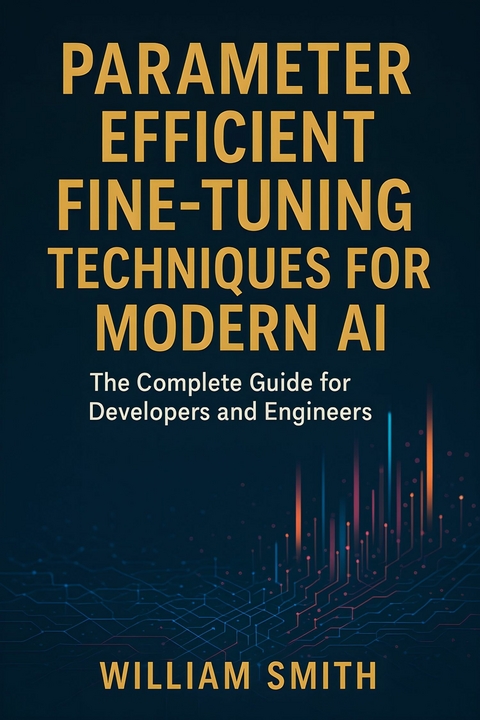
Parameter Efficient Fine-Tuning Techniques for Modern AI (eBook)
250 Seiten
HiTeX Press (Verlag)
978-0-00-102711-4 (ISBN)
'Parameter Efficient Fine-Tuning Techniques for Modern AI'
'Parameter Efficient Fine-Tuning Techniques for Modern AI' is an authoritative guide dedicated to the rapidly advancing field of parameter-efficient adaptation in artificial intelligence. Beginning with a thorough exploration of the historical evolution of transfer learning, the book articulates the practical motivations driving the quest to minimize trainable parameters, from energy savings to scalable and robust AI deployments. It lays a strong conceptual foundation by clarifying critical terminology, delineating core fine-tuning principles, and contextualizing the broad spectrum of real-world domains that stand to benefit from these emergent methodologies.
The book delves deeply into contemporary architectural innovations, unraveling the complexities of transformer models while examining mechanisms such as low-rank adaptations (LoRA), modular adapter layers, and prompt-based techniques that have collectively reshaped the efficiency landscape. Each chapter brings technical clarity and empirical rigor-whether contrasting sparse versus dense updates, exploring meta-learning and hypernetwork strategies for versatility, or dissecting trade-offs between performance and resource constraints. Comprehensive treatment extends to scalable training, hardware-aware optimization, and the unique challenges posed by cross-modal, multilingual, and multitask adaptation scenarios.
A forward-looking final section navigates the unresolved frontiers of the discipline, addressing pressing themes of interpretability, security, environmental sustainability, and open science. 'Parameter Efficient Fine-Tuning Techniques for Modern AI' is an indispensable reference for researchers, engineers, and practitioners eager to harness the full potential of foundation models while optimizing for efficiency, adaptability, and societal impact.
Chapter 1
Introduction to Parameter Efficient Fine-Tuning
Modern foundation models have achieved unprecedented scale and capability, but with this growth comes immense computational and resource demands during adaptation. This chapter uncovers the motivations, historical journey, and foundational concepts behind parameter efficient fine-tuning, providing context for why rethinking the way we adapt AI models is crucial for sustainable, accessible, and innovative artificial intelligence.
1.1 Historical Perspectives on Transfer Learning
The evolution of transfer learning is deeply rooted in the earlier concept of domain adaptation, which sought to address challenges when applying machine learning models trained on one domain to distinct but related domains. Initial efforts in domain adaptation, prominent in the late 1990s and early 2000s, focused on mitigating distributional discrepancies between source and target datasets through methods such as instance reweighting and feature space transformation. These early approaches emphasized statistical alignment techniques, leveraging assumptions about covariate shift and sample selection bias, but were often constrained by the limited size and complexity of data domains handled at the time.
The transition from domain adaptation to more general transfer learning paradigms became evident as researchers began to explore transferring knowledge across tasks with different label spaces and more abstract representations. This shift was catalyzed by advancements in representation learning, particularly with the rise of deep learning in the mid-2010s. Deep neural networks, with their hierarchical feature extraction capabilities, demonstrated remarkable success in learning generic features from large-scale datasets such as ImageNet. Such pre-trained models embodied transferable knowledge that could be adapted to various downstream tasks, transforming the understanding of transfer mechanisms from handcrafted feature mappings to learned representations.
Pre-trained models emerged as pivotal milestones in this trajectory. Initial attempts utilized fixed feature extractors, where learned embeddings served as input to simpler classifiers or regressors on new tasks. Subsequently, fine-tuning entire networks or selective layers became standard practice, capitalizing on the gradient-based optimization flexibility inherent to deep architectures. While early fine-tuning approaches involved updating all parameters, it became apparent that fine-tuning was a powerful mechanism to induce task-specific specialization while preserving the generalization capabilities acquired during pre-training.
The burgeoning availability of large-scale labeled datasets and improved hardware architectures, such as GPUs and TPUs, significantly influenced this progression. The enhanced computational capacity permitted the training of increasingly deep and complex models, enabling the empirical benefit of pre-training on massive corpora prior to task-specific adaptation. Concurrently, the proliferation of diverse datasets spanning natural images, text, and speech facilitated the broad applicability of transfer learning methods across domains and modalities.
Modern transfer learning is marked by a nuanced understanding of fine-tuning techniques shaped by evolving research inquiries. Early works prioritized achieving peak model accuracy on downstream tasks, often disregarding computational or memory efficiency. The absence of constraints on model size and inference cost reflected both the novelty of the paradigm and the hardware landscape of the era. However, as models such as BERT, GPT, and Vision Transformers reached billions of parameters, practical deployment constraints illuminated the inefficiencies of naïvely fine-tuning all parameters on each task.
This recognition sparked exploration into parameter-efficient fine-tuning approaches designed to reduce updateable components while retaining transfer performance. Techniques such as adapters, low-rank updates, and prompt tuning aim to optimize a smaller subset of parameters or introduce lightweight modules, dramatically reducing storage and computation requirements during adaptation. The rise of federated learning, edge computing, and resource-limited environments further emphasized the necessity for these efficient methodologies.
Hence, parameter efficiency, originally a non-issue during the nascent stages of transfer learning, has emerged as a central concern driving current research directions. The historical progression elucidates how shifts in data scale, hardware capabilities, and application demands coalesced to reshape transfer learning from domain adaptation roots into a sophisticated landscape balancing accuracy, efficiency, and adaptability. Understanding these chronological milestones provides critical context for the design choices and challenges that inform contemporary approaches to transfer learning.
1.2 Motivations for Parameter Efficiency
The escalating complexity of contemporary machine learning models, particularly deep neural networks, has led to a dramatic increase in the number of trainable parameters. This growth intensifies challenges not only in training and inferencing but also in the broader lifecycle management of models. Minimizing the number of trainable parameters during adaptation processes is thus critical for addressing several pressing technical and practical constraints.
- Economic and environmental costs associated with hardware resources constitute a primary motivation. Training large-scale models demands substantial computation, often necessitating powerful GPUs or specialized accelerators with significant energy consumption. Reducing the effective parameter count during fine-tuning dramatically decreases these demands. Parameter-efficient adaptation techniques such as low-rank factorization, adapter modules, or sparse updates reduce the overall floating-point operations (FLOPs) and memory footprint. This reduction correlates directly with lower electricity usage and cooling requirements, contributing to decreased operational expenses and carbon emissions. Empirical evidence, exemplified by adaptations of Transformer-based architectures, demonstrates up to a 50–70% decrease in energy consumption when parameter-efficient tuning methods replace full model retraining [1].
- Reducing trainable parameters expedites model deployment and iteration cycles. Full fine-tuning of large models can be time-consuming, often spanning hours or even days depending on hardware availability and dataset size. Parameter-efficient approaches shorten these durations by confining updates to subsets of model components or projected adaptation layers. This acceleration is crucial for real-world applications requiring rapid iteration, such as personalized recommendation systems, online learning, or adaptive control systems where models must swiftly incorporate new data. The ability to adapt models quickly promotes continuous improvement mechanisms and responsiveness to evolving environments.
- Heterogeneous hardware environments impose strict constraints on computational and memory resources, motivating parameter-efficient adaptation. Many deployment targets, including mobile devices, embedded systems, and edge AI modules, operate under tight power and capacity limitations. Full model fine-tuning or storage of multiple fully fine-tuned copies is often infeasible in these contexts. Instead, parameter-efficient strategies enable storage of lightweight, modular adapters or mask-based updates that require orders of magnitude fewer parameters. This compression facilitates feasible on-device adaptation and personalization, preserving user privacy and lowering dependence on cloud connectivity.
- Empirical research underscores the scalability advantages afforded by parameter efficiency in multi-task and continual learning setups. As models serve an increasing number of tasks, maintaining separate fully fine-tuned parameter sets is prohibitive due to quadratic growth in storage space. In contrast, modular adaptation techniques and sparse update schemes allow additive or compositional parameter increments, maintaining a manageable model size while accommodating diverse task requirements. This approach aligns with the practical demands of systems requiring simultaneous support of hundreds or thousands of specialized tasks.
Real-world applications provide concrete illustrations where parameter-efficient adaptation enables previously unattainable functionalities. In resource-constrained healthcare environments, deploying efficient models that accommodate unique institutional data without full model retraining reduces both latency and infrastructure costs, directly impacting patient care speed and quality. Similarly, in autonomous systems such as drones or self-driving vehicles, rapid, localized model retraining for domain-specific contexts (e.g., geographical perception variations or weather conditions) demands minimal computational overhead, achievable through parameter-efficient methods. Natural language processing pipelines benefiting from continual language evolution or domain shifts also leverage these techniques to reduce retraining-induced...
| Erscheint lt. Verlag | 20.8.2025 |
|---|---|
| Sprache | englisch |
| Themenwelt | Mathematik / Informatik ► Informatik ► Programmiersprachen / -werkzeuge |
| ISBN-10 | 0-00-102711-5 / 0001027115 |
| ISBN-13 | 978-0-00-102711-4 / 9780001027114 |
| Informationen gemäß Produktsicherheitsverordnung (GPSR) | |
| Haben Sie eine Frage zum Produkt? |
 EPUB (Adobe DRM)
Größe: 967 KB
Kopierschutz: Adobe-DRM
Adobe-DRM ist ein Kopierschutz, der das eBook vor Mißbrauch schützen soll. Dabei wird das eBook bereits beim Download auf Ihre persönliche Adobe-ID autorisiert. Lesen können Sie das eBook dann nur auf den Geräten, welche ebenfalls auf Ihre Adobe-ID registriert sind.
Details zum Adobe-DRM
Dateiformat: EPUB (Electronic Publication)
EPUB ist ein offener Standard für eBooks und eignet sich besonders zur Darstellung von Belletristik und Sachbüchern. Der Fließtext wird dynamisch an die Display- und Schriftgröße angepasst. Auch für mobile Lesegeräte ist EPUB daher gut geeignet.
Systemvoraussetzungen:
PC/Mac: Mit einem PC oder Mac können Sie dieses eBook lesen. Sie benötigen eine
eReader: Dieses eBook kann mit (fast) allen eBook-Readern gelesen werden. Mit dem amazon-Kindle ist es aber nicht kompatibel.
Smartphone/Tablet: Egal ob Apple oder Android, dieses eBook können Sie lesen. Sie benötigen eine
Geräteliste und zusätzliche Hinweise
Buying eBooks from abroad
For tax law reasons we can sell eBooks just within Germany and Switzerland. Regrettably we cannot fulfill eBook-orders from other countries.
aus dem Bereich


