


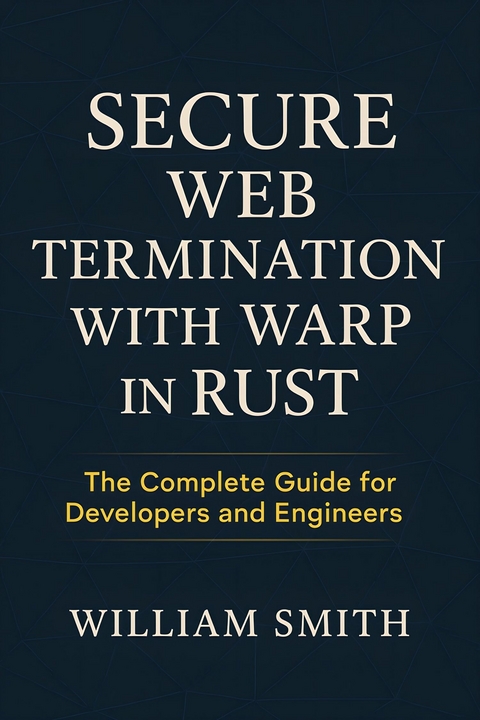
Secure Web Termination with Warp in Rust (eBook)
250 Seiten
HiTeX Press (Verlag)
978-0-00-102709-1 (ISBN)
'Secure Web Termination with Warp in Rust'
'Secure Web Termination with Warp in Rust' is a comprehensive and authoritative guide for engineers, architects, and security professionals seeking to build resilient web services with state-of-the-art security at the network edge. The book thoroughly examines the intersection of secure web termination principles and the unique capabilities of Rust, delving into core security properties, modern threat models, and the intricacies of protocols such as HTTP/1.x, HTTP/2, HTTP/3, and TLS. With a strong grounding in both zero trust architectures and multi-tenant environments, the text equips readers to architect defenses that limit lateral movement, enforce isolation, and protect sensitive workflows.
Building on Rust's foundational guarantees of memory safety and strong concurrency models, the book explores how the language's powerful ecosystem-featuring async runtimes like Tokio, robust third-party libraries, and advanced analysis tools-enables secure, high-throughput network services. Through detailed examinations of the Warp framework, including its filter system, integration with Hyper and Rustls, and middleware design patterns, readers learn to implement HTTPS, mutual TLS, and sophisticated authentication schemes. The book covers critical security controls such as input validation, session management, abuse prevention, and rate limiting, ensuring every layer from request handling to deployment enforces robust security policies.
Extending from architecture to operations, this guide provides actionable strategies for secure deployment in cloud-native environments, secrets management, monitoring, and continuous compliance. Real-world case studies illustrate migration to Warp, construction of secure API gateways, and incident response, while forward-looking chapters explore post-quantum cryptography, confidential computing, serverless patterns, and the evolution of web termination security with Rust. 'Secure Web Termination with Warp in Rust' is an indispensable resource for anyone striving to deploy secure, scalable, and future-ready web infrastructure in a rapidly evolving threat landscape.
Chapter 2
Rust as a Foundation for Secure Network Services
What if your network services were built on a language where many classes of vulnerabilities simply could not exist? This chapter ventures deep into the technical DNA of Rust, exposing how its memory safety, concurrency paradigms, and ecosystem of security tooling enable the construction of formidable defensive layers. Through advanced insights and practical guidance, you’ll discover how Rust transforms security from manual patchwork into an engineering guarantee.
2.1 Rust’s Safety and Security Model
Rust’s safety and security guarantees stem primarily from its novel systems of ownership, borrowing, and lifetimes, which together enforce memory and concurrency correctness at compile time. Unlike traditional languages such as C and C++, Rust eliminates entire classes of vulnerabilities-including buffer overflows, use-after-free errors, and data races-without sacrificing runtime performance, owing to its zero-cost abstractions. Understanding the interactions of these key components illuminates how Rust achieves secure network service implementations by construction.
The foundation of Rust’s model is ownership, a system where each value in memory has a single owner at a time. When that owner goes out of scope, the value is dropped automatically, preventing memory leaks and dangling pointers. This model replaces the explicit manual memory management found in C by encoding resource lifetimes within the type system, allowing the compiler to reason statically about memory safety. For example:
let buffer = vec![0u8; 1024]; // owner of the heap-allocated buffer
// use buffer here
} // buffer is automatically freed here
Here, buffer owns the allocated memory, which is freed deterministically when process_data() ends. No explicit free call exists, eliminating common use-after-free errors.
Rust’s borrowing model complements ownership by permitting temporary access to values without transferring ownership. Immutable and mutable borrows are distinguished by exclusive or shared access: only one mutable borrow or any number of immutable borrows can coexist at once. The compiler enforces this to prevent data races and synchronization errors in concurrent contexts.
For instance:
buffer.push(42);
}
fn main() {
let mut data = vec![1, 2, 3];
modify(&mut data); // mutable borrow passes ownership temporarily
println!("{:?}", data);
}
The mutable borrow &mut data allows modify to alter data without taking ownership. The borrow checker ensures no other references exist during this exclusive access, thereby preventing race conditions at compile time.
A third pillar, lifetimes, explicitly express how long references remain valid. Lifetimes prevent dangling references by ensuring all borrows are valid only within the scope of the owner. Rust infers many lifetimes automatically; however, explicit annotations clarify relationships in complex scenarios, reducing bugs common in C/C++ pointer arithmetic and manual memory handling.
Buffer overflows and out-of-bounds memory errors are eliminated by Rust’s strong type system and bounds-checked indexing. Rust’s standard collections such as Vec<T> perform boundary checking on all indexing operations. Unsafe blocks allow for pointer arithmetic and raw memory usage, but their use is strictly isolated and audited by the programmer to prevent errors from propagating.
Comparison with C highlights these advantages. Consider a buffer overflow in C:
...
| Erscheint lt. Verlag | 20.8.2025 |
|---|---|
| Sprache | englisch |
| Themenwelt | Mathematik / Informatik ► Informatik ► Programmiersprachen / -werkzeuge |
| ISBN-10 | 0-00-102709-3 / 0001027093 |
| ISBN-13 | 978-0-00-102709-1 / 9780001027091 |
| Informationen gemäß Produktsicherheitsverordnung (GPSR) | |
| Haben Sie eine Frage zum Produkt? |
 EPUB (Adobe DRM)
Größe: 778 KB
Kopierschutz: Adobe-DRM
Adobe-DRM ist ein Kopierschutz, der das eBook vor Mißbrauch schützen soll. Dabei wird das eBook bereits beim Download auf Ihre persönliche Adobe-ID autorisiert. Lesen können Sie das eBook dann nur auf den Geräten, welche ebenfalls auf Ihre Adobe-ID registriert sind.
Details zum Adobe-DRM
Dateiformat: EPUB (Electronic Publication)
EPUB ist ein offener Standard für eBooks und eignet sich besonders zur Darstellung von Belletristik und Sachbüchern. Der Fließtext wird dynamisch an die Display- und Schriftgröße angepasst. Auch für mobile Lesegeräte ist EPUB daher gut geeignet.
Systemvoraussetzungen:
PC/Mac: Mit einem PC oder Mac können Sie dieses eBook lesen. Sie benötigen eine
eReader: Dieses eBook kann mit (fast) allen eBook-Readern gelesen werden. Mit dem amazon-Kindle ist es aber nicht kompatibel.
Smartphone/Tablet: Egal ob Apple oder Android, dieses eBook können Sie lesen. Sie benötigen eine
Geräteliste und zusätzliche Hinweise
Buying eBooks from abroad
For tax law reasons we can sell eBooks just within Germany and Switzerland. Regrettably we cannot fulfill eBook-orders from other countries.
aus dem Bereich


