


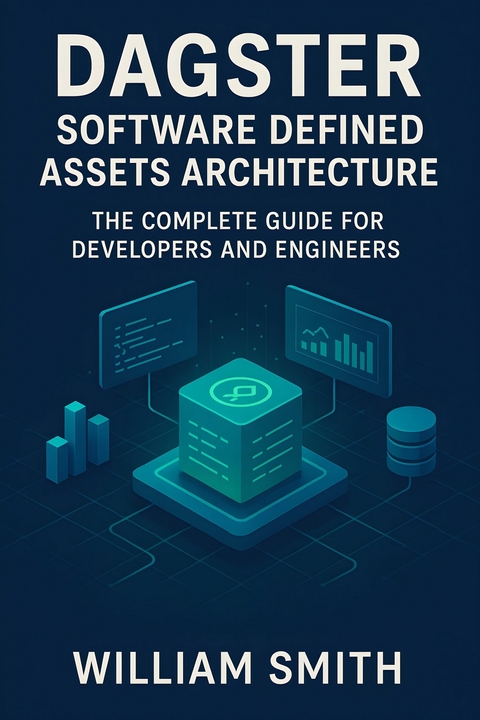
Dagster Software Defined Assets Architecture (eBook)
250 Seiten
HiTeX Press (Verlag)
978-0-00-102702-2 (ISBN)
'Dagster Software Defined Assets Architecture'
Unlock the transformative potential of modern data orchestration with 'Dagster Software Defined Assets Architecture.' This comprehensive guide delves into Dagster's pioneering software-defined assets (SDA) paradigm, exploring its philosophy and practical impact on scalable, reliable data systems. From foundational principles such as asset modeling and dependency graphs, to advanced concepts like partitioning, namespacing, and robust error recovery, the book provides a clear roadmap for building and maintaining complex, asset-driven pipelines that are at the forefront of today's data engineering practices.
Spanning architecture, operations, and strategy, this book lays out the full lifecycle of asset-driven workflows in Dagster-from declarative pipeline definitions and real-time orchestration, to sophisticated lineage tracking and auditability. Readers will gain valuable insight into high-performance runtime execution, observability best practices, and security essentials such as fine-grained access control and regulatory compliance. Through thorough coverage of extensibility points, integration with external systems, and patterns for automated testing and CI/CD, practitioners can confidently develop, scale, and govern enterprise-grade data platforms.
Written for engineers, architects, and data leaders, 'Dagster Software Defined Assets Architecture' blends technical depth with best practices and real-world guidance. It concludes by highlighting emerging trends shaping the future of SDAs-such as automated, self-healing pipelines, real-time asset streaming, and AI-powered orchestration-equipping readers to stay ahead in an evolving landscape. Whether you're starting with Dagster or optimizing a production-grade platform, this book is your essential companion for mastering software-defined asset architectures.
Chapter 2
Asset-Driven Pipeline Architecture
Imagine defining your pipelines in terms of what data you want to exist, not how to generate it-unlocking a higher level of abstraction for orchestration. This chapter deconstructs how Dagster’s asset-centric approach transforms pipeline engineering, from declarative definition and dependency resolution to recovery, backfills, and event-driven asset materialization. Dive into the elegant mechanics that turn asset graphs into durable, resilient data pipelines tailored for scale and change.
2.1 Declarative Pipeline Definitions
Pipeline design traditionally centers on explicitly enumerating individual tasks or jobs and their interdependencies. This imperative approach requires specifying exactly what operations occur and in what order, often leading to complex and brittle configurations prone to error and difficult to maintain. By contrast, declarative pipeline definitions shift the focus towards the higher-level abstraction of assets, fundamentally altering the way pipelines are conceptualized, authored, and executed.
An asset in a pipeline context represents a logical artifact or data entity that undergoes transformation. Instead of describing step-by-step instructions, the declarative style defines these assets and specifies their desired states, transformations, and dependency relationships. Pipelines are then constructed as graphs of assets, each node encapsulating an atomic unit of output, encompassing intermediate data, models, or other deliverables.
This asset-centric modeling offers several intrinsic benefits. First, it enhances modularity by encapsulating operations within discrete assets with well-defined inputs and outputs. This encapsulation abstracts the operational complexity, enabling developers to compose complex pipelines by linking assets rather than managing a proliferation of task invocations. Modular assets facilitate reuse across pipelines or projects, minimizing duplicated effort and encouraging standardized data representations.
Second, the declarative approach substantially improves maintainability. Because pipeline authors specify what assets are needed and how they relate, rather than how to produce them step-by-step, pipeline definitions become more concise and readable. Changes to the pipeline, such as adding new outputs or rearranging dependencies, require primarily adjusting asset declarations without deeply modifying the underlying logic flow. Additionally, declarative asset graphs allow automatic detection of dependency cycles and inconsistencies at compile or validation time, reducing runtime errors.
Third, reproducibility is strengthened by tightly coupling an asset’s definition with its transformation logic and resource specification. Declarative asset definitions typically incorporate metadata describing expected inputs, transformation commands, environment requirements, and outputs in a self-contained manner. When integrated into a pipeline execution engine, this guarantees consistent artifact generation across different platforms and runs, pivotal for scientific computing, regulated industries, or multi-stage production workflows.
To illustrate the distinction, consider a traditional imperative snippet that schedules individual tasks explicitly:
command: "python preprocess.py input.csv output.csv"
}
task train_model {
command: "python train.py output.csv model.pkl"
depends_on: preprocess
}
task evaluate {
command: "python evaluate.py model.pkl report.txt"
depends_on: train_model
}
This style requires the author to manage explicit task orchestration and dependencies. Adjusting or extending it involves modifying multiple points and ensuring consistency of dependencies and parameters.
In contrast, a declarative pipeline definition might express the same logic by defining assets as follows:
path: "input.csv"
asset processed_data:
transform: "python preprocess.py {raw_data.path} {self.path}"
path: "output.csv"
depends_on: [raw_data]
...
| Erscheint lt. Verlag | 20.8.2025 |
|---|---|
| Sprache | englisch |
| Themenwelt | Mathematik / Informatik ► Informatik ► Programmiersprachen / -werkzeuge |
| ISBN-10 | 0-00-102702-6 / 0001027026 |
| ISBN-13 | 978-0-00-102702-2 / 9780001027022 |
| Informationen gemäß Produktsicherheitsverordnung (GPSR) | |
| Haben Sie eine Frage zum Produkt? |
 EPUB (Adobe DRM)
Größe: 749 KB
Kopierschutz: Adobe-DRM
Adobe-DRM ist ein Kopierschutz, der das eBook vor Mißbrauch schützen soll. Dabei wird das eBook bereits beim Download auf Ihre persönliche Adobe-ID autorisiert. Lesen können Sie das eBook dann nur auf den Geräten, welche ebenfalls auf Ihre Adobe-ID registriert sind.
Details zum Adobe-DRM
Dateiformat: EPUB (Electronic Publication)
EPUB ist ein offener Standard für eBooks und eignet sich besonders zur Darstellung von Belletristik und Sachbüchern. Der Fließtext wird dynamisch an die Display- und Schriftgröße angepasst. Auch für mobile Lesegeräte ist EPUB daher gut geeignet.
Systemvoraussetzungen:
PC/Mac: Mit einem PC oder Mac können Sie dieses eBook lesen. Sie benötigen eine
eReader: Dieses eBook kann mit (fast) allen eBook-Readern gelesen werden. Mit dem amazon-Kindle ist es aber nicht kompatibel.
Smartphone/Tablet: Egal ob Apple oder Android, dieses eBook können Sie lesen. Sie benötigen eine
Geräteliste und zusätzliche Hinweise
Buying eBooks from abroad
For tax law reasons we can sell eBooks just within Germany and Switzerland. Regrettably we cannot fulfill eBook-orders from other countries.
aus dem Bereich


