


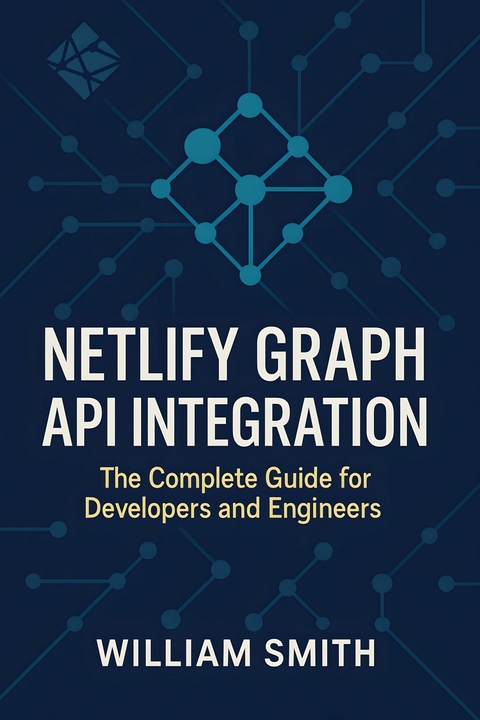
Netlify Graph API Integration (eBook)
250 Seiten
HiTeX Press (Verlag)
978-0-00-102692-6 (ISBN)
'Netlify Graph API Integration'
Unlock the full potential of modern web development with 'Netlify Graph API Integration,' a thorough and expertly crafted guide to mastering Netlify's powerful GraphQL platform. This book delves deep into the architecture and core principles that have positioned Netlify at the forefront of integration platforms, offering invaluable insight into the strategic design and extensibility of the Netlify Graph API. It dissects GraphQL fundamentals within the Netlify context, outlines robust versioning and evolution strategies, and explores integration techniques that span both frontend and backend ecosystems.
With security, reliability, and developer experience at its core, this book walks readers through advanced API authentication and authorization strategies-including OAuth, OpenID Connect, API key management, and defense-in-depth practices-as well as threat modeling and compliance frameworks tailored for modern SaaS. Comprehensive chapters on schema design, advanced modeling, and complex query orchestration empower developers to architect expressive, evolvable APIs, while practical advice on mutation workflows, pagination, and real-time data delivery ensures high-performance, scalable solutions.
Going beyond technical implementation, 'Netlify Graph API Integration' covers automation, DevOps best practices, testing, observability, and continuous delivery in cloud-native workflows. It addresses enterprise concerns such as multi-tenancy, compliance, cost management, and future trends in API integration. Whether you are building data-intensive JAMstack applications, creating resilient serverless architectures, or scaling mission-critical workloads, this book is the authoritative resource for professionals seeking to deliver robust, scalable, and innovative integrations with Netlify Graph API.
Chapter 2
Authentication, Authorization, and API Security
Security is not just a feature; it is a continuous discipline that shapes every interaction with the Netlify Graph API. In this chapter, discover the sophisticated authentication, authorization, and defense strategies that fortify integrations against evolving threats. Dive deep into the architectural decisions and best practices that balance airtight security with an agile, developer-friendly experience.
2.1 OAuth 2.0 and OpenID Connect in Netlify
OAuth 2.0 is a widely adopted framework that governs delegated authorization, enabling applications to obtain limited access to user resources on an HTTP service. OpenID Connect (OIDC) builds on OAuth 2.0 by providing a standardized mechanism for user authentication and identity federation. Netlify integrates these protocols to deliver secure, scalable, and federated identity management along with granular API authorization.
At its core, OAuth 2.0 defines several flows (authorization grant types) tailored for different client types and scenarios: authorization code, implicit, client credentials, and resource owner password credentials. Netlify primarily employs the authorization code flow enhanced with Proof Key for Code Exchange (PKCE) in its user authentication architecture, ensuring secure exchange of authorization codes by public clients such as single-page applications and mobile apps. This flow mandates a front-channel redirection for the user to authenticate via an identity provider, followed by a back-channel exchange of the authorization code for access and refresh tokens.
OpenID Connect introduces an id_token, a JSON Web Token (JWT) elucidating the identity of the authenticated user. Issued alongside OAuth 2.0 tokens, the id_token contains claims including the user’s unique identifier (sub), authentication timestamp (auth_time), and optionally verified attributes like email and profile data. Netlify leverages this token to establish user sessions, replace session cookies with portable tokens, and enable secure propagation of user identity to serverless functions and backend APIs.
A key concept in OAuth 2.0 and OIDC within Netlify’s architecture is token lifecycle management. The access token acts as a transient bearer credential with a short lifespan, typically ranging from minutes to an hour, crafted to minimize the window of exposure if compromised. To sustain long-term user sessions without repeated authentication, Netlify employs refresh tokens. These refresh tokens, encrypted and securely stored by client applications, permit the secure retrieval of fresh access tokens without user intervention. Notably, refresh tokens are not exposed externally in standard hosting scenarios but managed internally by Netlify Identity and API gateways. This division maintains security boundaries and reduces attack surfaces.
Scopes define the granularity of access permissions granted to client applications. Netlify uses scopes both to restrict API capabilities and to filter user claims in issued tokens. Typical scopes include openid for requesting authentication and profile claims, offline_access for refresh tokens, and custom API-specific scopes such as read:posts or write:comments. Scopes act as contract definitions between the authorization server (Netlify Identity) and resource servers (Netlify Functions, APIs), granting explicit capabilities while adhering to the principle of least privilege. During token introspection or validation, these scopes are verified to enforce access control policies centrally.
Client credentials, consisting of the client ID and client secret, are fundamental to the OAuth 2.0 client authentication process. In Netlify, these credentials are provisioned per registered application or service and are used to identify and authenticate non-interactive clients in flows such as client credentials grant, useful for machine-to-machine communication. Client secrets must be kept confidential and never embedded in frontend codebases; instead, they reside securely within server environments or Netlify environment variables accessible only to serverless functions. This segregation supports robust trust boundaries in distributed architectures.
The notion of user context is crucial when authorizing API access in multi-tenant or federated environments handled by Netlify. User context encapsulates the authenticated user’s identity, roles, scopes, and potentially group memberships or claims derived from external identity providers via OIDC federation. Netlify combines information from the id_token, token introspection endpoints, and custom claims to construct this context. Downstream serverless functions or APIs consume user context to make informed authorization decisions, enforce policy conditions, and audit access events.
Federated authentication, enabled by OpenID Connect, allows Netlify to broker authentication across multiple identity providers, supporting social logins (Google, GitHub, Facebook), enterprise directories (SAML via OIDC bridges), or custom OIDC-compliant providers. This federation abstracts the complexity of multiple authentication systems, offering a unified user experience. Netlify Identity operates a hosted authorization server, but through OIDC federation, it can act as a relying party or a proxy, delegating authentication while maintaining control over API authorization and token issuance.
In distributed architectures characteristic of modern Jamstack deployments, this approach offers several benefits:
- Decoupled Authentication and Authorization: User authentication is handled by federated providers, while Netlify manages authorization through strict scope enforcement and token validation.
- Scalable Session Management: Stateless JWT tokens enable horizontal scaling of serverless functions without centralized session stores.
- Fine-Grained Access Control: Custom scopes and claims crafted per API allow complex permission models that remain manageable and secure.
- Security Best Practices: Short-lived access tokens combined with secure refresh token handling and PKCE minimize risks from token leakage or replay attacks.
The following illustrates a typical OAuth 2.0 authorization code flow with PKCE as implemented by Netlify Identity:
2. User is redirected to Netlify Identity authorization endpoint with:
response_type=code,
client_id,
redirect_uri,
scope,
code_challenge,
code_challenge_method=S256
...
| Erscheint lt. Verlag | 20.8.2025 |
|---|---|
| Sprache | englisch |
| Themenwelt | Mathematik / Informatik ► Informatik ► Programmiersprachen / -werkzeuge |
| ISBN-10 | 0-00-102692-5 / 0001026925 |
| ISBN-13 | 978-0-00-102692-6 / 9780001026926 |
| Informationen gemäß Produktsicherheitsverordnung (GPSR) | |
| Haben Sie eine Frage zum Produkt? |
 EPUB (Adobe DRM)
Größe: 667 KB
Kopierschutz: Adobe-DRM
Adobe-DRM ist ein Kopierschutz, der das eBook vor Mißbrauch schützen soll. Dabei wird das eBook bereits beim Download auf Ihre persönliche Adobe-ID autorisiert. Lesen können Sie das eBook dann nur auf den Geräten, welche ebenfalls auf Ihre Adobe-ID registriert sind.
Details zum Adobe-DRM
Dateiformat: EPUB (Electronic Publication)
EPUB ist ein offener Standard für eBooks und eignet sich besonders zur Darstellung von Belletristik und Sachbüchern. Der Fließtext wird dynamisch an die Display- und Schriftgröße angepasst. Auch für mobile Lesegeräte ist EPUB daher gut geeignet.
Systemvoraussetzungen:
PC/Mac: Mit einem PC oder Mac können Sie dieses eBook lesen. Sie benötigen eine
eReader: Dieses eBook kann mit (fast) allen eBook-Readern gelesen werden. Mit dem amazon-Kindle ist es aber nicht kompatibel.
Smartphone/Tablet: Egal ob Apple oder Android, dieses eBook können Sie lesen. Sie benötigen eine
Geräteliste und zusätzliche Hinweise
Buying eBooks from abroad
For tax law reasons we can sell eBooks just within Germany and Switzerland. Regrettably we cannot fulfill eBook-orders from other countries.
aus dem Bereich


