


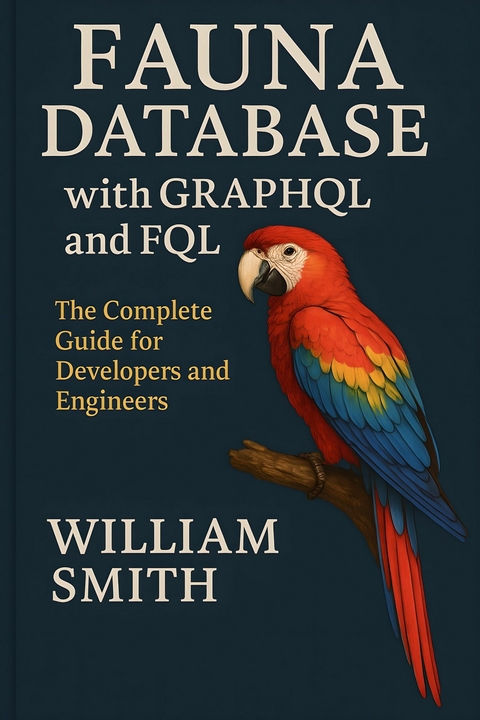
Fauna Database with GraphQL and FQL (eBook)
250 Seiten
HiTeX Press (Verlag)
978-0-00-102678-0 (ISBN)
'Fauna Database with GraphQL and FQL'
Unlock the full potential of globally distributed, serverless applications with 'Fauna Database with GraphQL and FQL.' This comprehensive guide delves into the architectural foundations of FaunaDB, revealing its unique approach to global data replication, low-latency reads, and strict consistency. Readers will gain a nuanced understanding of temporal data management, logical schema abstractions, and performance engineering-empowering them to build resilient, scalable, and high-performance applications ready for multi-region deployment and disaster recovery.
The book seamlessly bridges theory and practice, offering a deep dive into both GraphQL enablement and the powerful Fauna Query Language (FQL). Through step-by-step explorations, developers will master native GraphQL APIs, schema evolution, type relationships, and custom resolvers-all while integrating FQL for expressive queries, efficient indexing, and advanced analytics. Coverage of advanced data modeling techniques, event sourcing, real-time analytics, and composable query pipelines ensures that practitioners stay at the cutting edge of modern application design.
Rounding out its scope, 'Fauna Database with GraphQL and FQL' addresses critical concerns such as security, authentication, observability, and automated testing. Readers are guided through comprehensive strategies for fine-grained access control, integration with contemporary runtimes and frameworks, and robust migration and backup workflows. Packed with practical best practices, future-looking perspectives, and real-world lessons from the Fauna user community, this book is an essential resource for architects, developers, and teams seeking to leverage FaunaDB as a key enabler of next-generation cloud, edge, and event-driven solutions.
Chapter 2
GraphQL Enablement and Integration in FaunaDB
Imagine uniting the expressive power of GraphQL with the distributed, transactional strength of FaunaDB-without compromise. This chapter reveals the design philosophy and inner workings of Fauna’s native GraphQL interface, charting the journey from seamless schema deployment to advanced access patterns. Whether you’re migrating APIs or crafting sophisticated data layers, discover how Fauna makes GraphQL a first-class, scalable citizen of the modern cloud.
2.1 Fauna Native GraphQL API
Fauna’s native GraphQL API represents a distinctive approach to the implementation of GraphQL services, prioritizing seamless integration of schema definitions directly with the underlying database operations. Unlike conventional middleware patterns where the GraphQL server acts solely as an abstraction layer atop disparate data stores, Fauna’s design couples schema deployment with data structures and resolution logic, effectively rendering the GraphQL schema as the authoritative source of both API and database models.
At the core of Fauna’s architecture lies a declarative schema-driven approach. Users define their data models using a standard GraphQL Schema Definition Language (SDL) format, which Fauna’s system then translates into fully managed, operable endpoints. This translation process goes beyond typical code generation: the SDL directly instructs the configuration of Fauna’s transactional document store, enabling immediate execution of queries, mutations, and subscriptions without requiring additional resolver development. As a result, the native API supports a lower operational overhead and enforces strong consistency guarantees asynchronously maintained by Fauna’s distributed architecture.
Deployment workflows for Fauna’s GraphQL API emphasize simplicity and tight feedback loops. Upon submission of a schema definition to Fauna’s service-either via the web interface, CLI tools, or API-the schema validation and compilation processes initiate. This phase ensures the schema adheres to required constraints and then provisions the necessary collections, indexes, and permissions within the Fauna database ecosystem. Changes to the schema trigger automated migrations, which optimize for minimal disruption by preserving existing data and updating index configurations atomically. This continuous deployment feature allows developers to iterate rapidly, integrating changes directly into production environments without downtime or manual infrastructure modification.
The supported SDL features encompass a substantial subset of the GraphQL specification, including scalar types, object types, enums, interfaces, unions, and input types. Fauna extends the base SDL with custom directives and system types to align with its internal data storage model. For example, the @timestamp directive automatically manages temporal metadata fields, while @auth directives enable native role-based access control defined alongside the schema. Additionally, Fauna supports nested relationships and connection types, facilitating the expression of rich, relational graph patterns within a document-oriented backend.
However, Fauna’s GraphQL implementation imposes certain constraints that distinguish it from traditional GraphQL server environments. Notably, support for custom resolvers implemented in arbitrary server-side languages is deliberately omitted to maintain the transactional integrity and performance guarantees inherent to Fauna’s distributed fabric. This constraint ensures all schema operations execute deterministically within Fauna’s engine. Recursive queries and deeply nested mutations are subject to depth and complexity limits to prevent expensive operations that could impair multi-tenant resource fairness. Furthermore, Fauna currently restricts direct schema manipulation of non-GraphQL-native features such as access logs or background triggers to specialized system APIs, reflecting its prioritized abstraction surface.
Fauna also presents a unique set of GraphQL extensions leveraging its native features. One critical extension is the support for scalar set annotations, enabling queries to efficiently return sets of references or scalar values optimized through Fauna’s native indexing mechanisms. Another is the implementation of first-class temporal data types beyond the standard ISODate scalar, providing nanosecond precision timestamps directly accessible within GraphQL operations. Fauna’s native mutation operations include implicit upsert semantics and validation hooks that enforce schema integrity, surpassing vanilla GraphQL capabilities that traditionally offload such logic to application layers.
The execution model integrates transactional semantics implicitly, such that all queries and mutations against the GraphQL API participate in atomic, isolated transactions. This model guarantees snapshot isolation and linearizability without explicit transaction management by the client. Subscriptions leverage Fauna’s event-driven change streams, translating data changes into GraphQL subscription updates with minimal latency. Such integration is enabled by the underlying distributed data architecture and indexed query execution engine native to Fauna’s platform.
To illustrate the typical lifecycle, consider the deployment of a schema defining a User type with embedded Post references. Upon submission, Fauna provisions collections for User and Post, establishes indexes that support queries by common fields such as email or authorId, and generates queries and mutations automatically exposing CRUD operations. Authorization directives govern roles’ access, eliminating the need for explicit resolver code. When clients issue GraphQL queries against these generated endpoints, Fauna translates them into optimized transactional queries using its functional query language under the hood, ensuring consistent, performant data access.
In summary, Fauna’s native GraphQL API embodies a paradigm shift by binding GraphQL schema management and database schema strongly together. This tight coupling enables rapid iteration, scalable performance, and robust security by exploiting Fauna’s native engine capabilities while maintaining compatibility with familiar GraphQL SDL constructs. The constraints and extensions embedded within the system reflect a design balance aimed at maximizing transactional integrity and developer productivity without compromising the expressiveness or flexibility of GraphQL as a query language.
2.2 Extending and Managing GraphQL Schemas
GraphQL schema evolution within FaunaDB demands a disciplined approach to accommodate changes while preserving system stability and data integrity. The process integrates schema uploading, deployment, versioning, and iterative modifications, with a sharp focus on minimizing service disruption. Understanding how to navigate non-breaking and breaking changes within FaunaDB’s environment is essential for effective schema management.
FaunaDB offers a GraphQL API endpoint where schema definitions can be uploaded either through the Fauna Shell, Fauna Dashboard, or via automated CI/CD pipelines using Fauna’s HTTP API. Uploading a new schema involves submitting the entire SDL (Schema Definition Language) document, which Fauna then compiles and applies to the database. The command-line invocation typically uses:
Upon submission, Fauna performs a validation check against the existing schema and reports errors if syntactic inconsistencies or conflicts arise. Successful deployment results in an updated GraphQL endpoint that serves queries based on the new schema structure.
To manage iterative schema changes, versioning strategies become paramount. FaunaDB does not inherently version schemas but supports version control externally by maintaining schema files in source code repositories. Semantic versioning (SemVer) conventions applied to GraphQL schemas aid in tracking incremental updates. For example, a minor version bump indicates backward-compatible additions, while a major version signals breaking changes requiring careful rollout strategies.
Non-breaking migrations-adding new types, fields, or queries-are safe operations that extend the schema’s capabilities without invalidating existing client queries. Such changes should be scheduled during off-peak hours or coordinated with client teams to incrementally adopt...
| Erscheint lt. Verlag | 20.8.2025 |
|---|---|
| Sprache | englisch |
| Themenwelt | Mathematik / Informatik ► Informatik ► Programmiersprachen / -werkzeuge |
| ISBN-10 | 0-00-102678-X / 000102678X |
| ISBN-13 | 978-0-00-102678-0 / 9780001026780 |
| Informationen gemäß Produktsicherheitsverordnung (GPSR) | |
| Haben Sie eine Frage zum Produkt? |
 EPUB (Adobe DRM)
Größe: 717 KB
Kopierschutz: Adobe-DRM
Adobe-DRM ist ein Kopierschutz, der das eBook vor Mißbrauch schützen soll. Dabei wird das eBook bereits beim Download auf Ihre persönliche Adobe-ID autorisiert. Lesen können Sie das eBook dann nur auf den Geräten, welche ebenfalls auf Ihre Adobe-ID registriert sind.
Details zum Adobe-DRM
Dateiformat: EPUB (Electronic Publication)
EPUB ist ein offener Standard für eBooks und eignet sich besonders zur Darstellung von Belletristik und Sachbüchern. Der Fließtext wird dynamisch an die Display- und Schriftgröße angepasst. Auch für mobile Lesegeräte ist EPUB daher gut geeignet.
Systemvoraussetzungen:
PC/Mac: Mit einem PC oder Mac können Sie dieses eBook lesen. Sie benötigen eine
eReader: Dieses eBook kann mit (fast) allen eBook-Readern gelesen werden. Mit dem amazon-Kindle ist es aber nicht kompatibel.
Smartphone/Tablet: Egal ob Apple oder Android, dieses eBook können Sie lesen. Sie benötigen eine
Geräteliste und zusätzliche Hinweise
Buying eBooks from abroad
For tax law reasons we can sell eBooks just within Germany and Switzerland. Regrettably we cannot fulfill eBook-orders from other countries.
aus dem Bereich


