


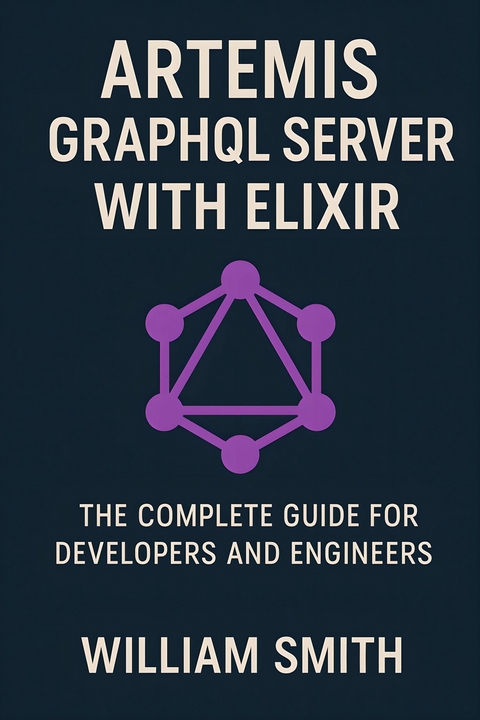
Artemis GraphQL Server with Elixir (eBook)
250 Seiten
HiTeX Press (Verlag)
978-0-00-102649-0 (ISBN)
'Artemis GraphQL Server with Elixir'
'Artemis GraphQL Server with Elixir' is a comprehensive guide designed for engineers, architects, and Elixir enthusiasts seeking to master scalable, production-ready GraphQL APIs with the Artemis server. Bridging the strengths of GraphQL's declarative data fetching and Elixir's dynamic concurrency model, this book delves deeply into both foundational concepts and advanced practical techniques. Readers will learn not only the essentials of GraphQL specification and Elixir's powerful language features, but also gain insight into the unique place Artemis occupies in the ecosystem-contrasting it with established solutions like Absinthe for a nuanced understanding of architecture and design trade-offs.
Through detailed and structured chapters, the book covers the full lifecycle of API development, from modular schema design, request lifecycle handling, and composing federated GraphQL services, to efficient backend integration with both relational and non-relational databases. It explores advanced querying, robust mutation paradigms, and real-time capabilities, placing a strong emphasis on performance optimization, error propagation, and security. Readers will acquire hands-on knowledge about authentication, authorization, policy enforcement, and governing GraphQL APIs for compliance and operational excellence.
'Artemis GraphQL Server with Elixir' goes further by offering production-grade strategies for testing, observability, debugging, and seamless deployment in cloud-native environments. Real-world case studies and migration playbooks provide actionable perspectives on enterprise adoption and evolving distributed systems, while explorations of open source contributions and future trends ensure readers are well-equipped to drive innovation in modern API architectures. This book is an indispensable resource for building robust, efficient, and future-proof GraphQL solutions with Elixir and Artemis.
Chapter 1
GraphQL Fundamentals and Elixir Integration
Unleash the power of expressive APIs by fusing the modern, type-safe world of GraphQL with the robust, concurrent ecosystem of Elixir. This chapter pulls back the curtain on GraphQL’s architecture, then reveals how Elixir’s distinctive features make it uniquely well-suited to high-performance API development. Whether you’re migrating from REST or seeking to level up beyond Absinthe, discover how Artemis redefines what’s possible for scalable, maintainable GraphQL backends.
1.1 Overview of GraphQL Specification
GraphQL emerged as a query language and runtime for APIs, devised to overcome the rigidity and inefficiencies associated with traditional REST and RPC paradigms. At its core, the GraphQL specification establishes a strongly-typed, declarative interface for client-server interaction, enabling clients to articulate precisely the shape and volume of data required. This pivotal design philosophy addresses inherent issues such as over-fetching and under-fetching of data, which are endemic in RESTful architectures where fixed endpoint responses often force clients to retrieve excessive or insufficient information.
A fundamental element in GraphQL is the schema, a comprehensive, strongly-typed contract that defines the capabilities of the API. This schema encapsulates all types, fields, input parameters, and relationships, allowing both clients and servers to maintain a synchronized understanding of the data graph. The schema’s strongly-typed nature ensures rigorous validation during query parsing and execution phases, thereby preempting many classes of runtime errors prevalent in dynamically typed API contracts.
GraphQL queries are inherently hierarchical, mirroring the nested structure of JSON responses. This facilitates the expressiveness of queries, enabling clients to request nested objects and related entities in a single operation. By expressing data requirements as a tree of fields and subfields, clients avoid multiple network round-trips and reduce latency, an advantage that is pronounced in mobile and geographically distributed applications. This hierarchical approach contrasts sharply with the flat, resource-oriented design of REST, which often necessitates chaining multiple requests to assemble related data.
The specification distinguishes three primary operation types: query, mutation, and subscription. The query operation encapsulates read-only fetches, where the server guarantees to return data without causing side effects. In contrast, mutation operations allow clients to request state changes on the server, with a promise of sequential execution order to preserve consistency. This explicit segregation enhances clarity and predictability in API interactions. The subscription operation type extends the model by enabling real-time data propagation through a persistent connection, typically via WebSockets. Subscriptions implement an observer pattern where clients receive asynchronous notifications when specified data changes, empowering reactive and event-driven applications.
Schema validation is a cornerstone of GraphQL’s robust specification. It includes static validation-verifying query conformity against the schema before execution-and runtime validation, ensuring data returned by resolvers adheres to the declared types. The schema enforces nullability constraints, scalar and object types, enumerations, interfaces, and union types with precise semantics. This degree of rigor facilitates tooling support such as auto-completion, static analysis, and client-side validation, which significantly improve developer productivity.
Introspection mechanisms constitute another defining feature of GraphQL. Introspection queries allow clients to dynamically explore the schema, enumerating available types, fields, directives, and descriptions. This self-descriptive capability not only simplifies the discovery and documentation of APIs but also supports advanced client generation tools and polyglot SDKs. By querying the schema itself, clients can adapt behavior at runtime, fostering greater flexibility and reducing tight coupling between client and server implementations.
The evolution of GraphQL is rooted in addressing limitations endemic to REST and RPC. REST’s fixed endpoints and representation-based interactions commonly induce over-fetching or multiple requests for composite data; RPC’s procedural style often obscures data shape and complicates client-side flexibility. GraphQL’s declarative syntax and typed schema abstract the data graph rather than exposing discrete resources or operations. This abstraction delivers significant benefits: optimized data fetching tailored per client, consolidated query execution, and a unified schema that bridges client and server expectations.
From a real-world API design perspective, adopting GraphQL mandates careful consideration of complexity management and performance tuning. While GraphQL facilitates rich and flexible queries, naive implementations may suffer from expensive joins and deep nested fetches. The specification enables writing resolvers, specialized functions that fetch data for each field in the schema. These resolvers support batching and caching strategies to mitigate potential performance pitfalls. Additionally, the explicit typing system aids in constructing rigorous API evolutions and deprecations without breaking clients.
The GraphQL specification orchestrates a novel approach to API design grounded in declarative, hierarchical queries over strongly-typed schemas. Its operational triad of queries, mutations, and subscriptions affords comprehensive data interaction modalities while introspection and strict validation mechanisms enhance reliability and developer experience. When juxtaposed with REST and RPC, GraphQL’s design offers significant improvements in client-driven data fetching and API evolution, though it demands a disciplined approach to schema design and backend implementation for optimal performance in real-world deployments.
1.2 The Elixir Language Ecosystem
Elixir, a dynamic, functional language built on the Erlang Virtual Machine (BEAM), extends the robust concurrency and fault-tolerance capabilities of Erlang with modern syntax and metaprogramming facilities. The ecosystem fully embraces BEAM’s lightweight process model, enabling millions of isolated processes to coexist with minimal overhead. Each process communicates via asynchronous message passing, avoiding shared memory and locks, which simplifies concurrent programming and enhances scalability.
At the core of Elixir’s concurrency model lies the Open Telecom Platform (OTP) framework, a collection of libraries and design principles originating from Erlang’s telecom heritage. OTP provides abstractions such as GenServer for generic server processes and the supervision tree architecture designed to monitor and manage process lifecycles. These supervision trees enforce structured fault tolerance; supervisors detect process crashes and automatically restart failed components based on predefined strategies, thus ensuring system resiliency without manual intervention.
Functional programming paradigms in Elixir reinforce robustness and maintainability. Immutability of data enforces state transitions through pure functions, eliminating side effects and race conditions inherent in shared mutable state. Combined with pattern matching and higher-order functions, these features facilitate concise, declarative logic that naturally fits asynchronous workflows and stream-processing applications. Immutable state and isolation of processes promote predictable behavior critical for distributed systems.
Elixir’s metaprogramming capabilities allow developers to extend the language semantics via macros, which operate on abstract syntax trees (ASTs) during compilation. This polymorphic meta-level manipulation enables the creation of domain-specific languages and complex compile-time optimizations, seamlessly integrating advanced patterns like protocol implementations, live code reloading, and compile-time assertions. Such flexibility distinguishes Elixir from Erlang by allowing cleaner, more expressive code while maintaining the performance and stability guaranteed by BEAM.
Massive scalability is a defining trait of the Elixir ecosystem. Applications can be easily distributed across nodes without changing the fundamental process code, thanks to the transparent distribution model of BEAM. Nodes in a cluster communicate using remote procedure calls and distributed messaging, enabling fault-tolerant, load-balanced deployments spanning multiple physical servers. The ecosystem supports hot code upgrades as well, permitting zero-downtime deployments critical for real-time, mission-critical applications.
The synergy among Elixir’s concurrency model, OTP’s supervision and fault-handling frameworks, and functional immutability creates an ideal foundation for building resilient servers servicing high-throughput, low-latency APIs. This architecture is particularly suited for distributed GraphQL implementations, where numerous client connections require isolated processing pipelines with minimal...
| Erscheint lt. Verlag | 20.8.2025 |
|---|---|
| Sprache | englisch |
| Themenwelt | Mathematik / Informatik ► Informatik ► Programmiersprachen / -werkzeuge |
| ISBN-10 | 0-00-102649-6 / 0001026496 |
| ISBN-13 | 978-0-00-102649-0 / 9780001026490 |
| Informationen gemäß Produktsicherheitsverordnung (GPSR) | |
| Haben Sie eine Frage zum Produkt? |
 EPUB (Adobe DRM)
Größe: 608 KB
Kopierschutz: Adobe-DRM
Adobe-DRM ist ein Kopierschutz, der das eBook vor Mißbrauch schützen soll. Dabei wird das eBook bereits beim Download auf Ihre persönliche Adobe-ID autorisiert. Lesen können Sie das eBook dann nur auf den Geräten, welche ebenfalls auf Ihre Adobe-ID registriert sind.
Details zum Adobe-DRM
Dateiformat: EPUB (Electronic Publication)
EPUB ist ein offener Standard für eBooks und eignet sich besonders zur Darstellung von Belletristik und Sachbüchern. Der Fließtext wird dynamisch an die Display- und Schriftgröße angepasst. Auch für mobile Lesegeräte ist EPUB daher gut geeignet.
Systemvoraussetzungen:
PC/Mac: Mit einem PC oder Mac können Sie dieses eBook lesen. Sie benötigen eine
eReader: Dieses eBook kann mit (fast) allen eBook-Readern gelesen werden. Mit dem amazon-Kindle ist es aber nicht kompatibel.
Smartphone/Tablet: Egal ob Apple oder Android, dieses eBook können Sie lesen. Sie benötigen eine
Geräteliste und zusätzliche Hinweise
Buying eBooks from abroad
For tax law reasons we can sell eBooks just within Germany and Switzerland. Regrettably we cannot fulfill eBook-orders from other countries.
aus dem Bereich


