


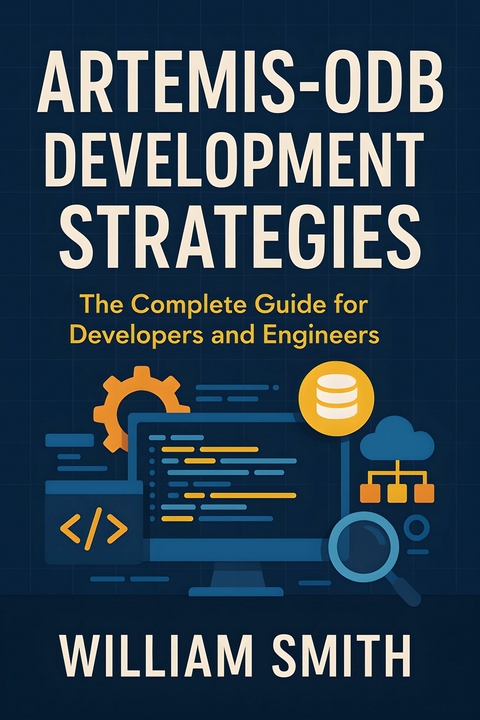
Artemis-ODB Development Strategies (eBook)
250 Seiten
HiTeX Press (Verlag)
978-0-00-102647-6 (ISBN)
'Artemis-ODB Development Strategies'
'Artemis-ODB Development Strategies' is a comprehensive and forward-looking exploration of the Artemis-ODB framework, tailored for developers seeking mastery in entity-component-system (ECS) architectures. This authoritative volume begins with a deep dive into core ECS principles, internal data structures, advanced memory and pooling techniques, and system scheduling algorithms, equipping readers with an in-depth understanding of the high-performance foundations that drive modern game engines and simulations. Each chapter balances theoretical insights with practical guidance, demystifying topics such as cache optimization, thread safety, and the effective management of component data at scale.
Moving beyond the essentials, the book delves into sophisticated design patterns and strategies for architecting robust ECS applications. Readers are guided through component and system specialization, dynamic runtime configuration, modular project organization, feature-oriented architectures, and plugin integration techniques that facilitate scalable development in large, collaborative projects. Seamless integration with rendering, physics, audio, input, and networking subsystems is addressed, ensuring that Artemis-ODB can serve as the backbone for complex, data-driven applications. Extensive chapters on testing, debugging, performance profiling, and observability empower teams to maintain reliability and agility through every stage of the development lifecycle.
The book culminates with advanced topics that are essential for next-generation systems: concurrency models, distributed ECS strategies, transactional persistence, live data migration, and robust security practices. Guidance on fault tolerance, system recovery, integrity management, and stress testing ensures production-ready deployments capable of withstanding real-world demands. Finally, readers are introduced to emerging trends in ECS theory, data-oriented programming, hardware synergies, and community-driven ecosystem evolution. 'Artemis-ODB Development Strategies' serves as both a strategic roadmap and a technical reference for building resilient, scalable, and future-proof ECS applications with Artemis-ODB.
Chapter 2
Advanced Component and System Design Patterns
Move beyond conventions and enter the realm of expert ECS engineering with Artemis-ODB. This chapter exposes the powerful design idioms and structural patterns that enable sophisticated, high-performance applications. Learn how to architect components for flexibility and speed, orchestrate complex system hierarchies, and adapt your ECS to changing runtime demands-unlocking agility and maintainability at any scale.
2.1 Component Design for Performance and Flexibility
Component design in modern software architecture necessitates a careful equilibrium between runtime efficiency and adaptability. Achieving optimal performance while retaining flexibility for extension and maintenance challenges engineers to select appropriate structural models. Predominantly, component models can be classified as flat, packed, or dynamic, each presenting trade-offs in memory consumption, cache utilization, and extensibility potential.
Flat components represent the simplest structural approach, where each component is allocated its own contiguous memory region, often as a standalone object or struct. The layout directly corresponds to the logical data schema, with fields laid out in a fixed order. This design favors straightforward implementation and fast access to individual elements due to predictability in memory layout.
From a performance standpoint, flat models benefit significantly from spatial locality when components are densely allocated in arrays or pools. Sequential iteration over such arrays leverages hardware prefetching, reducing cache misses. However, their rigidity impedes adaptability since extending components typically requires redefining data structures and recompilation. Additionally, unused or rarely accessed fields remain allocated for every instance, potentially inflating memory usage.
Packed component models aim to optimize cache performance and memory footprint by grouping component data tightly without intermediate padding or wasted space. A common implementation employs a Structure of Arrays (SoA) paradigm rather than the Array of Structures (AoS) design found in flat components. In SoA, data for each individual field is stored contiguously in separate arrays, facilitating vectorized operations and improved cache line efficiency when processing large numbers of components.
The packed design excels in scenarios involving batch processing of homogeneous components, allowing compilers and processors to better optimize instruction pipelines with SIMD extensions. Moreover, this model enables selective loading or modification of specific fields without incurring overhead from unrelated data.
Nevertheless, SoA sacrifices the natural locality of an individual component’s complete data, which may degrade performance in contexts requiring frequent access to multiple fields of a single entity. Maintenance complexity also rises; synchronization between parallel arrays must be meticulously managed to avoid state inconsistencies.
Dynamic components introduce flexibility through mechanisms such as pointers, dynamic typing, or component composition at runtime. These models often store components as heterogeneous collections, possibly employing indirections such as virtual tables, handles, or key-value mappings.
This increased adaptability supports evolving requirements, plugin architectures, and polymorphic behavior. Components can be extended or replaced without altering core data layouts, thereby fostering modularity and code reuse. Dynamic models are particularly fitting for applications facing frequent schema changes or diverse, sparse data.
The trade-off manifests in runtime overhead and reduced cache efficiency. Pointer indirection inhibits hardware prefetching and increases the likelihood of cache misses. Fragmented memory allocations escalate TLB (Translation Lookaside Buffer) pressure. The costs associated with dynamic dispatch and runtime type checks must also be considered critically in performance-sensitive domains.
Memory utilization hinges on both the density of component data and the allocation strategy. Flat models tend toward uniform size per component but risk waste due to seldom-used fields. Packed models minimize memory overhead but can fragment logical entity representation. Dynamic models introduce memory fragmentation and metadata overhead, impacting both memory size and access times.
Cache performance is influenced by data locality and access patterns. Flat AoS layouts optimize single-entity access, while SoA packed layouts cater to field-centric bulk operations. Dynamic models’ reliance on pointers impairs spatial locality, increasing cache misses. The choice between these models is intrinsically linked to the dominant workload characteristics: whether operations prioritize whole-entity processing or field-wise iteration.
Selecting an appropriate component design hinges on domain-specific access patterns, extensibility requirements, and hardware constraints:
- Static, Performance-Critical Domains: Systems such as real-time simulations and embedded control benefit from flat or packed designs due to their predictability and cache-friendly structures. Packed SoA data may be preferred when vectorization and bulk operations dominate.
- Highly Dynamic or Extensible Systems: Applications requiring frequent schema evolution, plugin integration, or component replacement favor dynamic models despite potential performance penalties. Flexible composition patterns, such as entity-component systems (ECS) with runtime registration, are common.
- Mixed Workloads: Hybrid approaches can combine static core components with dynamic extensions, balancing performance and flexibility. Such stratification involves fixed base layouts augmented by dynamically managed optional components.
- Memory-Constrained Environments: Packed layouts that minimize wasted space serve scenarios with stringent memory budgets, such as mobile or IoT devices. Here, careful profiling of access patterns enables judicious field grouping.
Consider an entity-component system managing position, velocity, and metadata components:
float x, y, z;
};
struct Velocity {
float vx, vy, vz;
};
struct Metadata {
uint32_t id;
char status;
};
A flat model might allocate an array of structs:
Position pos;
Velocity vel;
...
| Erscheint lt. Verlag | 20.8.2025 |
|---|---|
| Sprache | englisch |
| Themenwelt | Mathematik / Informatik ► Informatik ► Programmiersprachen / -werkzeuge |
| ISBN-10 | 0-00-102647-X / 000102647X |
| ISBN-13 | 978-0-00-102647-6 / 9780001026476 |
| Informationen gemäß Produktsicherheitsverordnung (GPSR) | |
| Haben Sie eine Frage zum Produkt? |
 EPUB (Adobe DRM)
Größe: 800 KB
Kopierschutz: Adobe-DRM
Adobe-DRM ist ein Kopierschutz, der das eBook vor Mißbrauch schützen soll. Dabei wird das eBook bereits beim Download auf Ihre persönliche Adobe-ID autorisiert. Lesen können Sie das eBook dann nur auf den Geräten, welche ebenfalls auf Ihre Adobe-ID registriert sind.
Details zum Adobe-DRM
Dateiformat: EPUB (Electronic Publication)
EPUB ist ein offener Standard für eBooks und eignet sich besonders zur Darstellung von Belletristik und Sachbüchern. Der Fließtext wird dynamisch an die Display- und Schriftgröße angepasst. Auch für mobile Lesegeräte ist EPUB daher gut geeignet.
Systemvoraussetzungen:
PC/Mac: Mit einem PC oder Mac können Sie dieses eBook lesen. Sie benötigen eine
eReader: Dieses eBook kann mit (fast) allen eBook-Readern gelesen werden. Mit dem amazon-Kindle ist es aber nicht kompatibel.
Smartphone/Tablet: Egal ob Apple oder Android, dieses eBook können Sie lesen. Sie benötigen eine
Geräteliste und zusätzliche Hinweise
Buying eBooks from abroad
For tax law reasons we can sell eBooks just within Germany and Switzerland. Regrettably we cannot fulfill eBook-orders from other countries.
aus dem Bereich


