


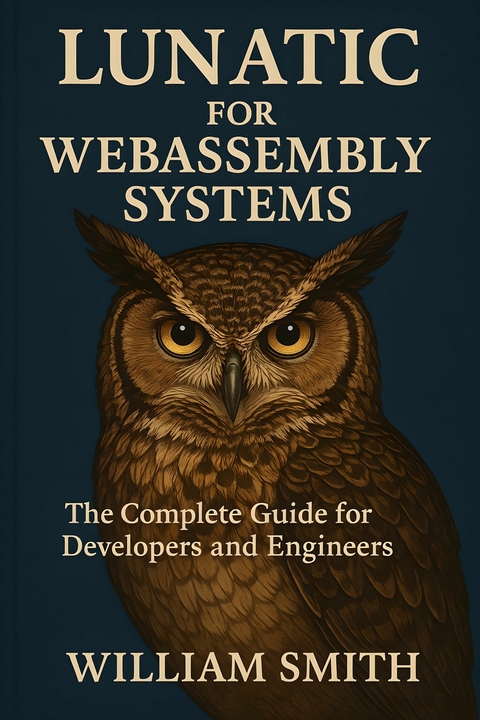
Lunatic for WebAssembly Systems (eBook)
250 Seiten
HiTeX Press (Verlag)
978-0-00-102611-7 (ISBN)
'Lunatic for WebAssembly Systems'
'Lunatic for WebAssembly Systems' is a definitive guide to the cutting edge of systems programming, blending the world of WebAssembly with advanced actor system engineering. This book unfolds the evolution of WebAssembly (Wasm) from browser sandboxing toward becoming a formidable systems runtime, and meticulously explores the surrounding ecosystem-from foundational execution models and type systems, through comparative analyses of major runtimes such as Wasmtime and Wasmer, to deep dives into WASI standards, operating systems, and serverless cloud integration. Security, interoperability, and the unique challenges of Wasm-based system software are unpacked in depth, offering a comprehensive landscape view for practitioners and architects alike.
At its heart, the book centers on the Lunatic runtime, a revolutionary actor model framework inspired by Erlang and reimagined for the Wasm era. Readers are guided through Lunatic's architectural principles-isolates, message passing, hierarchical supervision, WASI integration, and robust resource management-demonstrating how complex, high-concurrency distributed systems can be designed, managed, and scaled. Advanced chapters introduce practical development workflows, including Rust and AssemblyScript support, SDK usage, testing, performance optimization, and modern DevOps practices for reliable, high-throughput actor systems.
Going beyond the core runtime, the book illuminates advanced actor patterns, distributed orchestration, security governance, and real-world integration strategies for cloud, edge, and polyglot environments. Detailed examinations of consensus, state replication, observability, multi-tenancy, and zero-trust deployments empower readers to build secure, scalable, and resilient systems. Concluding with a forward-looking perspective, 'Lunatic for WebAssembly Systems' surveys emerging standards, AI and confidential computing use cases, and ways to engage with the growing Lunatic community, making it an indispensable resource for software engineers, systems designers, and technology leaders.
Chapter 2
The Lunatic Runtime: Architecture and Design
Move beneath the surface of Lunatic and discover a runtime that redefines how actor systems and WebAssembly intersect. Inspired by the reliability of Erlang and supercharged by Wasm’s efficiency, Lunatic offers an innovative foundation for building concurrent, highly isolated, and scalable applications. This chapter unpacks Lunatic’s architectural DNA and internal workings-exposing the choices, tradeoffs, and breakthroughs that position it at the leading edge of modern systems design.
2.1 Motivation and System Model
The evolution of concurrent and distributed systems has long been shaped by the quest for effective abstractions that reconcile scalability, reliability, and ease of programming. Among these, the actor model pioneered by Erlang has demonstrated enduring influence, proving that a disciplined approach to concurrency through message-passing and isolated state can yield systems of remarkable robustness and fault tolerance. However, as computational paradigms shift towards the cloud-native era and runtime environments increasingly emphasize portability and security, the actor model’s traditional implementations face challenges. Lunatic emerges as a purposeful reimagining of this foundational concurrency model, transposing its essential principles onto the WebAssembly (Wasm) execution environment, thereby addressing modern system requirements with fresh rigor.
The origins of Lunatic reside in the recognition that Erlang’s actor model, while conceptually elegant and operationally effective, was architected in an era predating contemporary concerns such as untrusted code execution, fine-grained sandboxing, and pervasive heterogeneity in deployment targets. Erlang processes embody isolated actors that communicate solely through asynchronous messaging, enabling fault isolation and enabling scalable distributed computing. This conceptual framework dovetails naturally with WebAssembly’s design goals: a lightweight, safe, and portable binary instruction format intended to run code across diverse environments with near-native performance. WebAssembly’s sandboxing capabilities provide strong safety guarantees, isolating modules at the runtime level and preventing exploitable behaviors-a critical attribute when executing untrusted code in multi-tenant environments or edge platforms.
However, the actor model in Erlang is tightly coupled with a specific virtual machine and runtime that integrate scheduling, message passing, and fault tolerance into a comprehensive but monolithic system. Lunatic diverges by leveraging Wasm’s language-independent bytecode semantics, enabling actors to be implemented in multiple source languages and executed in diverse runtime contexts without modification. The system thus decouples the concurrency abstraction from the language and runtime while preserving the essential actor principles of isolation, message-passing, and supervision.
Lunatic’s foundational philosophy centers on three core tenets:
- Fine-Grained Isolation: Each actor is executed within its own Wasm instance, ensuring strong isolation at the memory and execution level. This strict partitioning minimizes shared mutable state and thereby eliminates a broad class of concurrency errors.
- Scalable and Asynchronous Communication: Actor interactions occur exclusively through asynchronous, ordered message passing. Messages are serialized in a compact, platform-agnostic format, permitting transparent communication over diverse transports and enabling natural scaling from single-host to distributed deployments.
- Language-Agnosticism and Portability: By adopting WebAssembly as a compilation target, Lunatic actors can be authored in any language that compiles to Wasm, broadening the ecosystem and increasing composability. Portability across heterogeneous hardware and operating systems is implicit, facilitating deployment to cloud, edge, or embedded environments.
These principles enable Lunatic to support a concurrency model that is robust, modular, and adaptable, while simultaneously accommodating emerging operational models that prioritize security, flexibility, and performance.
The system model of Lunatic builds upon a concise set of abstractions inspired by Erlang yet distinctly adapted to the Wasm runtime environment.
Actor: The fundamental unit of computation is an isolated actor, represented by an independent WebAssembly instance. Each actor encapsulates its own memory, state, and execution context. Unlike traditional threads, actors cannot share memory directly, and all interaction occurs strictly through messages. The isolation boundaries enforce fault containment, allowing the system to detect and recover from faults without cascading failures.
Process: In Lunatic, the term process is closely aligned with the actor but includes the lifecycle management semantics. Processes can be spawned dynamically, and they communicate via explicitly managed message queues. Process identifiers serve as references to these actors and enable message routing and supervision.
Messaging: Messages are immutable data units serialized into a compact binary form optimized for Wasm’s efficiency constraints. The messaging API facilitates asynchronous communication, with non-blocking sends and non-deterministic receives. Message queues guarantee message ordering per sender-recipient pair, maintaining consistency without imposing global synchronization.
Supervision and Fault Handling: Processes are arranged into supervision trees emulating Erlang’s fault tolerance model. Supervisors monitor child actors and define restart strategies, enabling rapid recovery from transient faults. Lunatic’s model extends supervision semantics by leveraging Wasm’s sandboxing to detect actor failures precisely and enforce isolation boundaries, thus safeguarding unaffected processes and the overall system state.
Resource Management: The system model integrates resource constraining mechanisms intrinsic to Wasm, such as memory limits and execution quotas. This ensures that runaway processes cannot degrade system-wide availability, a critical consideration in multi-tenant and serverless environments.
Lunatic situates itself in a broader actor systems ecosystem as a next-generation framework that marries the time-tested abstractions of Erlang-style concurrency with the technological advances embodied in WebAssembly. It inherits and refines key actor system properties:
- Isolation and Fault Tolerance: Unlike JVM- or native-code-based actor implementations, Lunatic exploits Wasm sandboxes to provide hardware-enforced isolation boundaries, yielding stronger robustness guarantees.
- Polyglot Concurrency: By detaching the actor semantics from any particular programming language runtime, Lunatic introduces genuine polyglot compatibility, empowering heterogeneous actor systems composed of distinct language components.
- Deployment Flexibility: The system’s portability extends beyond traditional cloud infrastructures to edge and IoT deployments, where resource constraints and security concerns dominate.
- Security Model: Enhanced isolation coupled with capability-based security models in Lunatic substantially reduces the attack surface compared to conventional actor frameworks.
Compared to other contemporary actor systems, which often rely on heavyweight virtual machines or language-specific runtimes, Lunatic’s lightweight, Wasm-centric architecture promises more granular scalability and a secure foundation congruent with modern distributed platform requirements. Moreover, its integration with WebAssembly opens pathways to seamlessly bridging the actor model with emerging standards in cloud function runtimes and decentralized computing.
The synthesis that Lunatic presents-retaining Erlang’s conceptual sophistication while exploiting Wasm’s modern execution paradigm-thus provides a compelling substrate for building resilient, performant, and portable concurrent systems in a heterogeneous technological landscape.
2.2 Isolates, Processes, and Message Passing
At the core of Lunatic’s architecture lies the isolate abstraction, which serves as the fundamental unit of concurrency and fault isolation. Unlike traditional operating system processes, isolates embody lightweight, independently executing entities that encapsulate both logical computation and state. This abstraction is designed to enable massive concurrency with minimal overhead while ensuring robust isolation properties essential for secure and fault-tolerant systems.
Processes in Lunatic are represented as isolates created at runtime via explicit instantiation. Each isolate is spawned with a designated entry point function and an optional initial message payload for initialization data. The creation of an isolate follows a fork-like semantic, but invocation does not clone memory space; rather, the isolate initializes its own separate heap and runtime environment, granting complete memory...
| Erscheint lt. Verlag | 20.8.2025 |
|---|---|
| Sprache | englisch |
| Themenwelt | Mathematik / Informatik ► Informatik ► Programmiersprachen / -werkzeuge |
| ISBN-10 | 0-00-102611-9 / 0001026119 |
| ISBN-13 | 978-0-00-102611-7 / 9780001026117 |
| Informationen gemäß Produktsicherheitsverordnung (GPSR) | |
| Haben Sie eine Frage zum Produkt? |
 EPUB (Adobe DRM)
Größe: 816 KB
Kopierschutz: Adobe-DRM
Adobe-DRM ist ein Kopierschutz, der das eBook vor Mißbrauch schützen soll. Dabei wird das eBook bereits beim Download auf Ihre persönliche Adobe-ID autorisiert. Lesen können Sie das eBook dann nur auf den Geräten, welche ebenfalls auf Ihre Adobe-ID registriert sind.
Details zum Adobe-DRM
Dateiformat: EPUB (Electronic Publication)
EPUB ist ein offener Standard für eBooks und eignet sich besonders zur Darstellung von Belletristik und Sachbüchern. Der Fließtext wird dynamisch an die Display- und Schriftgröße angepasst. Auch für mobile Lesegeräte ist EPUB daher gut geeignet.
Systemvoraussetzungen:
PC/Mac: Mit einem PC oder Mac können Sie dieses eBook lesen. Sie benötigen eine
eReader: Dieses eBook kann mit (fast) allen eBook-Readern gelesen werden. Mit dem amazon-Kindle ist es aber nicht kompatibel.
Smartphone/Tablet: Egal ob Apple oder Android, dieses eBook können Sie lesen. Sie benötigen eine
Geräteliste und zusätzliche Hinweise
Buying eBooks from abroad
For tax law reasons we can sell eBooks just within Germany and Switzerland. Regrettably we cannot fulfill eBook-orders from other countries.
aus dem Bereich


