


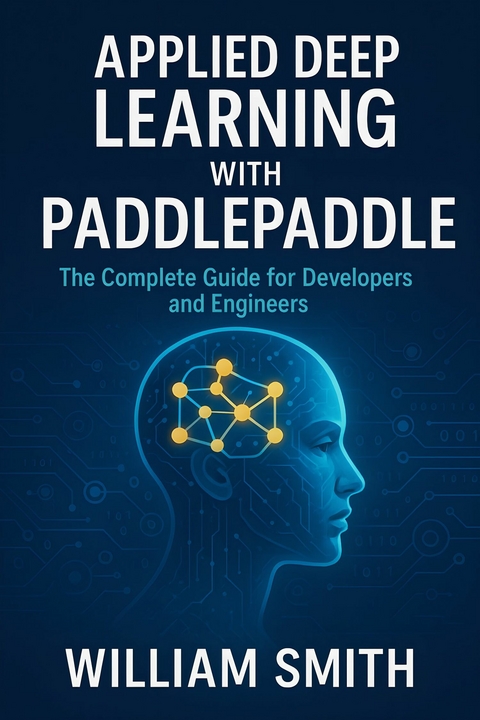
Applied Deep Learning with PaddlePaddle (eBook)
250 Seiten
HiTeX Press (Verlag)
978-0-00-102584-4 (ISBN)
'Applied Deep Learning with PaddlePaddle'
'Applied Deep Learning with PaddlePaddle' is a comprehensive guide for practitioners and researchers seeking to harness the power of Baidu's open-source deep learning platform in real-world settings. The book masterfully bridges theory and application, offering an in-depth exploration of PaddlePaddle's architecture, ecosystem, and its evolving role in the global landscape of artificial intelligence. Readers are introduced to the foundational paradigms of modern deep learning, best practices for reproducible research, and robust comparisons with leading frameworks such as PyTorch, TensorFlow, and JAX, empowering them to make informed decisions tailored to their application domains.
The text delves into advanced data handling, model architecture design, and state-of-the-art training techniques, providing detailed examples for vision, natural language processing, and audio/multimodal tasks. Innovative chapters guide users through building scalable data pipelines, handling challenging datasets, and engineering custom model components for cutting-edge research. Practical sections demonstrate the deployment and optimization of complex models for fast inference, distributed training, and production-grade workflows, including mobile and edge deployment with Paddle Lite and highly-available inference with PaddleServing.
Beyond technical mastery, 'Applied Deep Learning with PaddlePaddle' emphasizes end-to-end workflow management, robust testing, continuous integration, and responsible AI, including fairness, safety, and security. The final chapters examine emerging research frontiers, open-source community engagement, and high-impact industrial applications, making this book an indispensable resource for professionals seeking to unlock the full potential of deep learning with PaddlePaddle in both research and industry.
Chapter 2
Advanced Data Handling and Preprocessing Pipelines
In the world of deep learning, quality data pipelines are the unsung engine beneath every breakthrough model. This chapter exposes the sophisticated engineering required to ingest, transform, and ready data for modern AI at scale. Readers will discover not only how to feed neural networks efficiently but also how to architect robust pipelines that adapt to imperfect data and ever-expanding sources.
2.1 Data Ingestion: Datasets, DataLoader, and Streaming
Efficient data ingestion forms the backbone of scalable machine learning systems, particularly when handling massive, heterogeneous datasets spanning computer vision, natural language processing (NLP), and tabular domains. Modern frameworks, including PaddlePaddle, provide abstractions such as Dataset and DataLoader that enable streamlined, modular data pipelines. These abstractions facilitate seamless integration of diverse data sources while managing memory consumption and throughput. This section explores these core components, mechanisms for streaming data in online learning scenarios, and critical considerations for mitigating data pipeline bottlenecks at scale.
The Dataset abstraction in PaddlePaddle encapsulates raw data access and transformations, decoupling data retrieval from training logic. In complex applications, datasets typically represent large image repositories, text corpora, or extensive tabular records stored across distributed file systems or cloud object stores. The design of Dataset supports lazy loading and on-the-fly preprocessing-crucial for minimizing memory utilization when data volume exceeds available RAM. For instance, in computer vision workflows, an image Dataset may read JPEG files from disk and apply random cropping, resizing, and normalization as data augmentations. Similarly, NLP datasets commonly tokenize and batch variable-length text sequences during iteration.
The DataLoader complements Dataset by handling batching, shuffling, parallel data loading, and memory pinning to optimize GPU utilization. Its multi-threaded or multi-process prefetching reduces dataset I/O latencies and CPU preprocessing overhead, enabling smoother GPU compute pipelines. In PaddlePaddle, asynchronous workers interact with the Dataset iterator to fetch samples in parallel, assembling them into mini-batches with proper collation rules. The DataLoader’s shuffle parameter ensures stochastic gradient descent benefits from randomized sampling, enhancing model generalization. Users can tune the num_workers parameter based on hardware resources, balancing CPU load and data throughput. For tabular data, DataLoader supports sampling strategies such as stratified or weighted sampling to address class imbalance during training.
Streaming data ingestion extends these concepts to online learning and real-time applications. Unlike static datasets, streaming data arrives incrementally and potentially infinitely, necessitating architectures that process samples or mini-batches on the fly without loading the entire dataset. PaddlePaddle supports streaming through customized Dataset implementations and incremental DataLoader state handling, often coupled with event-driven or windowed processing approaches. In NLP or computer vision tasks over live video feeds, data streams must be ingested with low latency and synchronized with model inference or update steps. Tabular data streams from sensor networks or transaction logs require fault-tolerant buffering and checkpointing mechanisms to maintain data integrity.
A critical design consideration for streaming is the trade-off between batch size and update frequency. Larger batches improve statistical efficiency and hardware utilization but introduce latency incompatible with real-time demands. Adaptive batching algorithms dynamically adjust mini-batch size based on input rate and system load, thereby balancing throughput and responsiveness. Furthermore, techniques such as reservoir sampling enable maintaining representative samples from potentially unbounded streams for model retraining or evaluation.
Despite these abstractions, data ingestion often remains a key bottleneck in large-scale training pipelines. I/O bandwidth limitations, storage medium contention, and serialization overheads can throttle performance. High-throughput scenarios require optimizing file formats and storage layouts-for example, TFRecord, LMDB, or Parquet for efficient random access and decompression. Prefetch strategies must be carefully benchmarked to prevent excessive memory use or CPU-GPU synchronization stalls. Additionally, the interaction between DataLoader and underlying hardware buses demands profiling tools to identify stale pipelines or underutilized compute units.
Shuffling massive datasets presents a significant challenge; naive shuffling of multi-terabyte datasets is infeasible in memory. PaddlePaddle employs buffer shuffling and sharding techniques, dividing datasets into smaller shards that are shuffled independently and served in randomized order. Distributed training setups leverage sharded datasets aligned with device topology to minimize cross-node communication overhead in data loading.
For tabular data with heterogeneous feature types and missing values, preprocessing transformations executed inside the Dataset should balance computational cost and parallelism. Encoding categorical variables, normalizing continuous features, and imputing missing values are often performed asynchronously to maintain pipeline throughput. Data augmentation strategies in computer vision or NLP, such as rotation jitter or synonym replacement, introduce additional CPU cycles and must be optimized, for instance by leveraging hardware-accelerated libraries or caching.
PaddlePaddle’s Dataset and DataLoader abstractions provide a flexible and efficient foundation for ingesting diverse data modalities at scale. The extension to streaming data ingestion supports both batch and real-time learning needs, critical for interactive systems and continuous model adaptation. However, careful engineering and profiling are required to alleviate data bottlenecks, optimize resource usage, and maintain high-throughput training pipelines at scale. The continuous evolution of data ingestion mechanisms will remain pivotal in addressing the increasing velocity, variety, and volume of data driving modern AI applications.
2.2 Custom Data Transformations and Augmentation
Deep learning models heavily rely on diverse and representative training data to achieve robust generalization. While standard augmentation techniques such as random cropping, flipping, and Gaussian noise injection offer baseline improvements, domain-specific challenges often necessitate tailored transformations. Custom data augmentation strategies not only extend dataset variability but also embed domain knowledge into the training pipeline, thereby enhancing model resilience against distributional shifts and adversarial perturbations. This section delves into advanced augmentation tactics for image, audio, and text modalities, emphasizing integration with PaddlePaddle’s flexible pipeline architecture.
Advanced Image Augmentation Strategies
Beyond canonical image transformations, domain-specific augmentations exploit the semantic structure and statistical properties characteristic of a particular application. For medical imaging, intensity warping and synthetic artifact insertion simulate scanner variability and noise, while in remote sensing, geometric distortions aligned with sensor motion capture realistic variations. Techniques such as elastic deformations, introduced by Simard et al., induce local pixel displacement fields to mimic shape variations, which are crucial in handwritten character recognition and biomedical image analysis.
Color space augmentations-altering hue, saturation, and brightness-serve in scenarios where lighting conditions fluctuate, while domain-guided occlusions, such as simulating raindrops or shadows, boost robustness in autonomous driving systems. Another augmentation class composes multiple transformations in a probabilistic, structured manner, for example, AutoAugment and RandAugment, which search for optimal augmentation policies. However, these often require adaptation or retraining for domain-specific constraints.
In PaddlePaddle, custom image augmentations can be implemented as callable classes or functions, then incorporated into paddle.vision.transforms pipelines. For instance, an elastic deformation transform can be defined and chained with standard transforms, enabling GPU-accelerated on-the-fly augmentation that preserves batch pipeline efficiency.
...
| Erscheint lt. Verlag | 20.8.2025 |
|---|---|
| Sprache | englisch |
| Themenwelt | Mathematik / Informatik ► Informatik ► Programmiersprachen / -werkzeuge |
| ISBN-10 | 0-00-102584-8 / 0001025848 |
| ISBN-13 | 978-0-00-102584-4 / 9780001025844 |
| Informationen gemäß Produktsicherheitsverordnung (GPSR) | |
| Haben Sie eine Frage zum Produkt? |
 EPUB (Adobe DRM)
Größe: 1,1 MB
Kopierschutz: Adobe-DRM
Adobe-DRM ist ein Kopierschutz, der das eBook vor Mißbrauch schützen soll. Dabei wird das eBook bereits beim Download auf Ihre persönliche Adobe-ID autorisiert. Lesen können Sie das eBook dann nur auf den Geräten, welche ebenfalls auf Ihre Adobe-ID registriert sind.
Details zum Adobe-DRM
Dateiformat: EPUB (Electronic Publication)
EPUB ist ein offener Standard für eBooks und eignet sich besonders zur Darstellung von Belletristik und Sachbüchern. Der Fließtext wird dynamisch an die Display- und Schriftgröße angepasst. Auch für mobile Lesegeräte ist EPUB daher gut geeignet.
Systemvoraussetzungen:
PC/Mac: Mit einem PC oder Mac können Sie dieses eBook lesen. Sie benötigen eine
eReader: Dieses eBook kann mit (fast) allen eBook-Readern gelesen werden. Mit dem amazon-Kindle ist es aber nicht kompatibel.
Smartphone/Tablet: Egal ob Apple oder Android, dieses eBook können Sie lesen. Sie benötigen eine
Geräteliste und zusätzliche Hinweise
Buying eBooks from abroad
For tax law reasons we can sell eBooks just within Germany and Switzerland. Regrettably we cannot fulfill eBook-orders from other countries.
aus dem Bereich


