


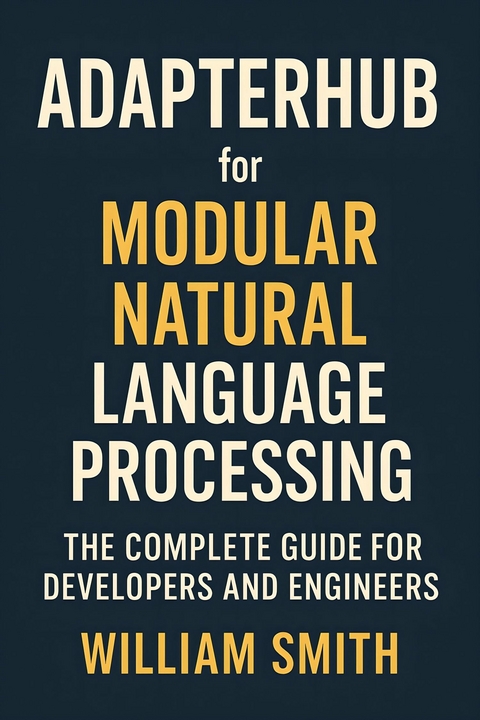
AdapterHub for Modular Natural Language Processing (eBook)
250 Seiten
HiTeX Press (Verlag)
978-0-00-102504-2 (ISBN)
'AdapterHub for Modular Natural Language Processing'
'AdapterHub for Modular Natural Language Processing' is a comprehensive, state-of-the-art guide to the design, implementation, and real-world deployment of modular deep learning architectures in NLP. It illuminates the motivations and foundations behind the shift toward modularity, presenting AdapterHub as a central platform for scalable, maintainable, and transferable development. Through a meticulous exploration of design patterns, architecture, and technical challenges, the book offers readers both a theoretical background and pragmatic tools for leveraging adapters in a rapidly evolving field.
This book presents an expert deep dive into the AdapterHub ecosystem, covering infrastructure, adapter taxonomy, integration with popular frameworks such as Hugging Face, and robust strategies for versioning, provenance, and security. Practitioners and researchers alike will find actionable insights into engineering custom adapters, optimizing their performance, and extending their utility to multimodal and multilingual tasks. Practical workflows for efficient training and evaluation are illustrated alongside cutting-edge topics such as dynamic routing, knowledge distillation, and mitigating catastrophic forgetting in continual learning scenarios.
Addressing real-world complexities, the text offers a rich treatment of operationalizing AdapterHub in production, addressing crucial concerns like security, fairness, ethical adoption, and sustainable computing. The book provides a visionary perspective on open challenges-including federated and decentralized adapter ecosystems, interdisciplinary applications, and environmental impact-making it an essential reference for professionals and academics aiming to harness the power of modularity for responsible, efficient, and future-proof NLP systems.
Chapter 1
Foundations of Modular NLP and AdapterHub
The evolution of modern natural language processing hinges on rethinking how models adapt, scale, and transfer knowledge across tasks and domains. This chapter challenges you to explore the conceptual and technical bedrock of modular NLP, revealing why AdapterHub emerged as a transformative force in the field. Expect a rigorous journey through the principles, design philosophies, and trade-offs behind modularity-and discover how adapters are redefining the relationship between research innovation and production robustness.
1.1 Background and Motivation for Modularity in NLP
Traditional natural language processing (NLP) architectures have often been constructed as monolithic systems, encompassing tightly integrated components that process language through a fixed sequence of operations. These monolithic designs, while historically effective for specific, narrowly focused tasks, have exhibited significant limitations as the field has evolved toward handling more complex, varied, and large-scale linguistic phenomena. Among these limitations, issues concerning scalability, inflexibility, and resource inefficiency stand out, considerably constraining the adaptability and practical deployment of NLP models in real-world applications.
Scalability emerges as a distinctive challenge rooted in the tightly coupled nature of monolithic architectures. As these models grow in size and complexity-particularly with the advent of deep learning-they tend to become increasingly unwieldy. Any extension or refinement to the architecture typically requires retraining or redesigning large portions of the system, imposing substantial computational costs and prolonged development cycles. This approach contrasts sharply with the need for NLP systems that can adapt fluidly to new languages, domains, or modalities without exhaustive reengineering. For instance, purely end-to-end monolithic models designed for specific tasks such as machine translation or sentiment analysis struggle to generalize when exposed to data with different distributions or when integrated as components into broader systems.
Inflexibility further constrains monolithic NLP models by limiting their ability to incorporate new information incrementally or to integrate complementary modules developed independently. When components are fused tightly, swapping or upgrading parts without affecting the entire system becomes problematic. This architectural rigidity hinders the incorporation of advances in specific subfields, such as syntax-aware modules or semantic reasoning enhancements, which might otherwise augment the overall performance. Moreover, the development of monolithic models often presupposes access to large, centralized datasets and entails end-to-end optimization strategies that obscure modular interpretability and explainability.
Resource inefficiency is another critical drawback, especially in light of the growing environmental and economic costs associated with training and deploying large-scale NLP models. Monolithic systems typically require recomputing or fine-tuning the entire model for new tasks or updates, resulting in significant duplication of computation and energy usage. This inefficiency also hampers deployment on resource-constrained platforms such as mobile or edge devices, where lighter, adaptable components are preferred.
The modular approach to NLP architectures emerges as a natural response to these limitations, advocating a decomposition of models into self-contained, interchangeable units that collectively realize complex language understanding and generation capabilities. Modularity enables each component to specialize in discrete functions, such as tokenization, syntactic parsing, semantic interpretation, or contextual embedding, each of which can be developed, trained, and optimized independently. This paradigm fosters reusability, making it feasible to leverage existing modules across diverse tasks without the need to retrain entire models from scratch.
Concrete examples of modularity’s impact can be observed in the domain of transfer learning. Pretrained contextual embedding models like BERT or GPT serve as general-purpose encoders whose representations may be fine-tuned for specific downstream applications. This reuse of a modular backbone significantly reduces the volume of task-specific data and computational resources required, enabling scalable deployment across an expanding array of NLP tasks. Similarly, continual learning frameworks benefit from modular architectures by isolating plasticity within individual modules, thus mitigating catastrophic forgetting and facilitating incremental knowledge acquisition.
Collaborative development is also greatly enhanced by modular designs. When teams or organizations develop discrete components adhering to standardized interfaces, these modules can be shared, combined, or replaced independently, fostering ecosystem growth and democratizing access to sophisticated NLP technologies. Open-source repositories hosting modular NLP components accelerate innovation by allowing researchers and practitioners to rapidly prototype novel configurations and extensions, avoiding duplication of effort common in monolithic pipelines.
Ultimately, modularity serves as a catalyst for rapid experimentation by enabling researchers to interchange modules, test hypotheses, and fine-tune system behavior with precision. Deployment efficiency is likewise improved, as lightweight modules can be selectively activated or scaled depending on application requirements, making systems agile and adaptive to varying operational constraints. This versatility paves the way for broader accessibility to state-of-the-art NLP models, lowering entry barriers for smaller organizations and individual developers who might lack the resources to train or maintain comprehensive monolithic architectures.
In summary, the move toward modularity addresses fundamental historical challenges of monolithic NLP systems by enhancing scalability, flexibility, and resource efficiency. It aligns with contemporary demands for adaptable, maintainable, and collaboratively developed language models, marking a paradigm shift that underpins many recent advances in NLP research and applications.
1.2 AdapterHub: Vision and Architecture
AdapterHub emerges as a strategic solution designed to tackle the escalating computational and maintenance challenges posed by fine-tuning large pre-trained models across diverse downstream tasks. Its foundational vision distills into three primary objectives: maximizing parameter efficiency, fostering model interoperability, and enabling community-driven innovation. These objectives collectively underpin a framework capable of supporting scalable research paradigms and reproducible deployment pipelines in natural language processing (NLP) and beyond.
Parameter Efficiency
The core motivation behind AdapterHub is to circumvent the inefficiencies inherent in conventional fine-tuning where the entire massive model is modified for each new task. Instead, AdapterHub introduces the concept of lightweight adapter modules that are inserted into the backbone network. These adapters contain a small fraction of the parameters relative to the original model, typically less than 5% per task, allowing for substantial compression of task-specific weights. By freezing the original backbone parameters during fine-tuning, AdapterHub dramatically reduces storage requirements and computational overhead, facilitating the handling of multiple tasks without model proliferation. This design supports rapid experiment cycles and large-scale task deployment with minimal resource consumption.
Model Interoperability via Architectural Separation
At the architectural level, AdapterHub rigorously enforces a modular design that delineates the backbone model-typically a state-of-the-art transformer-based architecture-from the adapters, which serve as tunable residual components injected at strategic network layers. This separation ensures the backbone remains task-agnostic and reusable across varied domains, while adapters encode task-specific behavioral nuances. The adapters typically employ a bottleneck architecture, comprising down-projection and up-projection layers with non-linearities, inserted after transformer subcomponents such as multi-head attention or feed-forward networks.
This modularization not only enables parameter-efficient transfer learning but also promotes interoperability between different backbone architectures and tasks. Through standardizing adapter interfaces and insertion points, AdapterHub supports interchangeable combinations whereby one can seamlessly overlay adapters trained on different tasks onto a shared backbone. This fosters a composable ecosystem where researchers and practitioners can mix-and-match adapters, leveraging prior work without retraining or joint fine-tuning.
Orchestration Mechanisms for Integration
The practical orchestration of AdapterHub’s modular components necessitates sophisticated mechanisms that enable transparent loading, switching, and management of adapters within the backbone model. AdapterHub provides a unified API and repository infrastructure that tracks the versioning, ...
| Erscheint lt. Verlag | 20.8.2025 |
|---|---|
| Sprache | englisch |
| Themenwelt | Mathematik / Informatik ► Informatik ► Programmiersprachen / -werkzeuge |
| ISBN-10 | 0-00-102504-X / 000102504X |
| ISBN-13 | 978-0-00-102504-2 / 9780001025042 |
| Informationen gemäß Produktsicherheitsverordnung (GPSR) | |
| Haben Sie eine Frage zum Produkt? |
 EPUB (Adobe DRM)
Größe: 1,4 MB
Kopierschutz: Adobe-DRM
Adobe-DRM ist ein Kopierschutz, der das eBook vor Mißbrauch schützen soll. Dabei wird das eBook bereits beim Download auf Ihre persönliche Adobe-ID autorisiert. Lesen können Sie das eBook dann nur auf den Geräten, welche ebenfalls auf Ihre Adobe-ID registriert sind.
Details zum Adobe-DRM
Dateiformat: EPUB (Electronic Publication)
EPUB ist ein offener Standard für eBooks und eignet sich besonders zur Darstellung von Belletristik und Sachbüchern. Der Fließtext wird dynamisch an die Display- und Schriftgröße angepasst. Auch für mobile Lesegeräte ist EPUB daher gut geeignet.
Systemvoraussetzungen:
PC/Mac: Mit einem PC oder Mac können Sie dieses eBook lesen. Sie benötigen eine
eReader: Dieses eBook kann mit (fast) allen eBook-Readern gelesen werden. Mit dem amazon-Kindle ist es aber nicht kompatibel.
Smartphone/Tablet: Egal ob Apple oder Android, dieses eBook können Sie lesen. Sie benötigen eine
Geräteliste und zusätzliche Hinweise
Buying eBooks from abroad
For tax law reasons we can sell eBooks just within Germany and Switzerland. Regrettably we cannot fulfill eBook-orders from other countries.
aus dem Bereich


