


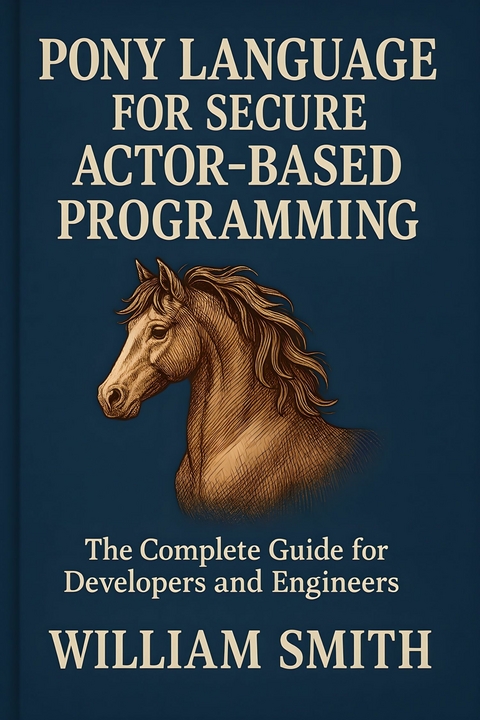
Pony Language for Secure Actor-Based Programming (eBook)
250 Seiten
HiTeX Press (Verlag)
978-0-00-102503-5 (ISBN)
'Pony Language for Secure Actor-Based Programming'
'Pony Language for Secure Actor-Based Programming' is a comprehensive guide to leveraging the Pony programming language for the development of robust, secure, and scalable actor-based systems. The book begins by systematically examining the foundational principles of the actor model and its associated security challenges, illuminating the risks and requirements unique to message-driven, concurrent architectures. Through detailed analysis, it highlights the limitations of traditional actor implementations and clarifies the essential language and runtime features necessary for building systems that balance performance with strong security guarantees.
Delving into the core mechanics of Pony, the text offers an accessible yet thorough treatment of its innovative design philosophy, strongly-typed system, and capability-based security model. Readers are introduced to Pony's distinctive reference capabilities-iso, trn, ref, val, box, and tag-that enforce strict actor isolation, prevent data races, and enable formal reasoning about safety and non-interference. The book provides concrete, real-world case studies that demonstrate how these language constructs mitigate common vulnerabilities, along with practical guidance for navigating potential pitfalls in secure actor programming.
Extending beyond core language features, the work addresses advanced topics such as formal verification, secure distributed architectures, cross-language interoperability, and security-focused operational strategies. Readers are equipped with best practices for secure messaging, robust error handling, auditing, and incident response, supported by lessons learned from both industrial and open-source Pony deployments. The final chapters explore evolving trends and open research challenges in actor-based security, offering a forward-looking perspective for researchers and practitioners committed to building the next generation of trustworthy actor systems.
Chapter 2
Introduction to the Pony Language
Pony redefines what’s possible in concurrent programming by merging provable safety and uncompromising performance-without ever sacrificing expressiveness. In this chapter, we dive into Pony’s architecture, unraveling how its radical choices around types, memory, and capabilities set the stage for building truly robust actor systems. Discover what makes Pony stand apart, from its fearless handling of data races to its innovative approach to isolation and security.
2.1 Overview and Design Philosophy
The Pony programming language is founded on a set of core motivations and guiding principles that distinctly shape its approach to concurrency, safety, and performance. Central among these motivations is the ambition to provide a language environment where data-race freedom is guaranteed statically, without compromising on expressiveness or efficiency. By embracing strong correctness guarantees as first-class design objectives, Pony targets applications requiring inherently reliable, high-throughput concurrent executions.
At the heart of Pony’s design lies a strict focus on data-race freedom. This is achieved through a sophisticated reference capability system that encodes ownership, mutability, and aliasing properties directly in the type system. Unlike conventional models that rely on dynamic checks or coarse synchronization primitives, Pony’s capabilities enforce at compile-time that no two independent execution contexts (actors) can access the same mutable data concurrently unless explicitly allowed with immutable or read-only references. This disciplined approach eliminates an entire class of concurrency bugs early in the development lifecycle, thereby reducing debugging complexity, runtime overhead, and the risk of catastrophic failures in concurrent programs.
Pony distinguishes itself by integrating this rigorous correctness framework with a strong commitment to performance. Unlike many safe concurrent languages that introduce prohibitive abstraction layers or runtime costs, Pony leverages its actor model combined with zero-cost abstractions to achieve high-performance concurrency. The actors-lightweight, independent units of computation communicating through asynchronous message passing-are efficiently executed without locks or shared mutable state, sidestepping traditional synchronization bottlenecks. Furthermore, the language and its runtime are designed to minimize garbage collection pauses, support real-time use cases, and optimize memory layout for cache efficiency. These considerations enable Pony to serve in domains ranging from embedded systems to large-scale distributed infrastructures with minimal latency and maximal throughput.
Explicit safety in Pony goes beyond memory and race safety to include deterministic encapsulation of mutable state, preventing accidental leakage or uncontrolled aliasing. The reference capability system enforces clear protocols for how data can be shared, transformed, or moved between contexts, providing developers with fine-grained control over aliasing semantics while maintaining safety invariants. This explicitness fosters a programming model where side effects are both visible and regulated, supporting reasoning about program correctness in complex concurrent environments. By avoiding implicit sharing or unchecked mutation, Pony reduces subtle bugs stemming from unintended interactions between concurrent components.
The trade-offs embodied in Pony’s design reflect a deliberate prioritization of rigorous correctness and concurrency over maximal flexibility or syntactic brevity. For example, the type system enforces strict ownership and capability rules that may require more upfront annotation or architectural consideration by the programmer. This can impose a steeper learning curve compared to languages with looser aliasing models or dynamic checks. Nonetheless, this design choice yields stronger static guarantees and cleaner runtime semantics, which are critical in systems demanding high assurance. Another trade-off is the choice to eschew shared-memory parallelism with lock-based synchronization in favor of an actor-based concurrency model, which, while mitigating data races and deadlocks, may impose a different mental model that developers must adopt for effective utilization.
Pony’s design philosophy also emphasizes composability and modularity within concurrent components. The actor model, coupled with immutable data sharing where appropriate, promotes building loosely coupled subsystems that communicate explicitly by message passing. This architecture naturally supports distributed systems and fault tolerance since actors isolate state and failure domains. Additionally, Pony’s garbage collection and scheduling mechanisms are built to be concurrent and non-blocking, enabling scalable performance without sacrificing safety. These runtime features are tightly integrated with the language semantics, reinforcing the overall safety and performance goals.
In summary, the visionary foundation of Pony rests on the intertwined priorities of data-race freedom, high performance, and explicit safety. Its design philosophy embraces principled trade-offs to ensure that these properties coexist harmoniously. By leveraging a robust type- and capability-based system to guarantee correctness at compile-time, employing actors to achieve scalable concurrency, and providing explicit control over aliasing and mutability, Pony offers a unique convergence of safety, speed, and expressiveness that addresses the complex demands of modern concurrent programming.
2.2 Core Language Syntax
The Pony programming language, designed for high-performance applications requiring safe concurrency, establishes a distinctive syntactic foundation that integrates module structuring, data types, expressions, and control flow with actor-based concurrency principles. This section delineates Pony’s core syntax elements, emphasizing idiomatic organization and characteristics that differentiate Pony from traditional systems languages such as C++ and Rust.
At the highest syntactic level, Pony’s code is organized into actors, primitive types, classes, interfaces, and traits, which are all encapsulated within a module. A module is signified in the source code by a directory or explicit package name, forming a namespace that controls visibility and linkage. Unlike languages with explicit import or include directives, Pony infers dependencies via the use declaration, enabling modularity and avoiding circular dependencies.
Fundamental data types in Pony can be categorized into primitives and composites. Built-in primitive types include Bool, I8, I16, I32, I64, U8, U16, U32, U64, F32, F64, and String. These map intuitively to underlying machine representations but feature strong type safety and integrated capabilities for multiplicities and permissions, which are essential for Pony’s guarantee of data race freedom.
Expressions in Pony adhere to an imperative style augmented by expression-oriented constructs. The syntax supports literal constants, arithmetic expressions, method calls, and pattern matching. Method invocation uses dot notation, and methods can be defined with multiple capabilities to govern aliasing and mutability. Pony notably employs capability keywords such as iso, trn, ref, val, and box to specify reference semantics, which are fundamental in controlling aliasing and ensuring data-race immunity.
Control flow in Pony combines traditional constructs with concurrency-aware features. Standard conditional structures use if …then …else expressions, supporting both statement and expression contexts. The match statement provides pattern matching with exhaustive checking, facilitating elegant deconstruction of tuples, option types, and user-defined variants. Looping constructs include while and for loops. The for loop supports iteration over collections via the Iterable interface, with syntax conforming to familiar idioms:
// loop body
end
A significant divergence from other systems languages is Pony’s emphasis on actors and message passing as the fundamental unit of concurrency, with explicit synchronous calls limited and generally avoided. Actors encapsulate state and behavior, and messages resulting in...
| Erscheint lt. Verlag | 20.8.2025 |
|---|---|
| Sprache | englisch |
| Themenwelt | Mathematik / Informatik ► Informatik ► Programmiersprachen / -werkzeuge |
| ISBN-10 | 0-00-102503-1 / 0001025031 |
| ISBN-13 | 978-0-00-102503-5 / 9780001025035 |
| Informationen gemäß Produktsicherheitsverordnung (GPSR) | |
| Haben Sie eine Frage zum Produkt? |
 EPUB (Adobe DRM)
Größe: 949 KB
Kopierschutz: Adobe-DRM
Adobe-DRM ist ein Kopierschutz, der das eBook vor Mißbrauch schützen soll. Dabei wird das eBook bereits beim Download auf Ihre persönliche Adobe-ID autorisiert. Lesen können Sie das eBook dann nur auf den Geräten, welche ebenfalls auf Ihre Adobe-ID registriert sind.
Details zum Adobe-DRM
Dateiformat: EPUB (Electronic Publication)
EPUB ist ein offener Standard für eBooks und eignet sich besonders zur Darstellung von Belletristik und Sachbüchern. Der Fließtext wird dynamisch an die Display- und Schriftgröße angepasst. Auch für mobile Lesegeräte ist EPUB daher gut geeignet.
Systemvoraussetzungen:
PC/Mac: Mit einem PC oder Mac können Sie dieses eBook lesen. Sie benötigen eine
eReader: Dieses eBook kann mit (fast) allen eBook-Readern gelesen werden. Mit dem amazon-Kindle ist es aber nicht kompatibel.
Smartphone/Tablet: Egal ob Apple oder Android, dieses eBook können Sie lesen. Sie benötigen eine
Geräteliste und zusätzliche Hinweise
Buying eBooks from abroad
For tax law reasons we can sell eBooks just within Germany and Switzerland. Regrettably we cannot fulfill eBook-orders from other countries.
aus dem Bereich


